

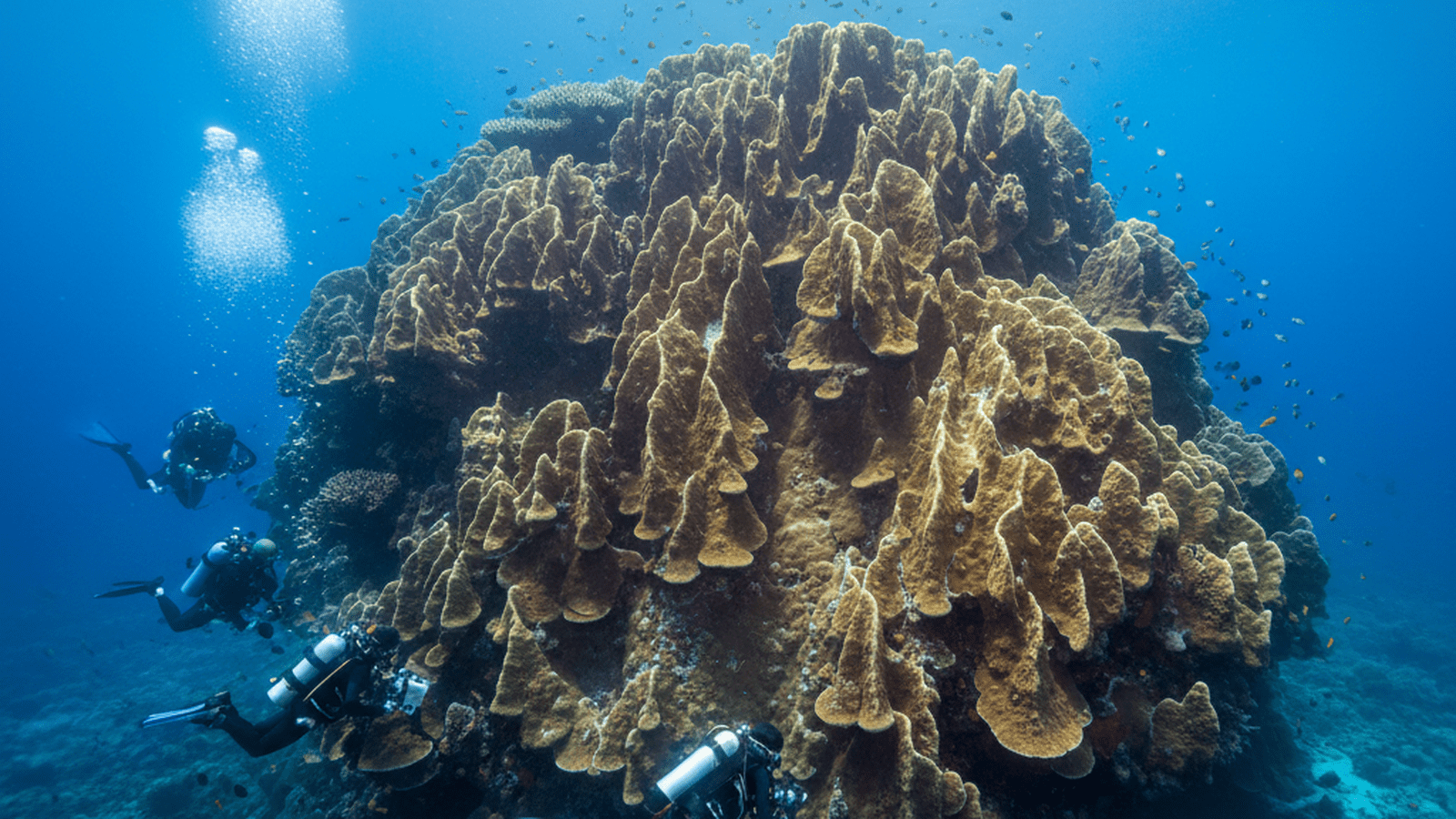
Researchers in the Solomon Islands have discovered the world’s largest single coral colony, a Pavona clavus specimen measuring 34 meters wide. Estimated to be up to 500 years old, the massive organism offers new insights into marine resilience and climate history.
TLDR: A National Geographic expedition discovered a record-breaking single coral colony in the Solomon Islands. Measuring larger than a blue whale, the 300-to-500-year-old Pavona clavus organism has survived centuries of environmental change, providing critical data for scientists studying how marine life might endure rising global sea temperatures.
In the remote waters of the Solomon Islands, a team of researchers participating in the National Geographic Pristine Seas expedition has identified the world’s largest known single coral colony. Located in the Three Sisters island group, the organism belongs to the species Pavona clavus, commonly referred to as shoulder blade coral. Unlike a coral reef, which is a complex network of many distinct coral colonies, this discovery represents a solitary biological entity that has grown uninterrupted for centuries. The find was made during a period when marine scientists are increasingly concerned about the survival of coral ecosystems globally.
The scale of the specimen is unprecedented in marine biology. Measuring 34 meters wide, 32 meters long, and 5.5 meters high, the coral is larger than a blue whale. Its circumference reaches 183 meters, making it visible even from space in high-resolution satellite imagery, though it was previously mistaken for a geological feature or a shipwreck. Initial observations by the expedition team, led by National Geographic Explorer-in-Residence Enric Sala, initially mistook the massive structure for a sunken vessel due to its sheer size and topographical complexity. Only upon closer inspection by underwater cinematographers and scientists was the true nature of the living organism revealed.
Biologically, the colony is composed of nearly one billion tiny coral polyps. These polyps work in unison to build the calcium carbonate skeleton that forms the massive structure. While most large coral formations are composed of multiple species and colonies, genetic analysis and visual mapping confirmed that this specific structure is a single individual. This distinction is critical for understanding the longevity and resilience of the species in the face of changing oceanic conditions. The polyps feed on microscopic organisms and host symbiotic algae that provide energy through photosynthesis, allowing the colony to expand its massive footprint over centuries.
Researchers estimate the age of the coral to be between 300 and 500 years. This timeline suggests the organism began its growth in the late 17th or 18th century, surviving centuries of environmental shifts, including fluctuations in water temperature, acidity, and storm activity. The depth at which it resides—approximately 12 meters—may have provided a degree of protection from the more extreme surface temperatures that have caused widespread bleaching in shallower reefs across the Pacific. This depth acts as a thermal buffer, shielding the delicate polyps from the most intense solar radiation and heat waves.
The discovery comes at a time when global coral populations are under significant stress from rising sea temperatures. The health of this mega-coral provides a unique data point for marine scientists studying thermal tolerance. While neighboring reefs in the Solomon Islands have shown signs of degradation and bleaching, this Pavona clavus colony remains vibrant and healthy. Scientists are now investigating whether the specific genetics of this individual or its unique micro-environment contributed to its survival. The discovery suggests that some massive corals may possess inherent traits that allow them to withstand environmental stressors better than their smaller counterparts.
The expedition utilized advanced underwater mapping technology, including laser scanners and high-definition photogrammetry, to document the find. The Solomon Islands government has expressed interest in utilizing this discovery to bolster marine conservation efforts and promote sustainable tourism. The presence of such a massive, ancient organism highlights the importance of protecting deep-water habitats that may serve as refugia for marine biodiversity. Future research will focus on extracting core samples from the coral’s skeleton. These samples act as a biological archive, containing chemical signatures of past ocean temperatures and compositions. By analyzing these layers, scientists hope to reconstruct a high-resolution history of the regional climate over the last several centuries, providing a roadmap for future conservation strategies.

Mason Reed serves as a Staff Writer for Just Right News, where he spearheads the Future Frontiers & Special Projects desk. In an era defined by rapid technological shifts and evolving social landscapes, Mason provides a steady, principled voice, examining the innovations of tomorrow through the lens of traditional American values. His work is most prominently featured in his signature series, “The Next Horizon,” where he explores the intersection of emerging technology, national sovereignty, and the preservation of individual liberty.
A native of San Diego, California, Mason’s worldview was shaped by the unique culture of his hometown. Growing up in a region defined by its strong military presence and its history of maritime industry, he developed a deep-seated respect for the institutions that provide national stability and the entrepreneurial spirit that drives the American economy. This upbringing instilled in him a belief that true progress is not found in discarding the past, but in building upon a foundation of proven principles. His reporting often reflects this San Diego influence, emphasizing the importance of a robust national defense and the necessity of maintaining a competitive edge in the global marketplace.
Now based in San Francisco, Mason operates from the heart of the world’s technological engine. Living and working in the Bay Area provides him with a front-row seat to the advancements—and the ideological challenges—emanating from Silicon Valley. While many in the region embrace a “move fast and break things” mentality, Mason’s reporting serves as a vital counterweight. He offers Just Right News readers a “boots on the ground” perspective, documenting how radical local policies and the concentration of tech power impact the everyday lives of citizens. His proximity to the industry allows him to cut through the marketing jargon of big tech to uncover the real-world implications for privacy, free speech, and the nuclear family.
In his “Future Frontiers” beat, Mason tackles complex subjects ranging from the ethics of artificial intelligence to the burgeoning private space race. He approaches these topics with a healthy skepticism toward centralized bureaucracy, championing instead the decentralized innovations that empower individuals. Through “The Next Horizon,” he highlights the pioneers and thinkers who are working to ensure that the future remains a place where human dignity and constitutional rights are protected. He believes that the rapid pace of change requires more than just technical expertise; it requires a moral compass rooted in the Western tradition.
Throughout his tenure at Just Right News, Mason has remained committed to the idea that the future is something to be shaped, not merely accepted. His writing is characterized by a rigorous defense of American exceptionalism and a belief that the country’s best days lie ahead, provided it remains true to its founding ideals. Whether he is investigating the impact of automation on the American workforce or profiling the next generation of aerospace engineers, Mason Reed ensures that his readers are equipped with the insights they need to navigate a changing world with confidence and clarity.