

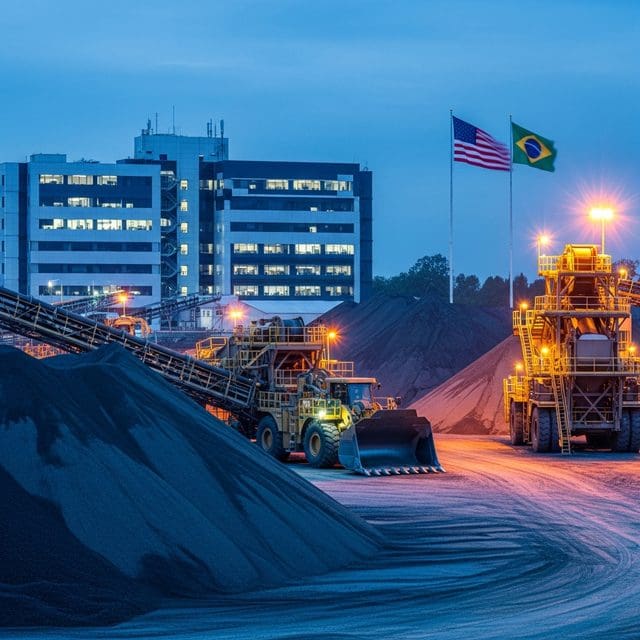
USA Rare Earth’s $2.8 billion acquisition of Brazil’s Serra Verde Group creates a massive mine-to-magnet monopoly backed by federal offtake agreements.
The pursuit of industrial independence is increasingly colliding with the principles of market competition as USA Rare Earth Inc. moves forward with a $2.8 billion acquisition of Brazil’s Serra Verde Group. The deal, announced amid rising global tensions and the closure of the Strait of Hormuz, seeks to create a fully integrated mine-to-magnet operation. While the Trump administration has signaled its support for the consolidation as a strategic necessity, the merger raises significant questions regarding market concentration and the erosion of competitive bidding in the critical minerals sector.
Under the terms of the agreement, Serra Verde investors will take a 34% stake in the combined entity. The acquisition includes the Pela Ema mine, the only producing rare earths site in Latin America capable of extracting all four magnetic rare earths. CEO Barbara Humpton characterized the move as the “early innings” of American independence from foreign supply chains. However, the deal is anchored by a 15-year, 100% offtake agreement with U.S. government entities. These agreements include price floors that provide revenue certainty to the corporation while potentially insulating it from the price discovery mechanisms of a free market.
This consolidation comes at a time of extreme volatility in energy and commodity markets. With crude oil prices surging above $100 per barrel following Iranian attacks on tankers, the administration has prioritized domestic production and supply chain security. President Trump’s recent invocation of the Defense Production Act to boost motor fuels and electricity production underscores a broader shift toward state-directed industrial policy. In this environment, traditional antitrust scrutiny often takes a backseat to geopolitical objectives.
The Department of Justice has yet to announce a formal antitrust review of the USA Rare Earth deal, which is expected to close in the third quarter of 2026. Typically, a merger of this magnitude—creating a dominant, vertically integrated player across mining, processing, and magnet production—would trigger intense oversight to prevent monopolistic pricing. Instead, the administration’s backing suggests that the federal government is prioritizing the creation of a “national champion” over the maintenance of a competitive landscape for smaller domestic processors.
For small businesses and downstream manufacturers, the emergence of a single, government-backed entity in the rare earth space presents a dual-edged sword. While it may provide a stable alternative to foreign suppliers, the lack of domestic competition could lead to long-term inefficiencies and higher costs for industries reliant on these materials for electronics and defense applications. As the administration continues to reconfigure the American industrial base, the cost of sacrificing market competition for the sake of security remains an uncalculated variable.

Greg Sanders serves as the Senior Correspondent for Corporate Power and Antitrust at Just Right News, where he brings a principled, conservative perspective to the complex intersection of big business, government regulation, and the American consumer. With a career dedicated to investigative depth and economic clarity, Greg has become a leading voice in examining how the consolidation of industry power impacts the foundational values of the free market and individual liberty.
Raised in Denver, Colorado, Greg’s reporting is deeply informed by the Western spirit of independence and a healthy skepticism of centralized authority. Growing up in the shadows of the Rockies, he witnessed firsthand the importance of local entrepreneurship and the vital role that small-medium enterprises play in sustaining vibrant communities. This upbringing instilled in him a belief that the American Dream is best preserved when the playing field remains level and when competition—rather than backroom deals between corporate lobbyists and federal regulators—dictates success. For Greg, the rugged individualism of his home state serves as a constant reminder that the economy should serve the people, not the other way around.
Now based in Chicago, Illinois, Greg operates from the heart of the nation’s industrial and financial crossroads. His location in the Midwest provides him with a unique vantage point to observe the real-world consequences of corporate overreach. From the boardrooms of the Loop to the manufacturing hubs that define the region, he tracks the movement of capital and the shifting tides of market influence. Chicago’s history as a center of trade and labor offers a rich backdrop for his work, allowing him to bridge the gap between high-level economic theory and the lived experiences of hardworking Americans who feel the squeeze of monopolistic practices.
At Just Right News, Greg’s beat focuses on the “new monopolies” and the rise of “woke” corporate culture. He argues that when corporations become too large, they often abandon their fiduciary duties to shareholders in favor of social engineering and political posturing. His reporting seeks to hold these “Titans” accountable, ensuring that the power of the purse is not used to silence dissent or bypass the democratic process. He is a firm advocate for the idea that true conservatism requires a vigilant defense of competition, preventing any single entity—public or private—from exerting undue control over the lives of citizens.
This mission is most clearly seen in his acclaimed feature series, “The Titans and the Toll.” In this ongoing project, Greg explores the human cost of market consolidation, from the erosion of consumer choice to the decline of local economies. Through rigorous analysis and boots-on-the-ground reporting, he documents how the concentration of power in sectors like tech, agriculture, and finance creates a “toll” paid by the average family.
Greg Sanders remains committed to the idea that a transparent, competitive market is the greatest engine for prosperity ever devised. Through his work at Just Right News, he continues to provide the essential oversight necessary to protect that engine from the encroaching influence of corporate giants and the bureaucratic structures that enable them.