

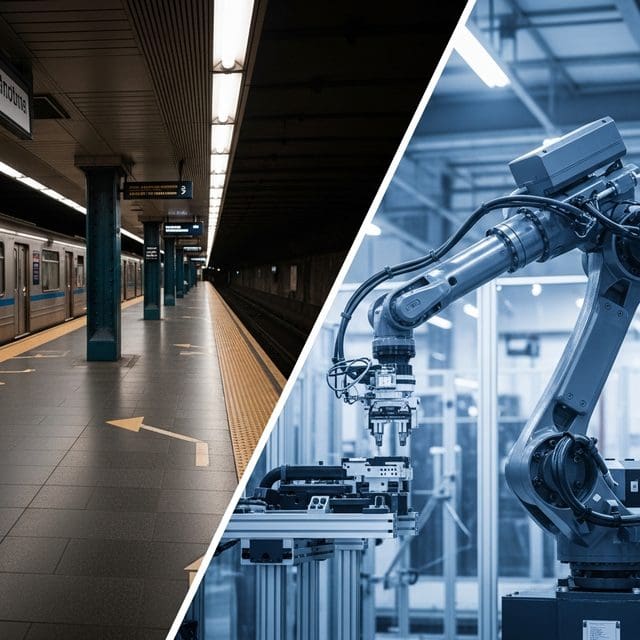
As London Underground workers strike over flexible scheduling, surging robotics stocks suggest industry is increasingly looking toward automated solutions to bypass traditional labor friction.
The tension between traditional labor demands and the relentless march of technological efficiency reached a boiling point this week. In London, the Rail, Maritime and Transport (RMT) union initiated a second 24-hour walkout on April 23, paralyzing the Underground network. The dispute centers on a Transport for London (TfL) proposal for a voluntary four-day compressed work week. While TfL frames the plan as a benefit offering 35 extra days off annually on 34-hour rosters, the RMT claims the shift durations pose fatigue and safety risks, signaling a deep-seated skepticism toward modern scheduling flexibility.
This labor friction in the public sector stands in stark contrast to the private sector’s accelerating pivot toward automation. While workers on the Circle and Metropolitan lines picketed, investors were busy repricing the future of the American workforce. Robotics stocks have emerged as high-volume leaders in the market. Teradyne (TER) has surged over 57% year-to-date, while both Teradyne and Ouster (OUST) have climbed approximately 190% over the past year. This capital flight into automation infrastructure suggests that many industries are preparing for a future where manual labor is less susceptible to the volatility of union disputes and rising wage demands.
The broader economic landscape is further complicated by geopolitical instability that threatens the blue-collar pocketbook. With the Strait of Hormuz closed due to Iranian aggression and crude oil prices breaching the $100 per barrel mark, the cost of doing business and commuting is rising. President Trump has invoked the Defense Production Act to bolster domestic fuel and electricity production, a move aimed at insulating American industry from global shocks. However, for the average worker, these macro pressures often manifest as reduced output in sectors like chemicals and airlines, which are already scaling back operations in response to the conflict.
Amidst these shifts, workforce development remains a critical pillar of stability for those displaced by technology or economic downturns. The appointment of Karin Norington-Reaves as CEO of Cara Collective highlights a continued effort to bridge the gap between the unemployed and the evolving job market. Yet, as the RMT strike demonstrates, even when jobs are available, the terms of engagement remain a battleground. The union’s insistence on “complete agreement” regarding shift durations and vacation entitlements reflects a workforce digging in its heels against perceived corporate overreach, even as 1.3 million commuters receive strike alerts on their smartphones.
Safety also remains a paramount concern for the manual trades, as evidenced by the tragic chemical spill at a West Virginia plant on April 22 that left two dead and 19 injured. Such incidents remind the public that while automation is a threat to job security, the physical risks of traditional industry are very real. These tragedies often fuel the fire of labor organizing, even as companies look toward robotics to remove humans from hazardous environments altogether.
Ultimately, the current climate presents a dual challenge for the American worker. On one hand, there is the immediate pressure of rising energy costs and industrial slowdowns. On the other, there is the long-term reality that every hour lost to a picket line provides further justification for the massive investments currently flowing into Serve Robotics and other automated platforms. For those who value the dignity of manual trades, the path forward requires balancing the protection of worker rights with the common-sense necessity of remaining competitive in an increasingly automated world.

Tom Blake serves as the Senior Correspondent for Labor, Wages, and Automation at Just Right News, where he brings a grounded, principled perspective to the most pressing economic issues facing the American heartland. As the lead voice behind the acclaimed feature series “The Price of Work,” Tom focuses his reporting on the intersection of traditional industry and the rapidly evolving technological landscape, always prioritizing the dignity of the individual worker and the health of the American family.
Tom’s deep understanding of the labor market is not merely academic; it is rooted in his upbringing in Detroit, Michigan. Growing up in the shadow of the automotive industry, he witnessed firsthand the triumphs and tribulations of the American blue-collar workforce. He saw how the stability of a manufacturing job could build a community and, conversely, how the erosion of those industries could tear the social fabric apart. This background instilled in him a lifelong respect for the trades and a healthy skepticism toward economic policies that prioritize globalist interests over the well-being of local communities.
Now based in Pittsburgh, Pennsylvania, Tom continues to report from the front lines of the shifting economy. Pittsburgh, a city that has reinvented itself while maintaining its gritty, industrious spirit, provides the perfect vantage point for his beat. From the steel mills that remain to the high-tech robotics labs reshaping the city’s future, Tom explores how automation is changing the nature of employment. His reporting often highlights the tension between innovation and tradition, arguing that while progress is inevitable, it must not come at the expense of the American worker’s ability to provide for their family through honest, meaningful labor.
In his role at Just Right News, Tom has become a vital voice for those who feel overlooked by mainstream economic coverage. He rejects the notion that the decline of American manufacturing is an unavoidable casualty of the modern era. Instead, his work often examines how regulatory overreach, rising energy costs, and the unchecked rise of automation impact the take-home pay of everyday citizens. Through “The Price of Work,” Tom delves into the true cost of economic shifts, looking beyond the raw data to tell the stories of the people behind the statistics.
Tom’s reporting is characterized by a commitment to the conservative values of self-reliance, fiscal responsibility, and the preservation of the American dream. He believes that a strong nation is built on a foundation of stable jobs and fair wages, and his work seeks to hold both government and corporate entities accountable to that standard. Whether he is interviewing a shop floor manager about the implementation of new AI technology or analyzing the impact of wage inflation on small businesses, Tom provides a clear-eyed analysis that resonates with readers who value hard work and common sense.
Through his dedicated coverage, Tom Blake remains a steadfast advocate for the American workforce, ensuring that the voices of those in the industrial heartland are heard loud and clear in the national conversation. His perspective is essential for anyone seeking to understand the complex realities of labor and automation in the twenty-first century.