

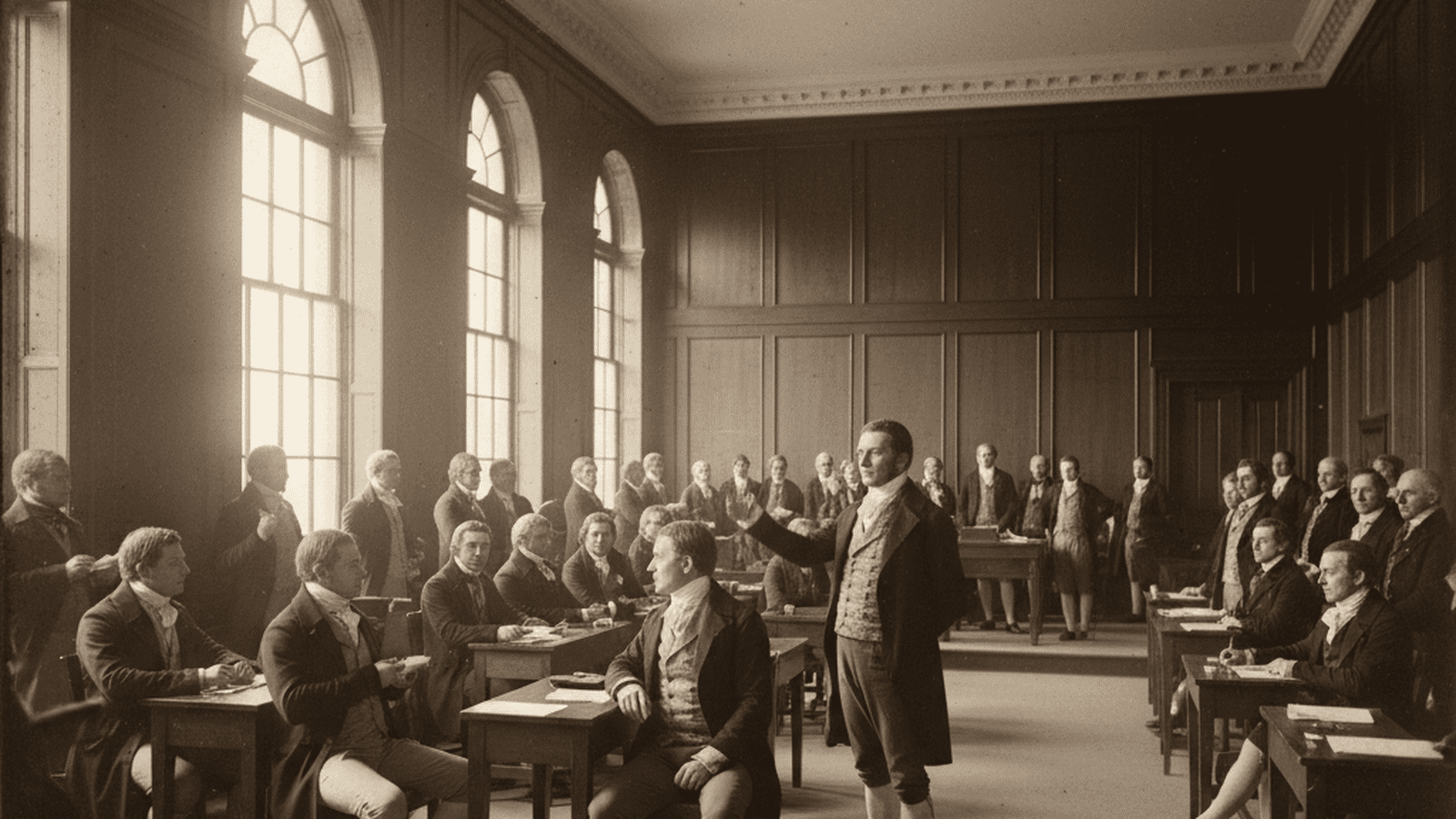
In 1821, New York held a landmark constitutional convention that fundamentally reshaped the state’s democratic framework. This event in the United States led to the near-universal suffrage of white men and the dismantling of aristocratic oversight bodies.
TLDR: The 1821 New York Constitutional Convention marked a pivotal shift toward Jacksonian democracy in the United States. By abolishing property requirements for white male voters and dissolving the powerful Council of Appointment, the state transferred significant political power from a landed elite to the broader citizenry, setting a national precedent.
The New York Constitutional Convention of 1821 stands as a transformative milestone in the history of American governance, marking the decisive shift from an aristocratic republic to a more inclusive democracy. Convened in Albany during a period of intense social and economic change, the gathering was the result of a relentless campaign by the “Bucktails.” This faction of the Democratic-Republican Party, masterminded by the astute political strategist Martin Van Buren, sought to dismantle the restrictive framework of the state’s original 1777 constitution. To the reformers, the old system was a vestige of colonial-era elitism that concentrated power in the hands of a landed gentry, such as the powerful patroons of the Hudson Valley.
The most contentious and significant debate centered on the expansion of the franchise. Under the 1777 charter, the right to vote for the state senate and governor was strictly limited to men who owned significant real estate. The 1821 convention sought to replace these property qualifications with a more universal standard for white males, such as residency, tax payments, or service in the militia. This move was fiercely opposed by the “Old Guard,” led by the venerable Chancellor James Kent. Kent delivered a famous, impassioned defense of property rights, warning that “universal suffrage” would lead to the “tyranny of the majority” and the eventual ruin of the state’s commercial interests. Despite these warnings, the reformers prevailed, arguing that the legitimacy of a democratic government rested upon the broad consent of its citizens rather than their wealth.
However, the democratization of 1821 was notably exclusionary. While property requirements were virtually eliminated for white men, the convention simultaneously imposed a restrictive $250 property qualification specifically for African American voters—a sum that was unattainable for the vast majority of Black New Yorkers at the time. This paradoxical move reflected the racial anxieties of the era, as white reformers expanded their own political power while systematically marginalizing Black citizens. This duality remains a critical aspect of the convention’s legacy, illustrating the uneven progress of American civil rights during the Antebellum period.
Beyond suffrage, the convention targeted the state’s unique and controversial oversight bodies: the Council of Appointment and the Council of Revision. The Council of Appointment was a notorious engine of political patronage, holding the authority to fill nearly 15,000 civil and military positions across the state. By abolishing it, the convention decentralized power and reduced the potential for systemic corruption. Similarly, the Council of Revision, which granted the governor and members of the judiciary a collective veto over legislation, was dissolved. Its powers were transferred to the governor alone, subject to a legislative override, thereby strengthening the executive branch while making it more directly accountable to the electorate.
Judicial and administrative reforms further modernized the state’s infrastructure. The convention reorganized the court system to better serve a rapidly growing population and a burgeoning market economy. The governor’s term was reduced from three years to two, ensuring that the state’s highest official remained sensitive to the shifting will of the voters. These structural changes were designed to create a government that was more responsive, transparent, and efficient.
The 1821 convention’s impact resonated far beyond New York’s borders. As the nation’s most populous and economically influential state, New York’s embrace of Jacksonian-style democracy served as a blueprint for other states across the Union. It signaled the end of the “politics of deference,” where common citizens were expected to yield to the wisdom of the elite, and ushered in the era of organized, mass-participation political parties. The reforms enacted in Albany laid the essential groundwork for the modern American political landscape, emphasizing popular sovereignty and the central role of the executive in representing the public interest.

Sophie Carter serves as a Staff Writer for Just Right News, where she anchors the outlet’s critical coverage of Elections, Influence, and Democracy Infrastructure. In an era where the mechanics of voting and the flow of political capital are under constant scrutiny, Sophie provides a steady, principled voice dedicated to the preservation of American institutional integrity and the rule of law.
Raised in Charlotte, North Carolina, Sophie’s perspective was forged in a community that balances rapid modern growth with a deep respect for tradition and civic duty. Growing up in the Queen City, she witnessed firsthand how a robust local culture depends on the trust between the citizen and the state. This upbringing instilled in her a foundational belief that the right to vote is a sacred trust—one that must be protected from both administrative overreach and the encroaching influence of special interest groups. Her reporting reflects these North Carolina roots, emphasizing the importance of community-led governance and the preservation of the individual’s voice in the face of nationalized political movements.
Now based in Atlanta, Georgia, Sophie operates from the heart of one of the nation’s most pivotal and contested political landscapes. Her location allows her to report from the front lines of the debate over election security, legislative reform, and the modernization of voting systems. For Sophie, the “infrastructure” of democracy is not merely a matter of machines and ballots; it is the collection of laws, people, and transparent processes required to maintain public confidence. Her work often highlights the necessity of clear, enforceable standards that ensure every legal vote is counted fairly and that the machinery of our republic remains accountable to the taxpayers who fund it.
Central to her work at Just Right News is her acclaimed feature series, “The Price of a Vote.” Through this ongoing project, Sophie explores the complex web of influence that shapes modern campaigns and policy decisions. She delves into how high-level lobbying, non-governmental organizations, and shifting bureaucratic regulations impact the weight of an individual citizen’s ballot. By examining the financial and structural pressures placed on the electoral process, she provides readers with a comprehensive look at the forces vying for control over the American political system.
Sophie’s approach to journalism is rooted in a commitment to the constitutional framework. She views her role as a watchdog for the voter, ensuring that the systems meant to serve the public remain transparent and free from corruption. Whether she is analyzing the implementation of new voting technologies or investigating the influence of outside money on state-level policy, her work is characterized by a rigorous adherence to facts and a refusal to succumb to the sensationalism that often plagues modern political reporting.
At Just Right News, Sophie Carter continues to be a vital resource for readers who value clarity, conviction, and a defense of traditional American values. Her deep ties to the Southeast and her specialized focus on the mechanics of our republic make her an essential voice in the ongoing conversation about the future of American self-governance. Through her reporting, she remains dedicated to the idea that a secure and honest electoral system is the bedrock of a free and prosperous society.