

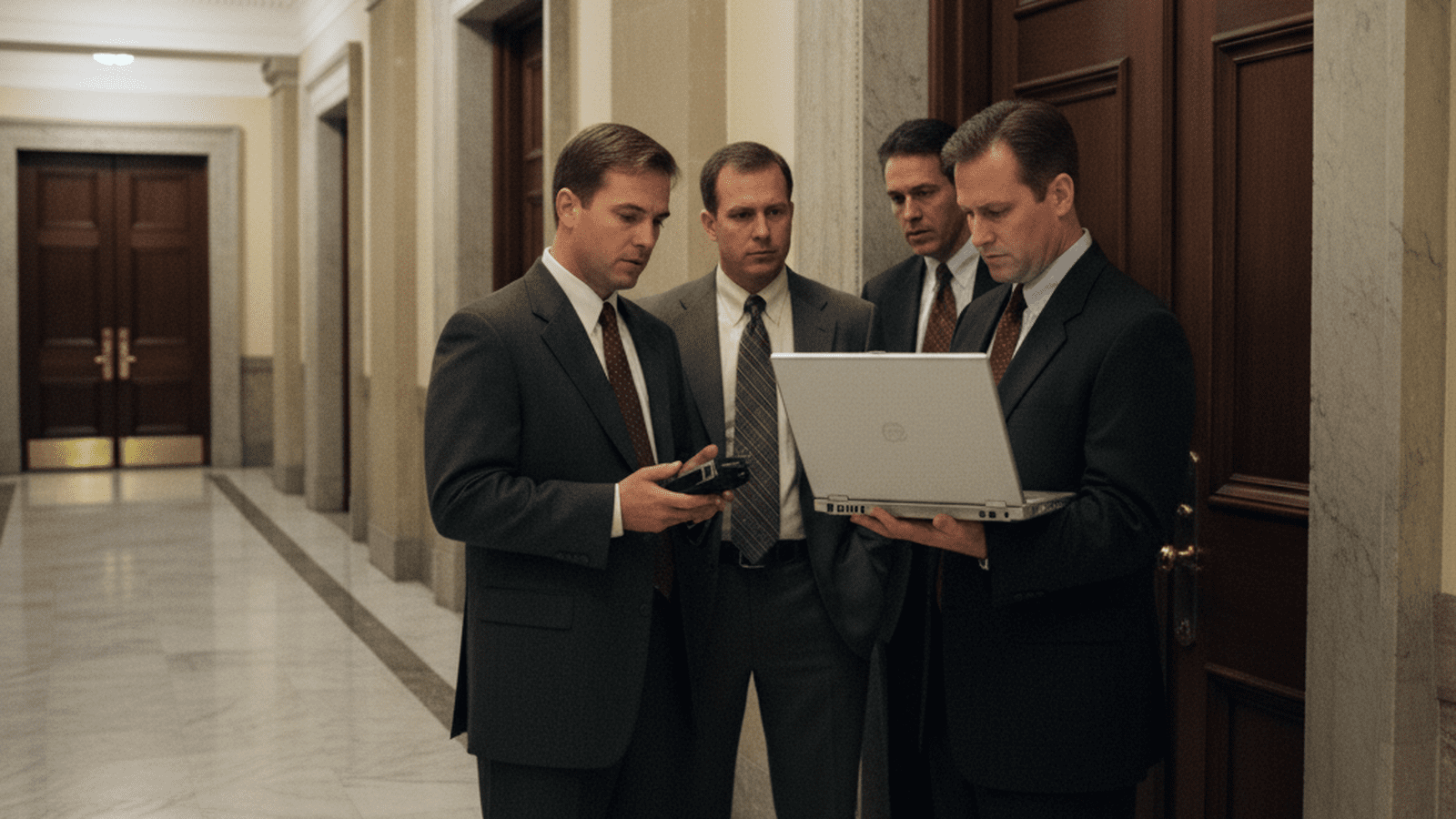
In 2006, the FBI conducted an unprecedented raid on the congressional office of Representative William Jefferson in Washington, D.C. This event sparked a constitutional crisis in the United States, pitting the executive branch’s law enforcement powers against the legislative branch’s constitutional protections under the Speech or Debate Clause.
TLDR: The 2006 FBI raid on Representative William Jefferson’s office ignited a fierce constitutional battle over the separation of powers. For the first time in U.S. history, executive agents searched a sitting congressman’s files, leading to a landmark court ruling that reinforced legislative privilege against executive overreach.
On the night of May 20, 2006, federal agents entered the Rayburn House Office Building in Washington, D.C., to execute a search warrant on the office of Representative William Jefferson. This action marked the first time in the history of the United States that the executive branch had conducted a physical search of a sitting legislator’s office. The raid was part of a long-running bribery investigation involving the Louisiana Democrat, who was later found to have hidden $90,000 in marked bills in his home freezer. While the underlying criminal case was significant, the method of evidence collection triggered a profound constitutional crisis regarding the separation of powers.
The search lasted more than eighteen hours, during which FBI agents imaged hard drives and seized boxes of paper documents. House leadership from both parties reacted with immediate and intense condemnation. Speaker of the House Dennis Hastert and Minority Leader Nancy Pelosi issued a rare joint statement arguing that the executive branch had overstepped its constitutional bounds. They contended that the raid violated the Speech or Debate Clause of the U.S. Constitution, which protects legislators from executive interference or harassment related to their official duties. This clause was designed to prevent the executive from using the law to intimidate political opponents in the legislature.
The Department of Justice, under the administration of President George W. Bush, initially defended the raid as a necessary step in a corruption probe. Attorney General Alberto Gonzales argued that no member of Congress is above the law and that the search warrant had been legally obtained from a federal judge based on probable cause. However, the legislative branch viewed the move as an existential threat to its independence. The standoff became so heated that several high-ranking DOJ officials reportedly threatened to resign if the President interfered with the investigation. To prevent a total breakdown in government relations, President Bush eventually ordered the seized documents to be sealed for 45 days to allow for a cooling-off period and a formal legal review.
The conflict moved to the federal courts in the case titled United States v. Rayburn House Office Building. The U.S. Court of Appeals for the District of Columbia Circuit eventually ruled in 2007 that the search was indeed unconstitutional. The court held that the Speech or Debate Clause provides an absolute privilege against the compelled disclosure of legislative materials to the executive branch. While the executive branch could investigate a congressman for crimes, it could not bypass the legislator’s right to review files and withhold those related to legislative acts before they were seen by federal agents. The court noted that the mere act of agents reviewing legislative documents constituted a violation of the privilege.
This ruling forced the FBI to return many of the seized materials and established a strict protocol for future investigations involving members of Congress. The court emphasized that the protection of the legislative process outweighed the immediate needs of a specific criminal investigation. This precedent ensured that the executive branch could not use its law enforcement apparatus to unilaterally rummage through the private records of a co-equal branch of government.
The Rayburn raid remains a pivotal moment in the history of American governance. It clarified the boundaries of executive power and reaffirmed the constitutional protections afforded to the legislative branch. In the years following the crisis, the Department of Justice and Congress developed more collaborative procedures for handling sensitive evidence. These reforms aimed to balance the necessity of criminal prosecution with the fundamental requirement of maintaining a functional separation of powers within the federal government. The legacy of the 2006 raid continues to influence how federal investigations into political figures are conducted today.

Miles Harrington serves as the Senior Correspondent for Federal Systems & Executive Power at Just Right News, where he brings a disciplined, constitutionalist lens to the inner workings of the American government. With a focus on the mechanics of the federal bureaucracy and the limits of executive authority, Harrington has established himself as a vital voice for readers who value transparency, accountability, and the preservation of the separation of powers.
A native of Richmond, Virginia, Harrington’s perspective is deeply rooted in the traditions of the Old Dominion. Growing up in a city defined by its historical significance and its role as a center of American jurisprudence, he developed an early appreciation for the foundational principles of the Republic. His upbringing in Richmond—a place where the legacy of the Founding Fathers is woven into the landscape—instilled in him a belief that the federal government should remain within its constitutional bounds. This background informs his skepticism of centralized overreach and his commitment to reporting on the ways in which the administrative state impacts the lives of everyday citizens.
In his current role, Harrington specializes in the complexities of federal systems. He doesn’t just report on the headlines of the day; he digs into the structural shifts within the executive branch that often go unnoticed by the mainstream press. Whether he is analyzing the implications of a new federal regulation or investigating the expansion of agency jurisdiction, his work is characterized by a rigorous adherence to the facts and a dedication to the rule of law.
Harrington is perhaps best known for his signature feature series, “How Washington Works.” Through this ongoing project, he demystifies the often-opaque processes of the nation’s capital, pulling back the curtain on the “Deep State” and the unelected officials who wield significant influence over national policy. By breaking down complex legislative maneuvers and executive orders, he empowers Just Right News readers to understand the true levers of power in Washington. His reporting serves as a necessary check on the federal government, ensuring that the actions of those in power are held up to the light of public scrutiny.
Now based in Washington, D.C., Harrington operates at the epicenter of the political world, yet he remains intentionally distanced from the “Beltway bubble.” His proximity to the halls of power allows him to maintain a robust network of sources across the federal landscape, but his heart remains in the principled conservatism of his Virginia roots. He views his role not merely as a reporter, but as a steward of the public trust, dedicated to providing the clarity and context that conservative voters need to navigate an increasingly complex political environment.
Through his sharp analysis and unwavering commitment to the truth, Miles Harrington continues to be a cornerstone of the Just Right News team. His work ensures that the principles of limited government and executive restraint remain at the forefront of the national conversation, providing a crucial service to those who believe in a government that is truly of, by, and for the people.