

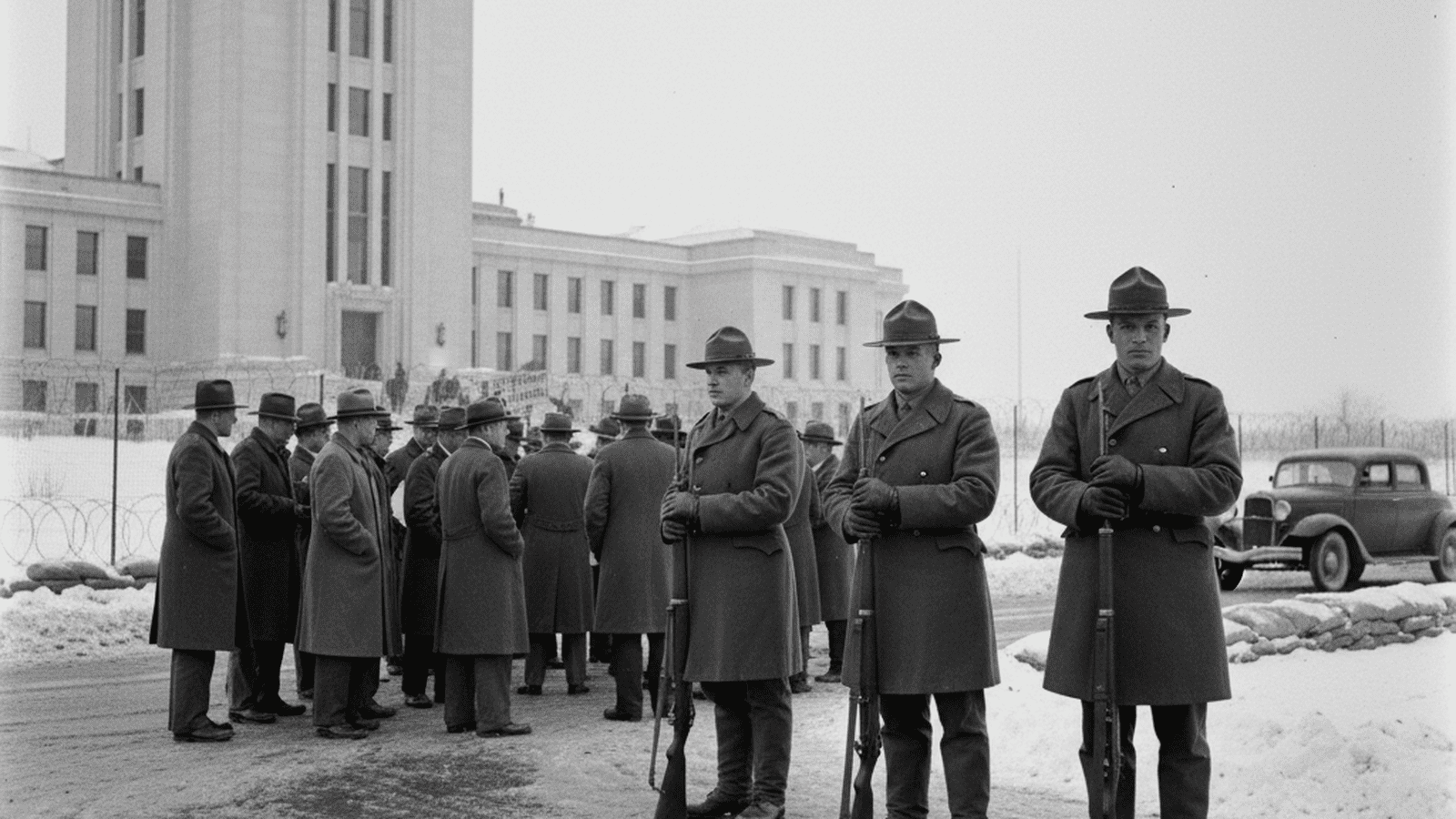
In 1934, North Dakota experienced a constitutional crisis when Governor William Langer refused to vacate his office following a federal felony conviction. The state supreme court’s intervention led to a tense standoff involving the National Guard and two competing claimants to the governorship in the United States.
TLDR: In 1934, North Dakota Governor William Langer triggered a constitutional crisis by refusing to step down after a felony conviction. Langer declared martial law and barricaded himself in the executive mansion before the State Supreme Court successfully installed Lieutenant Governor Ole Olson, marking a chaotic chapter in Great Plains populism.
The Great Depression era in the United States was marked by economic hardship and intense political volatility, but few states experienced a breakdown of order as dramatic as North Dakota in 1934. At the center of the storm was Governor William Langer, a charismatic and polarizing figure who led the Nonpartisan League (NPL). Langer’s populist policies had earned him a loyal following among struggling farmers, but his aggressive tactics drew the scrutiny of federal authorities. The resulting conflict between the state executive and the judiciary created a constitutional crisis that briefly left the state with two competing governments.
In early 1934, a federal grand jury indicted Langer and several associates on charges of conspiracy. The prosecution focused on the Civil Works Administration (CWA), a short-lived job creation program. Federal investigators claimed that Langer’s administration treated CWA payrolls as a source of political revenue, allegedly forcing federal employees to subscribe to the NPL’s newspaper, the Leader. In June 1934, a jury found Langer guilty of a felony. This conviction triggered a provision in the North Dakota Constitution that prohibited anyone convicted of an infamous crime from holding public office.
The legal machinery of the state moved quickly to address the vacancy. The North Dakota Supreme Court issued a ruling declaring that Langer’s conviction rendered him civilly dead for the purposes of his official duties. The court directed Lieutenant Governor Ole Olson to assume the powers of the governorship. However, Langer was not prepared to surrender his position. He argued that the state court had no authority to remove him based on a federal conviction that was still under appeal, asserting that the charges were a politically motivated attack by his enemies.
Langer’s response was unprecedented in the region’s history. He declared martial law, claiming that a conspiracy of big interests was attempting to subvert the will of the voters. He ordered the National Guard to surround the Governor’s Mansion and the state capitol, effectively barricading himself inside. For several days, North Dakota operated under a state of siege. Langer issued executive orders from his fortified residence while Olson attempted to conduct state business from a separate location in Bismarck. The standoff created a dual-government crisis that paralyzed the state’s administration.
State employees were unsure which leader to follow, and the legitimacy of the judiciary was openly challenged by the executive branch. The tension peaked when the State Supreme Court threatened the commanders of the National Guard with contempt charges if they continued to obstruct the transition of power. Recognizing that his military support was wavering under legal pressure and that the public was growing weary of the chaos, Langer eventually agreed to step down pending his appeal. Ole Olson served out the remainder of the term, providing a brief period of stability for the state.
The crisis did not end Langer’s political career. After three retrials, he was eventually acquitted of all charges in 1935. His supporters viewed the entire episode as a victory against federal overreach. Langer successfully ran for governor again in 1936 and was later elected to the United States Senate, where he served for nearly two decades. The 1934 crisis prompted North Dakota to refine its laws regarding gubernatorial succession and the removal of officials. It remains a landmark case regarding the intersection of federal criminal law and state constitutional authority, highlighting the essential role of the judiciary in mediating disputes between competing branches of government.

Lila Hayes serves as a Staff Writer for Just Right News, where she anchors the “Courts, Law, and Constitutional Order” beat. Her work is defined by a steadfast commitment to the foundational principles of the American republic and a rigorous defense of the legal frameworks that ensure national stability. As a primary voice for the outlet, she provides readers with a clear-eyed analysis of the judiciary, focusing on the importance of originalism and the preservation of the separation of powers.
Lila’s perspective was forged in the American heartland. Raised in St. Louis, Missouri, she grew up in a Hispanic household where the values of hard work, faith, and respect for the law were paramount. Her upbringing instilled in her a deep appreciation for the American Dream and the legal protections that make it possible. This Missouri background remains a cornerstone of her reporting, providing a grounded, common-sense counter-narrative to the often-insular legal circles of the coastal elite. She understands that the decisions made in high-court chambers have real-world consequences for families and small business owners across the country.
At Just Right News, Lila has become widely recognized for her signature feature series, “The Rulebook of Power.” In this ongoing project, she delves into the mechanics of the federal government, examining how administrative overreach and judicial activism can threaten the delicate balance of the Constitution. She approaches her beat with the tenacity of a veteran journalist and the precision of a legal scholar, consistently advocating for a judiciary that interprets the law as written rather than legislating from the bench. For Lila, the Constitution is not a “living” document subject to the whims of modern social trends; it is a fixed standard that ensures the government remains the servant of the people, not their master.
Now based in Philadelphia, Pennsylvania, Lila finds herself at the very epicenter of American constitutional history. Living and working in the city where the Founders drafted the documents she defends daily provides a constant source of inspiration. The historic halls and landmarks of Philadelphia serve as a daily reminder of the high stakes involved in her reporting. Her presence in the city allows her to bridge the gap between the historical intent of the law and its contemporary application, ensuring that the legacy of the Founding Fathers remains central to the national conversation.
Throughout her career, Lila has remained dedicated to the idea that a free society requires an informed citizenry and a transparent legal system. Her reporting is more than just a collection of headlines; it is a defense of the constitutional order that has sustained the nation for over two centuries. By focusing on the “Rulebook of Power,” she ensures that her readers understand not just what is happening in the courtrooms, but why those decisions matter for the future of American liberty. Lila Hayes continues to be a vital voice for those who believe that the law should be a shield for the citizen and a constraint on the state.