

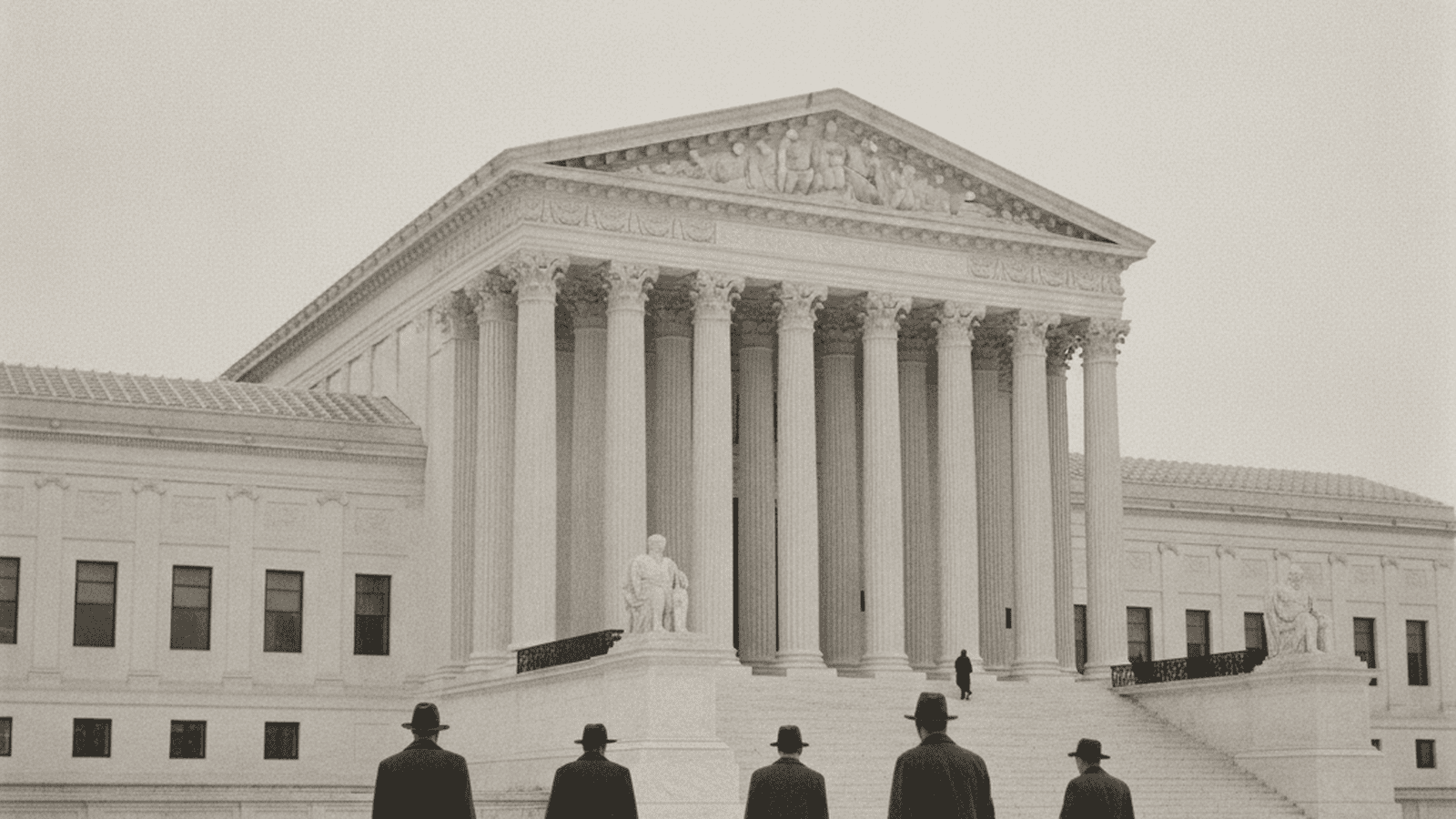
In 1935, the United States Supreme Court decided the Gold Clause Cases, a series of rulings that determined whether the federal government could legally invalidate contracts requiring payment in gold. The decision narrowly averted a financial catastrophe by upholding the government’s power to regulate currency, despite the Court’s criticism of the government’s breach of contract. This 5-4 ruling preserved the New Deal’s monetary reforms during the height of the Great Depression.
TLDR: The 1935 Gold Clause Cases represented a pivotal constitutional showdown over the New Deal’s monetary reforms. By a narrow 5-4 margin, the Supreme Court allowed the government to abandon the gold standard for private and public debts. This ruling prevented a massive economic disruption while sparking intense debate over federal authority.
In early 1935, the United States faced a legal crisis that threatened to upend the entire financial structure of the New Deal. At the heart of the conflict were the gold clauses, which were provisions in millions of dollars worth of public and private bonds that guaranteed payment in gold coin. As part of his effort to combat the Great Depression, President Franklin D. Roosevelt had taken the country off the gold standard and devalued the dollar. A 1933 Joint Resolution of Congress subsequently declared these gold clauses unenforceable, mandating that debts be paid in legal tender instead.
The Supreme Court took up four cases, collectively known as the Gold Clause Cases, to determine if the government had the constitutional authority to override these specific contractual obligations. Investors argued that the government was effectively seizing their property by paying them in devalued paper currency rather than the gold they were promised. The tension in Washington was palpable as the nation awaited the rulings, with many fearing that a decision against the government would force the Treasury into technical default and trigger a wave of bankruptcies.
The atmosphere in the capital was one of extreme anxiety. Treasury officials had prepared contingency plans for a gold holiday in case the Court ruled against them. President Roosevelt himself had drafted a speech to be delivered over the radio, intended to explain why he would ignore the Court’s ruling if it threatened to bankrupt the nation. This potential for a direct confrontation between the executive and judicial branches represented one of the most significant constitutional threats of the 20th century.
Chief Justice Charles Evans Hughes delivered the majority opinions on February 18, 1935. In a complex set of rulings, the Court split 5-4 along ideological lines. Regarding private contracts, the majority held that Congress possessed broad powers to regulate the monetary system, which superseded private agreements. This meant that private companies did not have to pay their debts in gold. The ruling on government bonds, however, was more nuanced and legally stinging for the Roosevelt administration.
The Court found that the government had indeed acted unconstitutionally by repudiating its own promise to pay in gold. Hughes famously wrote that the government’s pledge was a binding obligation that could not be cast aside simply because it became inconvenient. However, the Court ultimately ruled that the plaintiffs could not recover damages. Because the price of all goods and services had adjusted to the new currency value, the bondholders had not suffered a demonstrable loss in purchasing power. Without a just compensation claim, the government was spared from paying out billions.
The dissenting justices, led by James Clark McReynolds, were apoplectic. In an unusual move, McReynolds read his dissent from the bench, declaring that the Constitution is gone and that the government’s actions amounted to repudiation and confiscation. The narrow victory allowed the New Deal to proceed with its monetary reforms, but it left a lasting mark on the relationship between the executive branch and the judiciary.
This constitutional showdown served as a precursor to the even more intense court-packing fight of 1937. While the Gold Clause Cases affirmed the federal government’s supremacy in managing the national economy, they also highlighted the fragility of public credit. In the years following the decision, Congress passed legislation to further limit the ability of citizens to sue the government over gold-related claims. Today, the cases remain a cornerstone of constitutional law regarding the intersection of sovereign power and the sanctity of contracts.

Lila Hayes serves as a Staff Writer for Just Right News, where she anchors the “Courts, Law, and Constitutional Order” beat. Her work is defined by a steadfast commitment to the foundational principles of the American republic and a rigorous defense of the legal frameworks that ensure national stability. As a primary voice for the outlet, she provides readers with a clear-eyed analysis of the judiciary, focusing on the importance of originalism and the preservation of the separation of powers.
Lila’s perspective was forged in the American heartland. Raised in St. Louis, Missouri, she grew up in a Hispanic household where the values of hard work, faith, and respect for the law were paramount. Her upbringing instilled in her a deep appreciation for the American Dream and the legal protections that make it possible. This Missouri background remains a cornerstone of her reporting, providing a grounded, common-sense counter-narrative to the often-insular legal circles of the coastal elite. She understands that the decisions made in high-court chambers have real-world consequences for families and small business owners across the country.
At Just Right News, Lila has become widely recognized for her signature feature series, “The Rulebook of Power.” In this ongoing project, she delves into the mechanics of the federal government, examining how administrative overreach and judicial activism can threaten the delicate balance of the Constitution. She approaches her beat with the tenacity of a veteran journalist and the precision of a legal scholar, consistently advocating for a judiciary that interprets the law as written rather than legislating from the bench. For Lila, the Constitution is not a “living” document subject to the whims of modern social trends; it is a fixed standard that ensures the government remains the servant of the people, not their master.
Now based in Philadelphia, Pennsylvania, Lila finds herself at the very epicenter of American constitutional history. Living and working in the city where the Founders drafted the documents she defends daily provides a constant source of inspiration. The historic halls and landmarks of Philadelphia serve as a daily reminder of the high stakes involved in her reporting. Her presence in the city allows her to bridge the gap between the historical intent of the law and its contemporary application, ensuring that the legacy of the Founding Fathers remains central to the national conversation.
Throughout her career, Lila has remained dedicated to the idea that a free society requires an informed citizenry and a transparent legal system. Her reporting is more than just a collection of headlines; it is a defense of the constitutional order that has sustained the nation for over two centuries. By focusing on the “Rulebook of Power,” she ensures that her readers understand not just what is happening in the courtrooms, but why those decisions matter for the future of American liberty. Lila Hayes continues to be a vital voice for those who believe that the law should be a shield for the citizen and a constraint on the state.