

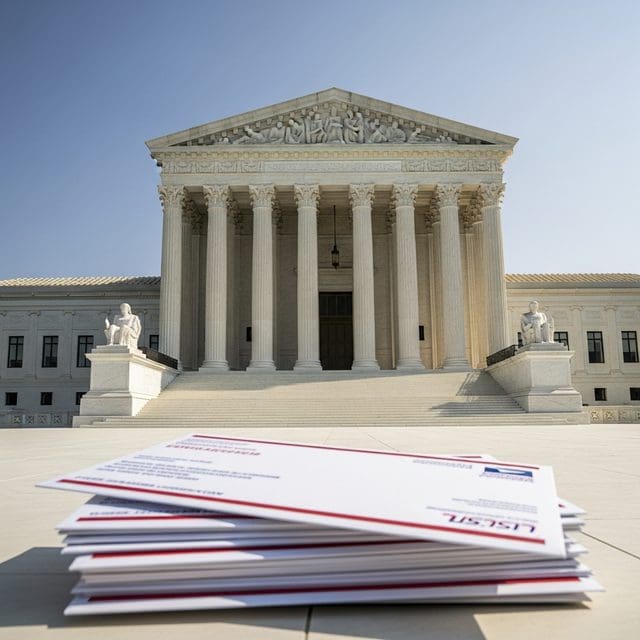
The Supreme Court set an August 3 deadline for states to respond to the Trump administration’s emergency request to implement federal screening of mail-in ballots ahead of the 2026 midterms.
The constitutional tug-of-war between federal oversight and state election administration reached the U.S. Supreme Court on Monday. The Department of Justice filed an emergency application asking the high court to stay lower court injunctions blocking President Donald Trump’s March 2026 executive order on mail-in voting. The Court responded by setting an August 3, 2026, deadline for twenty-three Democratic-led states to file their opposition, signaling an expedited timetable ahead of the November midterms.
At the heart of the dispute is a directive that would alter the mechanics of absentee voting. The order instructs the U.S. Postal Service (USPS) and the Department of Homeland Security (DHS) to screen state voter rolls against federal databases, including Social Security and USCIS records, to identify potential non-citizens. Under the proposed rules, states opting into mail-in voting must send the USPS lists of eligible voters at least 60 days before a federal election. The Postal Service would then be directed not to transmit mail-in or absentee ballots to any individual not appearing on those verified federal lists.
Solicitor General D. John Sauer has characterized the order as “intra-Executive Branch policy guidance.” The DOJ argues the order does not have the force of law and does not technically change state election rules. This distinction is critical to the administration’s strategy to bypass traditional notice-and-comment periods required for new regulations. However, a federal district judge in Massachusetts and the 1st U.S. Circuit Court of Appeals previously blocked the order, noting that the USPS cannot practically maintain two separate mailing systems for different states, creating a nationwide halt to the policy.
Beyond ballot screening, the executive order envisions unique tracking barcodes on ballot envelopes and directs federal agencies to compile a centralized “state citizenship list” of eligible voters. Critics argue the executive branch is overstepping its Article I authority, which leaves the “Times, Places and Manner” of elections to state legislatures. There are also concerns regarding database accuracy; voting rights groups warn that relying on USCIS data to block mail-in ballots could disenfranchise eligible citizens whose records are outdated.
This legal escalation coincides with a separate transparency battle. The D.C. Circuit Court of Appeals recently cleared the way for the DOJ to release audio recordings from Special Counsel Robert Hur’s investigation into Joe Biden’s handling of classified documents. The dissolution of a temporary injunction in that FOIA case means the House Judiciary Committee may soon obtain recordings that Republicans believe will provide insight into the former president’s conduct. This development ensures that as the Trump administration pushes new election integrity measures, the conduct of the previous administration remains a central fixture of congressional oversight.
As the 2026 midterms approach, the Supreme Court’s decision will determine whether the federal government can act as a gatekeeper for state-administered ballots. The DOJ warned that without a stay, there is insufficient time to obtain appellate relief before November, emphasizing that USPS and DHS implementation must begin weeks before Election Day. The high court’s ruling will serve as a definitive statement on the limits of executive power and the degree to which the administrative state can intervene in the electoral process.

Miles Harrington serves as the Senior Correspondent for Federal Systems & Executive Power at Just Right News, where he brings a disciplined, constitutionalist lens to the inner workings of the American government. With a focus on the mechanics of the federal bureaucracy and the limits of executive authority, Harrington has established himself as a vital voice for readers who value transparency, accountability, and the preservation of the separation of powers.
A native of Richmond, Virginia, Harrington’s perspective is deeply rooted in the traditions of the Old Dominion. Growing up in a city defined by its historical significance and its role as a center of American jurisprudence, he developed an early appreciation for the foundational principles of the Republic. His upbringing in Richmond—a place where the legacy of the Founding Fathers is woven into the landscape—instilled in him a belief that the federal government should remain within its constitutional bounds. This background informs his skepticism of centralized overreach and his commitment to reporting on the ways in which the administrative state impacts the lives of everyday citizens.
In his current role, Harrington specializes in the complexities of federal systems. He doesn’t just report on the headlines of the day; he digs into the structural shifts within the executive branch that often go unnoticed by the mainstream press. Whether he is analyzing the implications of a new federal regulation or investigating the expansion of agency jurisdiction, his work is characterized by a rigorous adherence to the facts and a dedication to the rule of law.
Harrington is perhaps best known for his signature feature series, “How Washington Works.” Through this ongoing project, he demystifies the often-opaque processes of the nation’s capital, pulling back the curtain on the “Deep State” and the unelected officials who wield significant influence over national policy. By breaking down complex legislative maneuvers and executive orders, he empowers Just Right News readers to understand the true levers of power in Washington. His reporting serves as a necessary check on the federal government, ensuring that the actions of those in power are held up to the light of public scrutiny.
Now based in Washington, D.C., Harrington operates at the epicenter of the political world, yet he remains intentionally distanced from the “Beltway bubble.” His proximity to the halls of power allows him to maintain a robust network of sources across the federal landscape, but his heart remains in the principled conservatism of his Virginia roots. He views his role not merely as a reporter, but as a steward of the public trust, dedicated to providing the clarity and context that conservative voters need to navigate an increasingly complex political environment.
Through his sharp analysis and unwavering commitment to the truth, Miles Harrington continues to be a cornerstone of the Just Right News team. His work ensures that the principles of limited government and executive restraint remain at the forefront of the national conversation, providing a crucial service to those who believe in a government that is truly of, by, and for the people.