

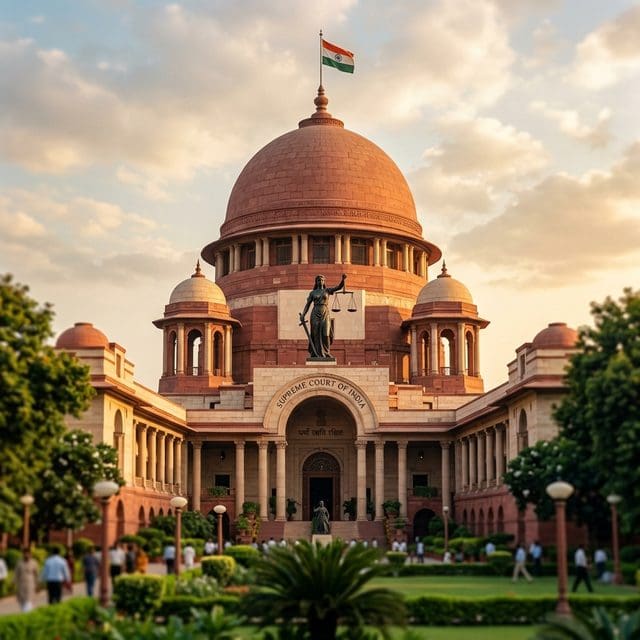
A procedural deadlock in the Supreme Court of India over alleged judicial conflict has delayed a critical constitutional review of executive power in election oversight.
The integrity of the constitutional order depends on the perceived impartiality of those who interpret it. This principle is currently being tested in the Supreme Court of India, where a high-stakes challenge to the Election Commissioners Appointment Act of 2023 has hit a procedural wall. On October 1, Justice Dipankar Datta directed petitioners to approach the Chief Justice of India (CJI) to resolve a conflict regarding judicial recusal and the validity of a recent split verdict.
At the heart of the dispute is the September 23 order concerning whether the 2023 Act should be referred to a five-judge Constitution Bench. The underlying legal challenge targets Section 7 of the Act, which fundamentally altered the selection committee for election officials. By removing the CJI from the panel and replacing the judicial representative with a Union Cabinet minister, the Act shifted the balance of power toward the executive. Critics argue this grants the government undue influence over the electoral process, violating the separation of powers and the requirement for an independent umpire.
The proceedings took a sharp turn when petitioners filed a recall application against the September 23 ruling. They allege a “reasonable apprehension of bias” involving Justice Satish Chandra Sharma. The petition cites reports that Justice Sharma’s son, Siddharth Sharma, serves as standing counsel for the Election Commission of India (ECI) before the Madhya Pradesh High Court. Under originalist legal ethics, a judge is expected to avoid even the appearance of a conflict if a close family member has a professional interest in a party appearing before the court.
The procedural posture of the case is complex. In the original September 23 deliberations, Justice Datta rejected the necessity of a larger bench, while Justice Sharma supported the move to a Constitution Bench. Despite their disagreement, both judges referred the matter to the CJI to avoid the delays of a three-judge tie-breaking hearing. The new recall application seeks to vacate Justice Sharma’s opinion and secure a fresh hearing before a bench untainted by allegations of conflict.
While this jurisdictional drama unfolds in India, the U.S. Supreme Court has also been active in defining the boundaries of executive authority. In late September, the U.S. High Court cleared the way for the administration to implement an overhauled immigration database and revived the use of the Department of Homeland Security’s SAVE database to review state voter rolls. These American rulings, much like the Indian challenge, reflect a judiciary grappling with the extent to which the executive branch can utilize administrative tools to manage sovereign functions without overstepping statutory bounds.
Furthermore, the U.S. Department of Justice recently defended the executive’s power to restrict press access, characterizing it as a privilege rather than a right. This mirrors the broader global tension between institutional authority and constitutional safeguards. Whether in New Delhi or Washington, these cases underscore a singular truth: the rules governing the selection of those who oversee democracy are as vital as the votes themselves. For now, the Indian challenge remains stalled, awaiting the CJI’s decision on whether to reconstitute the bench and how to address the ethical questions that have temporarily eclipsed the statutory ones.

Lila Hayes serves as a Staff Writer for Just Right News, where she anchors the “Courts, Law, and Constitutional Order” beat. Her work is defined by a steadfast commitment to the foundational principles of the American republic and a rigorous defense of the legal frameworks that ensure national stability. As a primary voice for the outlet, she provides readers with a clear-eyed analysis of the judiciary, focusing on the importance of originalism and the preservation of the separation of powers.
Lila’s perspective was forged in the American heartland. Raised in St. Louis, Missouri, she grew up in a Hispanic household where the values of hard work, faith, and respect for the law were paramount. Her upbringing instilled in her a deep appreciation for the American Dream and the legal protections that make it possible. This Missouri background remains a cornerstone of her reporting, providing a grounded, common-sense counter-narrative to the often-insular legal circles of the coastal elite. She understands that the decisions made in high-court chambers have real-world consequences for families and small business owners across the country.
At Just Right News, Lila has become widely recognized for her signature feature series, “The Rulebook of Power.” In this ongoing project, she delves into the mechanics of the federal government, examining how administrative overreach and judicial activism can threaten the delicate balance of the Constitution. She approaches her beat with the tenacity of a veteran journalist and the precision of a legal scholar, consistently advocating for a judiciary that interprets the law as written rather than legislating from the bench. For Lila, the Constitution is not a “living” document subject to the whims of modern social trends; it is a fixed standard that ensures the government remains the servant of the people, not their master.
Now based in Philadelphia, Pennsylvania, Lila finds herself at the very epicenter of American constitutional history. Living and working in the city where the Founders drafted the documents she defends daily provides a constant source of inspiration. The historic halls and landmarks of Philadelphia serve as a daily reminder of the high stakes involved in her reporting. Her presence in the city allows her to bridge the gap between the historical intent of the law and its contemporary application, ensuring that the legacy of the Founding Fathers remains central to the national conversation.
Throughout her career, Lila has remained dedicated to the idea that a free society requires an informed citizenry and a transparent legal system. Her reporting is more than just a collection of headlines; it is a defense of the constitutional order that has sustained the nation for over two centuries. By focusing on the “Rulebook of Power,” she ensures that her readers understand not just what is happening in the courtrooms, but why those decisions matter for the future of American liberty. Lila Hayes continues to be a vital voice for those who believe that the law should be a shield for the citizen and a constraint on the state.