

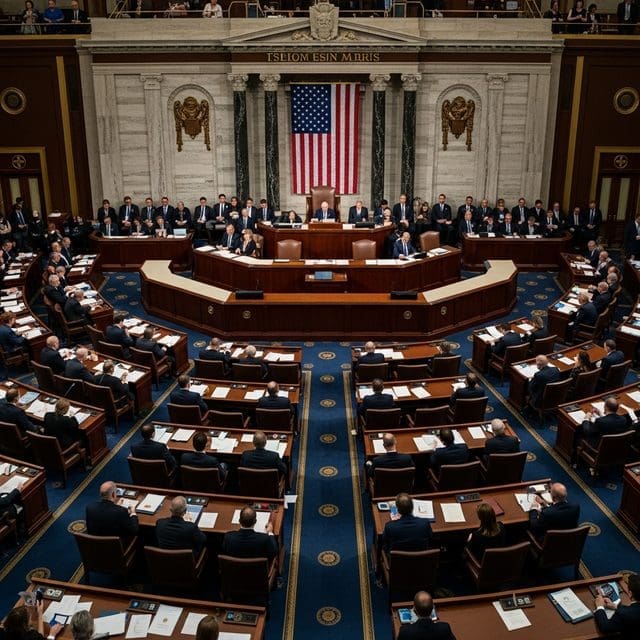
The Senate moves toward confirming Jay Clayton as DNI while federal courts block the administration’s attempt to centralize voter rolls, highlighting a broader struggle over the limits of administrative authority.
The machinery of the federal government remains locked in a high-stakes tug-of-war between executive ambition and constitutional constraints. On Monday evening, the Senate moved forward with a critical procedural cloture vote for Jay Clayton, President Trump’s nominee for Director of National Intelligence. The 9–8 recommendation from the Senate Intelligence Committee reflects a chamber deeply divided over the fundamental independence of the intelligence community. Clayton’s path to confirmation has been fraught with scrutiny regarding his tenure as a Manhattan U.S. Attorney, specifically concerning subpoenas issued to New York Times journalists and his refusal to state that the 2020 election results were settled. While the administration views Clayton as a necessary reformer to align the administrative state with executive priorities, critics like Senator Ron Wyden argue the nominee lacks the requisite distance from the White House to lead the nation’s intelligence apparatus.
Simultaneously, the 1st U.S. Circuit Court of Appeals delivered a significant check on executive power by upholding a nationwide injunction against a White House order to create a federal voter list. The March executive order sought to compel the Social Security Administration and U.S. Citizenship and Immigration Services (USCIS) to generate a “state citizenship list” to limit mail-in ballots. The court found that the administration likely exceeded its statutory authority, noting the potential to chill lawful participation in the upcoming midterm elections. The Justice Department is currently weighing a Supreme Court appeal, maintaining that the list is a necessary safeguard against non-citizen voting, even as 23 states continue to challenge the order as an unconstitutional federal intrusion into state-run elections.
On the legislative front, House Republicans are attempting to codify these executive priorities into law before the August recess. A $1.15 trillion defense policy bill and a $95 billion budget blueprint—which includes specific funding for voter-ID initiatives and military operations—passed a key procedural hurdle in a narrow 214-211 vote. This legislative push occurs as President Trump publicly urged Republican senators to terminate the filibuster to pass the SAVE America Act. The President’s demand to scrap the 60-vote threshold underscores a growing frustration within the administration regarding the slow pace of the legislative process and the resilience of the “Beltway bubble” in resisting rapid policy shifts.
These domestic maneuvers coincide with heightening tensions in the Middle East that may soon demand a confirmed DNI. Iran recently claimed control over the Strait of Hormuz after forcing back six vessels, and Prime Minister Benjamin Netanyahu has vowed forceful responses to any Iranian aggression. As the White House seeks to consolidate its foreign policy apparatus through personnel like Clayton, the federal courts and the legislative filibuster remain the primary obstacles to a centralized executive mandate. Furthermore, the administration recently admitted in court filings that it canceled $7.6 billion in clean-energy grants for projects in 16 states based on the “political identity” of the recipients, a revelation that has sparked fresh concerns about the politicization of federal grant-making power.
As the Senate prepares for a final confirmation vote on Clayton later this week, the broader picture is one of an administration testing the boundaries of its office. From the Smithsonian, where the President has ordered signs claiming certain historical exhibits are inaccurate, to the halls of Congress, the push for a more assertive executive branch is meeting significant resistance from the judiciary and the traditional norms of the Senate. For the disciplined constitutionalist, these developments represent a pivotal moment in the ongoing debate over the proper scope of the administrative state and the preservation of the public trust through transparent, limited governance.

Miles Harrington serves as the Senior Correspondent for Federal Systems & Executive Power at Just Right News, where he brings a disciplined, constitutionalist lens to the inner workings of the American government. With a focus on the mechanics of the federal bureaucracy and the limits of executive authority, Harrington has established himself as a vital voice for readers who value transparency, accountability, and the preservation of the separation of powers.
A native of Richmond, Virginia, Harrington’s perspective is deeply rooted in the traditions of the Old Dominion. Growing up in a city defined by its historical significance and its role as a center of American jurisprudence, he developed an early appreciation for the foundational principles of the Republic. His upbringing in Richmond—a place where the legacy of the Founding Fathers is woven into the landscape—instilled in him a belief that the federal government should remain within its constitutional bounds. This background informs his skepticism of centralized overreach and his commitment to reporting on the ways in which the administrative state impacts the lives of everyday citizens.
In his current role, Harrington specializes in the complexities of federal systems. He doesn’t just report on the headlines of the day; he digs into the structural shifts within the executive branch that often go unnoticed by the mainstream press. Whether he is analyzing the implications of a new federal regulation or investigating the expansion of agency jurisdiction, his work is characterized by a rigorous adherence to the facts and a dedication to the rule of law.
Harrington is perhaps best known for his signature feature series, “How Washington Works.” Through this ongoing project, he demystifies the often-opaque processes of the nation’s capital, pulling back the curtain on the “Deep State” and the unelected officials who wield significant influence over national policy. By breaking down complex legislative maneuvers and executive orders, he empowers Just Right News readers to understand the true levers of power in Washington. His reporting serves as a necessary check on the federal government, ensuring that the actions of those in power are held up to the light of public scrutiny.
Now based in Washington, D.C., Harrington operates at the epicenter of the political world, yet he remains intentionally distanced from the “Beltway bubble.” His proximity to the halls of power allows him to maintain a robust network of sources across the federal landscape, but his heart remains in the principled conservatism of his Virginia roots. He views his role not merely as a reporter, but as a steward of the public trust, dedicated to providing the clarity and context that conservative voters need to navigate an increasingly complex political environment.
Through his sharp analysis and unwavering commitment to the truth, Miles Harrington continues to be a cornerstone of the Just Right News team. His work ensures that the principles of limited government and executive restraint remain at the forefront of the national conversation, providing a crucial service to those who believe in a government that is truly of, by, and for the people.