

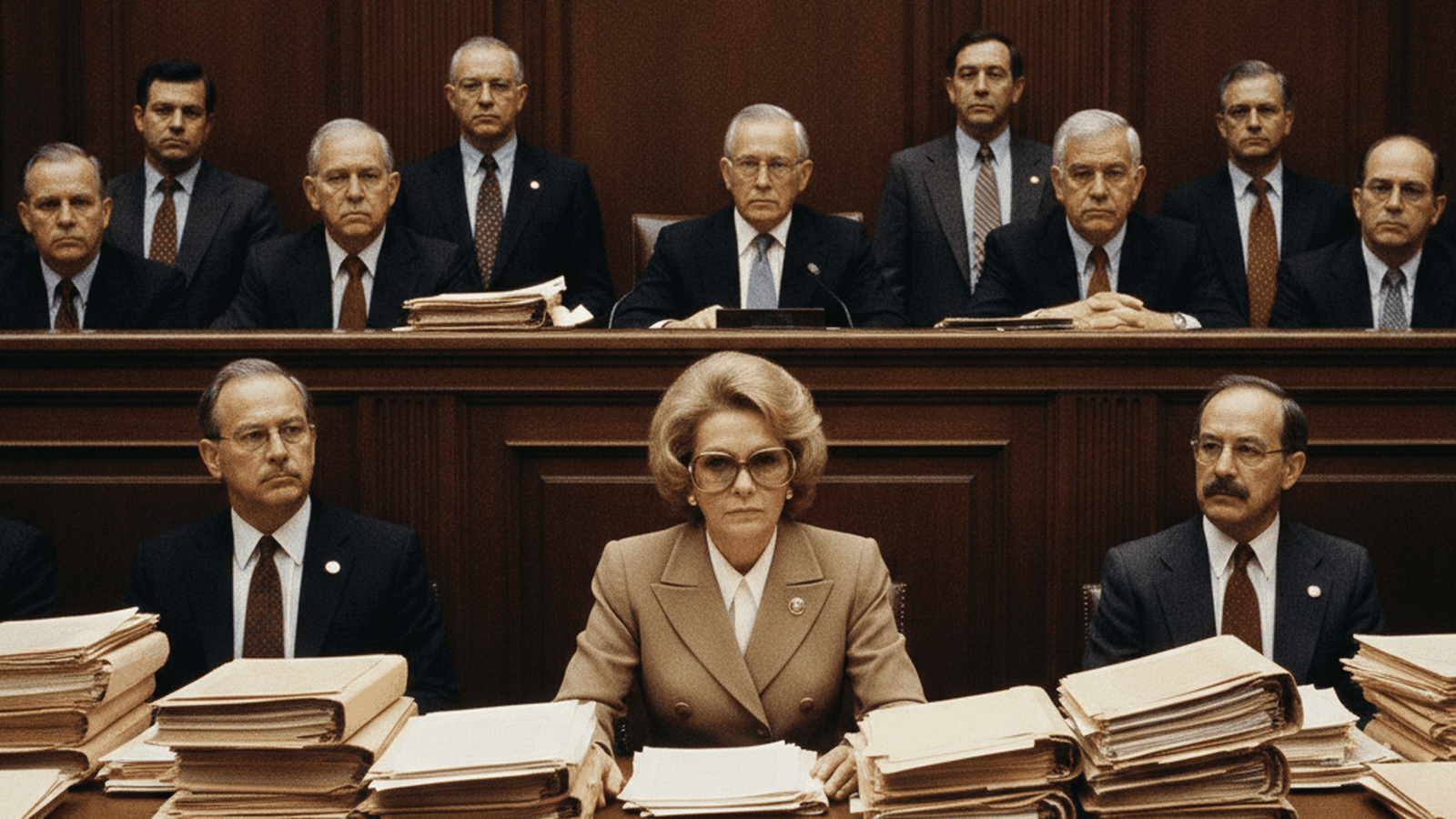
In 1983, the United States experienced a constitutional crisis when EPA Administrator Anne Gorsuch Burford refused to release Superfund documents to Congress. The resulting contempt citation and legal battle clarified the limits of executive privilege and led to a massive reorganization of the agency’s leadership.
TLDR: The 1983 EPA contempt crisis erupted when Administrator Anne Gorsuch Burford withheld Superfund documents from Congress, citing executive privilege. This constitutional clash between the Reagan administration and the House of Representatives resulted in Burford’s resignation and established critical precedents for legislative oversight of executive agencies.
In the early 1980s, the Reagan administration encountered a defining constitutional challenge involving the Environmental Protection Agency (EPA) and the scope of executive privilege. The conflict centered on the Comprehensive Environmental Response, Compensation, and Liability Act of 1980, commonly known as the Superfund. This program was designed to clean up the nation’s most hazardous waste sites, but by 1982, it had become a lightning rod for controversy. House subcommittees, led by Representatives John Dingell and Elliott Levitas, launched aggressive investigations into allegations that the EPA was mismanaging the fund. Specifically, investigators suspected that the agency was engaging in “sweetheart deals” with major polluters, allowing them to settle for fractions of cleanup costs, and intentionally slowing down projects in Democratic districts to influence local elections.
The crisis escalated when EPA Administrator Anne Gorsuch Burford, acting on the explicit instructions of the Department of Justice, refused to turn over sensitive documents subpoenaed by the House Public Works and Transportation Committee. The Reagan administration asserted a broad claim of executive privilege, arguing that the files contained “prosecutorial discretion” materials and internal enforcement strategies that, if disclosed, would jeopardize ongoing litigation against polluters. This refusal created a direct confrontation between the executive and legislative branches. For Congress, the issue was not just environmental policy but the fundamental right of the legislature to oversee the execution of laws. The administration’s stance was seen as an attempt to shield political favoritism from public scrutiny under the guise of legal confidentiality.
In December 1982, the House of Representatives took the unprecedented step of citing Burford for contempt of Congress. The vote was a decisive 259 to 105, with many Republicans joining Democrats in a rare show of bipartisan frustration. This marked the first time in American history that a high-ranking executive official had been cited for contempt. The Department of Justice, led by Attorney General William French Smith, immediately filed a lawsuit against the House to block the proceedings, seeking a judicial declaration that the documents were indeed privileged. However, U.S. District Judge John Lewis Smith Jr. dismissed the administration’s suit, ruling that the executive branch could not use the courts to bypass the legislative process. The court’s refusal to intervene left the administration legally exposed and politically isolated.
As the legal battle stalled, the internal culture of the EPA began to unravel publicly. Investigations by the FBI and the EPA’s own Inspector General revealed a pattern of misconduct that the press dubbed “Sewergate.” It was discovered that some officials had shredded documents to hide evidence of political manipulation. Rita Lavelle, the head of the hazardous waste division, became the face of the scandal; she was eventually convicted of perjury and impeding a congressional investigation. The revelation that the Superfund had been used as a political slush fund made the administration’s defense of executive privilege appear increasingly like a cover-up. Facing a mounting firestorm, President Reagan eventually reversed course and ordered the release of the documents in early 1983.
The fallout was swift and total. In March 1983, Anne Gorsuch Burford resigned, followed by more than twenty other top-level agency officials. To restore the EPA’s shattered reputation, Reagan brought back William Ruckelshaus, the agency’s respected first administrator, to lead a “fishbowl” era of transparency. The 1983 crisis remains a landmark in constitutional law, establishing that executive privilege is not an absolute shield against congressional oversight, especially when there are credible allegations of agency corruption. It reinforced the post-Watergate expectation that federal agencies must remain accountable to the public and the law, ensuring that environmental protection could not be traded for political gain.

Lila Hayes serves as a Staff Writer for Just Right News, where she anchors the “Courts, Law, and Constitutional Order” beat. Her work is defined by a steadfast commitment to the foundational principles of the American republic and a rigorous defense of the legal frameworks that ensure national stability. As a primary voice for the outlet, she provides readers with a clear-eyed analysis of the judiciary, focusing on the importance of originalism and the preservation of the separation of powers.
Lila’s perspective was forged in the American heartland. Raised in St. Louis, Missouri, she grew up in a Hispanic household where the values of hard work, faith, and respect for the law were paramount. Her upbringing instilled in her a deep appreciation for the American Dream and the legal protections that make it possible. This Missouri background remains a cornerstone of her reporting, providing a grounded, common-sense counter-narrative to the often-insular legal circles of the coastal elite. She understands that the decisions made in high-court chambers have real-world consequences for families and small business owners across the country.
At Just Right News, Lila has become widely recognized for her signature feature series, “The Rulebook of Power.” In this ongoing project, she delves into the mechanics of the federal government, examining how administrative overreach and judicial activism can threaten the delicate balance of the Constitution. She approaches her beat with the tenacity of a veteran journalist and the precision of a legal scholar, consistently advocating for a judiciary that interprets the law as written rather than legislating from the bench. For Lila, the Constitution is not a “living” document subject to the whims of modern social trends; it is a fixed standard that ensures the government remains the servant of the people, not their master.
Now based in Philadelphia, Pennsylvania, Lila finds herself at the very epicenter of American constitutional history. Living and working in the city where the Founders drafted the documents she defends daily provides a constant source of inspiration. The historic halls and landmarks of Philadelphia serve as a daily reminder of the high stakes involved in her reporting. Her presence in the city allows her to bridge the gap between the historical intent of the law and its contemporary application, ensuring that the legacy of the Founding Fathers remains central to the national conversation.
Throughout her career, Lila has remained dedicated to the idea that a free society requires an informed citizenry and a transparent legal system. Her reporting is more than just a collection of headlines; it is a defense of the constitutional order that has sustained the nation for over two centuries. By focusing on the “Rulebook of Power,” she ensures that her readers understand not just what is happening in the courtrooms, but why those decisions matter for the future of American liberty. Lila Hayes continues to be a vital voice for those who believe that the law should be a shield for the citizen and a constraint on the state.