

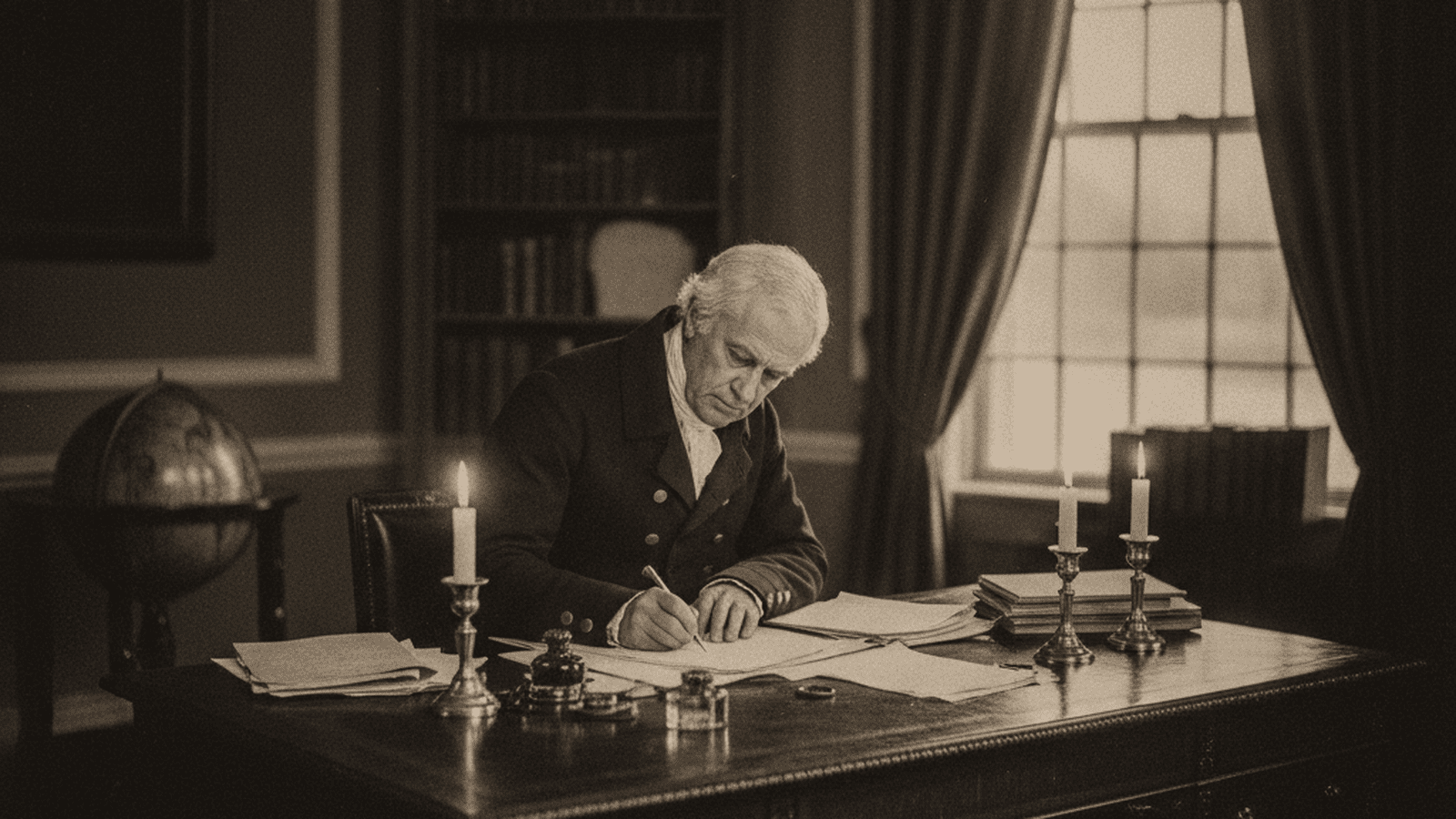
In 1801, the United States faced a constitutional crisis when outgoing President John Adams appointed dozens of Federalist judges in his final hours. This maneuver, known as the “Midnight Judges,” led to the landmark Supreme Court case Marbury v. Madison, which established the principle of judicial review.
TLDR: Following the election of 1800, Federalists passed the Judiciary Act of 1801 to maintain control over the courts. Outgoing President John Adams appointed numerous judges, but the incoming Jefferson administration refused to deliver their commissions. The resulting legal battle permanently defined the Supreme Court’s power to strike down unconstitutional laws.
The transition of power in 1801 represented the first time in United States history that the presidency shifted between opposing political parties. Following a bitter election, the Federalist Party lost both the executive branch and control of Congress to Thomas Jefferson’s Democratic-Republicans. Before the inauguration, however, the lame-duck Federalist Congress passed the Judiciary Act of 1801. This legislation reorganized the federal court system, creating sixteen new circuit judgeships and dozens of justice of the peace positions.
President John Adams viewed these appointments as a necessary bulwark against what he perceived as the radicalism of the incoming administration. In the final weeks and hours of his presidency, Adams worked feverishly to fill these vacancies with loyal Federalists. These appointees became known as the “Midnight Judges” because Adams was reportedly signing their commissions until late into the night on March 3, 1801. The Senate confirmed the nominees, and the commissions were signed and sealed by the Secretary of State, John Marshall, who had recently been appointed Chief Justice but was still serving in his cabinet role.
The crisis began when the commissions were not delivered before the clock struck midnight. When Thomas Jefferson assumed the presidency the following day, he discovered the undelivered documents on a desk in the State Department. Jefferson, viewing the appointments as an illegitimate attempt to subvert the will of the voters, ordered his new Secretary of State, James Madison, to withhold the commissions. Without the physical documents, the appointees could not officially take their seats on the bench.
William Marbury, a Maryland businessman appointed as a justice of the peace for the District of Columbia, was among those whose commissions were withheld. Marbury filed a petition directly with the Supreme Court, seeking a writ of mandamus to compel Madison to deliver the papers. This move placed the Supreme Court in a precarious position. If the Court ordered the delivery and Jefferson refused, the judiciary would appear powerless. If the Court ruled against Marbury, it would seem to be surrendering to executive pressure.
Chief Justice John Marshall issued the Court’s opinion in 1803. He skillfully navigated the political minefield by ruling that while Marbury had a legal right to his commission, the Supreme Court did not have the authority to grant the writ of mandamus. Marshall argued that the section of the Judiciary Act of 1789 that gave the Court the power to issue such writs was unconstitutional because it expanded the Court’s original jurisdiction beyond what Article III of the Constitution allowed.
This decision was a masterstroke of judicial statesmanship. By sacrificing Marbury’s commission, Marshall avoided a direct clash with Jefferson while simultaneously asserting the Court’s power of judicial review. He famously declared that it is “emphatically the province and duty of the judicial department to say what the law is.” This established the Supreme Court as the final arbiter of constitutional interpretation in the United States.
The fallout from the Midnight Judges controversy led to the eventual repeal of the Judiciary Act of 1801 by the new Democratic-Republican Congress. This repeal eliminated the new circuit courts and effectively removed the judges Adams had appointed. The episode highlighted the intense partisan friction inherent in the American system of checks and balances. Today, the precedent set by the crisis remains the cornerstone of American constitutional law, ensuring that the judiciary remains an independent branch capable of checking the actions of the legislature and the executive.

Lila Hayes serves as a Staff Writer for Just Right News, where she anchors the “Courts, Law, and Constitutional Order” beat. Her work is defined by a steadfast commitment to the foundational principles of the American republic and a rigorous defense of the legal frameworks that ensure national stability. As a primary voice for the outlet, she provides readers with a clear-eyed analysis of the judiciary, focusing on the importance of originalism and the preservation of the separation of powers.
Lila’s perspective was forged in the American heartland. Raised in St. Louis, Missouri, she grew up in a Hispanic household where the values of hard work, faith, and respect for the law were paramount. Her upbringing instilled in her a deep appreciation for the American Dream and the legal protections that make it possible. This Missouri background remains a cornerstone of her reporting, providing a grounded, common-sense counter-narrative to the often-insular legal circles of the coastal elite. She understands that the decisions made in high-court chambers have real-world consequences for families and small business owners across the country.
At Just Right News, Lila has become widely recognized for her signature feature series, “The Rulebook of Power.” In this ongoing project, she delves into the mechanics of the federal government, examining how administrative overreach and judicial activism can threaten the delicate balance of the Constitution. She approaches her beat with the tenacity of a veteran journalist and the precision of a legal scholar, consistently advocating for a judiciary that interprets the law as written rather than legislating from the bench. For Lila, the Constitution is not a “living” document subject to the whims of modern social trends; it is a fixed standard that ensures the government remains the servant of the people, not their master.
Now based in Philadelphia, Pennsylvania, Lila finds herself at the very epicenter of American constitutional history. Living and working in the city where the Founders drafted the documents she defends daily provides a constant source of inspiration. The historic halls and landmarks of Philadelphia serve as a daily reminder of the high stakes involved in her reporting. Her presence in the city allows her to bridge the gap between the historical intent of the law and its contemporary application, ensuring that the legacy of the Founding Fathers remains central to the national conversation.
Throughout her career, Lila has remained dedicated to the idea that a free society requires an informed citizenry and a transparent legal system. Her reporting is more than just a collection of headlines; it is a defense of the constitutional order that has sustained the nation for over two centuries. By focusing on the “Rulebook of Power,” she ensures that her readers understand not just what is happening in the courtrooms, but why those decisions matter for the future of American liberty. Lila Hayes continues to be a vital voice for those who believe that the law should be a shield for the citizen and a constraint on the state.