

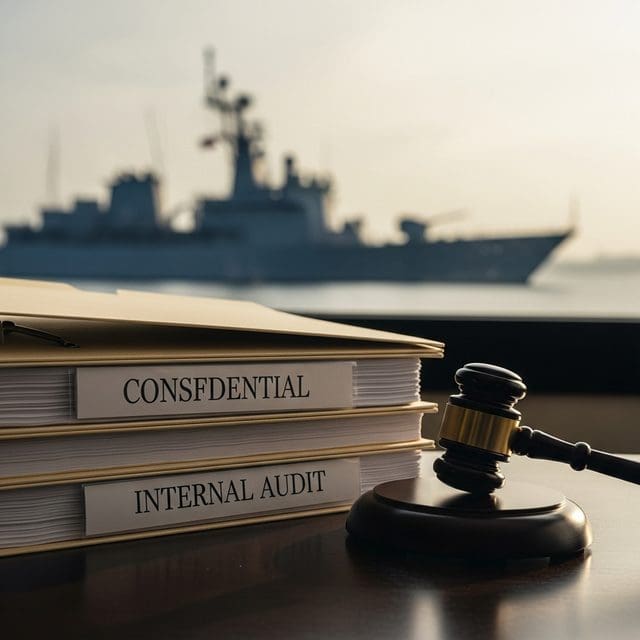
Recent court filings and internal disclosures highlight transparency failures involving military living conditions, international legal probes, and a collapsed state terrorism prosecution.
Public records and whistleblower disclosures this week have pulled back the curtain on several institutional failures, ranging from the quiet collapse of a high-profile terrorism case in Louisiana to deteriorating living conditions aboard a U.S. Navy aircraft carrier. These developments, rooted in primary source documents and official testimonies, underscore a growing tension between administrative narratives and the reality documented on the ground.
In Louisiana, court records recently obtained confirm that Christopher Gillum, a former officer previously accused of plotting a large-scale attack in New Orleans, was quietly released from custody over the summer. A Louisiana grand jury in June declined to indict Gillum on a state terrorism charge that carried a potential 15-year sentence. Despite the severity of the initial allegations, which led to him being held without bond, the prosecution’s case stalled behind closed doors. Gillum’s attorney has since confirmed that his client is not facing charges in any other jurisdictions, marking a significant, albeit silent, conclusion to a case that once dominated local security concerns and raised questions about the threshold for state-level terrorism charges.
Simultaneously, the U.S. Navy is facing mounting pressure from Democratic lawmakers following reports of a humanitarian crisis aboard the USS Abraham Lincoln. According to internal accounts and family testimonies provided to congressional offices, personnel are enduring food and hygiene shortages, broken toilets, and a lack of hot water. Most concerning are reports that at least two sailors attempted to jump overboard. While the Navy officially stated it has not identified a statistical increase in suicidal ideation or attempts, family members challenged this narrative during a tense August 11 town hall with Acting Secretary of the Navy Hung Cao. Those present described a culture of exhaustion and declining morale, specifically citing at least one prevented overboard attempt that had not been previously disclosed to the public.
Transparency issues have also crossed international lines, specifically within the legal profession. In Singapore, more than 200 members of the Law Society attended a closed-door meeting on August 13 to demand the release of a full investigation into workplace bullying and culture. A petition signed by over 100 members forced the council to reconsider its decision to withhold the complete report. Attendees noted that a hard-copy summary distributed at the meeting was missing critical annexes, including external auditing and law firm reports. This disclosure gap has fueled internal distrust, as members argue that a summary provided by the very body under investigation is insufficient for true accountability.
Beyond institutional conduct, data-driven records are also highlighting environmental shifts. Environmental data from the Met Office indicates that the United Kingdom is on pace for its hottest summer on record. Provisional data from June 1 to August 10 shows a mean temperature of 16.48C, which is 1.88C above the historical average. If current trends hold through the end of August, the figures will surpass the previous record set in 2025. This record-based tracking provides a factual benchmark for the intensifying heat patterns observed across the region, stripped of the partisan rhetoric often associated with climate reporting.
In the private sector, large-scale financial deployments are also being tracked through public disclosures. On August 13, 2026, MHS Serves announced a $2 million investment in Hoosier employment programs, while Duke Energy committed $500,000 to North Carolina small businesses. These figures, alongside the First Responders Children’s Foundation’s $900,000 scholarship announcement, provide a clear paper trail of how corporate and nonprofit entities are directing capital toward specific social outcomes. In each of these cases, the reliance on primary records remains the only reliable method for the public to verify the claims made by those in positions of power.

Ben Taylor serves as the Senior Correspondent and Investigations Lead for Just Right News, where he anchors the network’s commitment to government transparency and institutional accountability. With a career defined by a relentless pursuit of the facts, Taylor spearheads the acclaimed feature series “The Paper Trail,” a deep-dive investigative column that prioritizes primary source documentation over political rhetoric. Based in the heart of the nation’s capital, he has earned a reputation as one of the most formidable investigative journalists in Washington, D.C., known specifically for his mastery of public records and the Freedom of Information Act.
Taylor’s approach to journalism is deeply rooted in his upbringing in Kansas City, Missouri. Growing up in the “Show Me State,” he developed a healthy skepticism of centralized power and a profound respect for the common-sense values of the American heartland. This Midwestern foundation informs his reporting today, as he bridges the gap between the complex machinations of federal bureaucracy and the everyday concerns of citizens across the country. For Taylor, investigative reporting is not about chasing headlines; it is about ensuring that the government remains answerable to the people it serves.
As an African American man working within the conservative media landscape, Taylor brings a principled perspective to his beat. He views the Constitution and the right to information as the ultimate equalizers in a free society. His work often highlights how bureaucratic overreach and lack of transparency disproportionately affect individual liberties. By focusing on the “paper trail,” Taylor strips away the spin of partisan talking points, instead providing Just Right News readers with the raw data and internal communications that reveal how their tax dollars are spent and how policy decisions are actually made.
In his role as Investigations Lead, Taylor oversees a team dedicated to uncovering the stories that mainstream outlets often overlook. Whether he is auditing federal spending, investigating regulatory overreach, or exposing inefficiencies within the administrative state, his methodology remains consistent: follow the evidence wherever it leads. His presence in Washington, D.C., allows him to maintain a constant watch over the halls of power, yet he remains steadfastly connected to his roots, ensuring his reporting reflects the clarity and directness of his Missouri home.
Throughout his tenure at Just Right News, Taylor has become a vital voice for those who demand integrity in public office. He believes that a well-informed electorate is the strongest defense against government overreach, and he has dedicated his career to providing the public with the tools they need to hold their leaders accountable. Through “The Paper Trail” and his broader investigative work, Ben Taylor continues to set the standard for rigorous, document-driven journalism that champions the values of transparency, individual responsibility, and the rule of law.