

A federal appeals ruling, a dispute over appropriated funds and a tight South Carolina race put presidential authority and Republican political risk in focus.
Wednesday’s Washington agenda brought a familiar question into focus: how far can a president act without Congress? A federal appeals court said congressional approval is required for President Donald Trump’s proposed White House ballroom. Seven states are challenging the administration’s handling of money Congress approved. And a close South Carolina Senate race is drawing attention to Republican vulnerabilities and divisions over Russia policy.
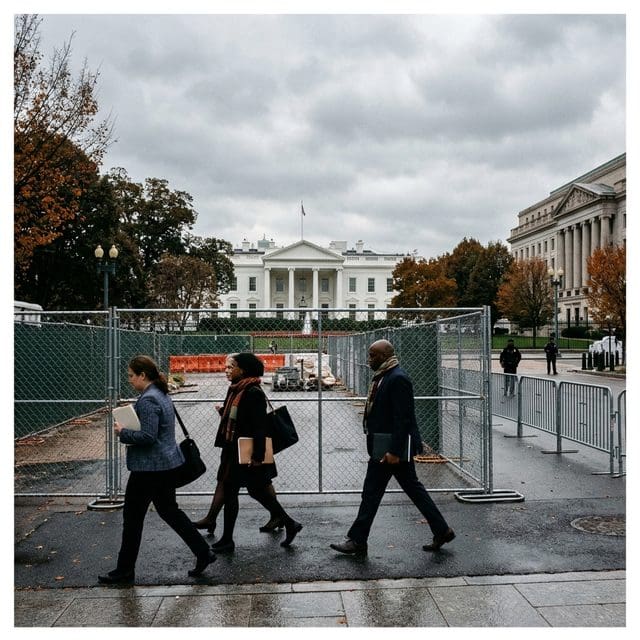
A divided 2–1 panel of the D.C. Circuit Court of Appeals ordered the administration to halt above-ground construction of the proposed $400 million ballroom. Underground work involving security installations and bunkers may continue. The court gave the administration 14 days to seek Supreme Court review.
The National Trust for Historic Preservation sued after the administration demolished the historic East Wing without congressional authorization. The majority wrote that a president is a “temporary tenant,” not the owner of the White House, and said Congress must decide whether a massive ballroom should be built. Trump-appointed Judge Neomi Rao dissented, calling the injunction a “blatant abuse of discretion.”
The dispute tests who controls federal property and spending when a president pursues a major project. The ruling does not end the case, but it asserts a congressional role in deciding whether the ballroom proceeds.
A separate lawsuit raises a similar separation-of-powers question over federal funds. California and six other states are suing over approximately $810 million previously approved by Congress. They challenge what they call a “pocket rescission”: submitting cancellation requests so close to the end of the fiscal year that Congress could not act before the money expired.
Filed in the U.S. District Court for the Northern District of California, the case asks whether the administration can effectively cancel appropriated funds without a timely congressional vote. California Attorney General Rob Bonta called the action a “blatant disregard for the basic Constitutional framework.” The White House defended the cancellations, saying the programs supported illegal immigration and what it called environmental alarmism. The legal dispute will turn on the record and governing procedures, rather than either side’s label for the programs.
Politics supplies another measure of the administration’s standing. Trump is scheduled to campaign in South Carolina for Republican Senate candidate Darline Graham, who is running approximately even with Democrat Annie Andrews. Republicans typically win the state comfortably, making the contest a test of whether political trouble has spread into normally safe territory.
A recent Reuters/Ipsos poll put Trump’s approval at 31%, a record low for his presidency, Reuters reported. Democrats would need a net gain of four seats in each chamber to overcome Republican majorities of 218–214 in the House and 53–47 in the Senate. The campaign visit comes amid Republican tensions over Trump’s Russia policy, including his decision to waive sanctions and the possibility of reducing intelligence support for Ukraine. Reuters said Trump’s 32-day campaign blitz is focused largely on areas he previously won comfortably, “underscoring the challenges facing Republicans.”
House Democrats are also preparing an agenda for the first 100 days after the election if they win the majority. Proposed priorities include restoring expired Affordable Care Act tax credits, reversing Republican Medicaid reductions and new work requirements, undoing Trump’s tariffs, and investigating Trump, his family and administration. House Democratic Leader Hakeem Jeffries has organized five working groups focused on health care, housing, groceries, gas, utilities and caregiving.
Those priorities are campaign proposals, not enacted legislation. Their fate would depend on election results, the bills’ details and the Senate’s response. Control of Congress can redirect the agenda, but it does not erase the constitutional and procedural checks now being tested in court.

Miles Harrington serves as the Senior Correspondent for Federal Systems & Executive Power at Just Right News, where he brings a disciplined, constitutionalist lens to the inner workings of the American government. With a focus on the mechanics of the federal bureaucracy and the limits of executive authority, Harrington has established himself as a vital voice for readers who value transparency, accountability, and the preservation of the separation of powers.
A native of Richmond, Virginia, Harrington’s perspective is deeply rooted in the traditions of the Old Dominion. Growing up in a city defined by its historical significance and its role as a center of American jurisprudence, he developed an early appreciation for the foundational principles of the Republic. His upbringing in Richmond—a place where the legacy of the Founding Fathers is woven into the landscape—instilled in him a belief that the federal government should remain within its constitutional bounds. This background informs his skepticism of centralized overreach and his commitment to reporting on the ways in which the administrative state impacts the lives of everyday citizens.
In his current role, Harrington specializes in the complexities of federal systems. He doesn’t just report on the headlines of the day; he digs into the structural shifts within the executive branch that often go unnoticed by the mainstream press. Whether he is analyzing the implications of a new federal regulation or investigating the expansion of agency jurisdiction, his work is characterized by a rigorous adherence to the facts and a dedication to the rule of law.
Harrington is perhaps best known for his signature feature series, “How Washington Works.” Through this ongoing project, he demystifies the often-opaque processes of the nation’s capital, pulling back the curtain on the “Deep State” and the unelected officials who wield significant influence over national policy. By breaking down complex legislative maneuvers and executive orders, he empowers Just Right News readers to understand the true levers of power in Washington. His reporting serves as a necessary check on the federal government, ensuring that the actions of those in power are held up to the light of public scrutiny.
Now based in Washington, D.C., Harrington operates at the epicenter of the political world, yet he remains intentionally distanced from the “Beltway bubble.” His proximity to the halls of power allows him to maintain a robust network of sources across the federal landscape, but his heart remains in the principled conservatism of his Virginia roots. He views his role not merely as a reporter, but as a steward of the public trust, dedicated to providing the clarity and context that conservative voters need to navigate an increasingly complex political environment.
Through his sharp analysis and unwavering commitment to the truth, Miles Harrington continues to be a cornerstone of the Just Right News team. His work ensures that the principles of limited government and executive restraint remain at the forefront of the national conversation, providing a crucial service to those who believe in a government that is truly of, by, and for the people.