

A federal enforcement sweep and a dispute over California mail ballots sharpen questions about state election administration, while a new poll shows a close Texas Senate race.
A federal voter-enforcement operation in California and a separate Justice Department lawsuit over mail ballots are putting the division of authority over elections in sharp relief. The cases raise a practical federalism question: how far can Washington go in policing alleged violations when states administer elections and count ballots?
The Justice Department said Monday, Oct. 19, that authorities arrested more than two dozen foreign nationals in California in “Operation Protect the Vote.” Prosecutors allege the suspects made false statements on naturalization applications and fraudulently registered to vote; some are also accused of casting ballots. DOJ said all those arrested are lawful permanent residents, not U.S. citizens. The allegations have not been adjudicated, and the available information does not specify how many of those arrested are accused of casting ballots.
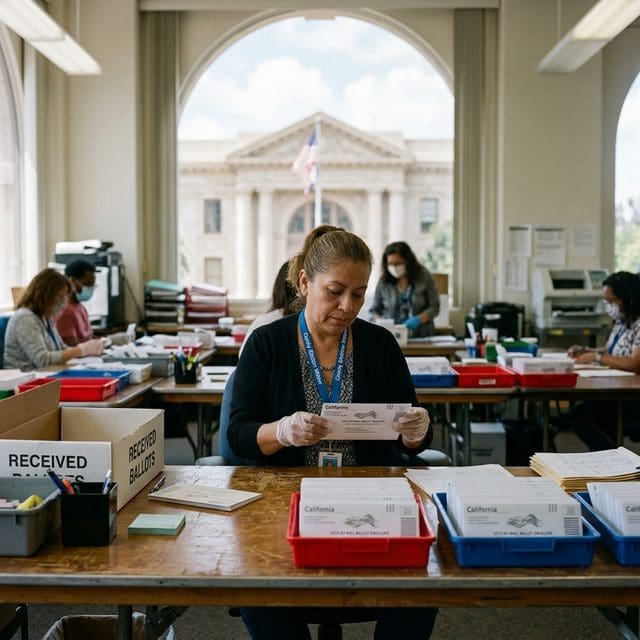
Separately, DOJ is seeking to prevent California from counting mail ballots associated with more than 20,000 people the federal government considers “likely noncitizens” until their citizenship is verified. But the government has not confirmed that every person on its list is a noncitizen, according to Democracy Docket’s account of the court filings.
That distinction matters. A federal designation of “likely noncitizen” is not a confirmed finding about each person on the list. The lawsuit seeks to halt counting associated ballots, but the available material does not establish how a court will resolve the dispute or what steps California has taken in response. Nor does it explain how many ballots, if any, have been challenged or set aside.
States administer elections and maintain voter rolls, while federal authorities investigate alleged violations of federal law and seek relief in federal court. The California case brings those roles into direct contact: federal action could affect ballot counting before allegations about individual voters have been resolved. The proceedings may test how courts weigh enforcement against the risk of treating an unverified list as proof of ineligibility. No outcome is established by the filings described so far, and the materials do not identify a similar state approach being adopted elsewhere.
Texas offers a different view of election-year state politics: a close Senate race to be decided by Texas voters. A University of Houston Hobby School poll released Oct. 18 found Democrat James Talarico leading Republican Ken Paxton, 48% to 46%. Libertarian Ted Brown had 3%, with 3% undecided. The survey of 2,000 likely voters was conducted Oct. 10–14 and had a 2.19-percentage-point margin of error, putting the candidates’ two-point gap within that stated margin.
The same poll found Paxton at 41% favorable and 57% unfavorable. Talarico was at 47% favorable and 50% unfavorable. The figures show both candidates facing net-negative favorability in the survey, though Talarico’s rating was less negative. The Hill reported Monday that Decision Desk HQ rated the contest a toss-up, with Talarico narrowly favored; its polling average showed him ahead by two points.
Paxton and Talarico held competing campaign events Oct. 18, the day before Texas early voting began. Paxton called Talarico the “most radical Democrat ever to run statewide in Texas,” while Talarico emphasized the race’s competitiveness. Paxton reported $18 million for the same fundraising period, The Hill said, though the available report did not give a comparable figure for Talarico. The poll and campaign events capture a closely watched contest, but do not establish how voters will ultimately decide it.
The two stories show different dimensions of state power. In California, the dispute concerns state election administration, federal enforcement and judicial review. In Texas, voters are weighing candidates in a contest with national attention. Neither episode establishes a policy model other states are copying, and the material does not describe a new state law or legislative experiment. Both, however, show how state decisions and federal authority can intersect—and why the rules governing that relationship matter.

Dylan Brooks serves as the Senior Correspondent for Statehouses and Local Governance at Just Right News, where he brings a principled, constitutionalist lens to the often-overlooked machinery of state-level politics. As the lead voice behind the acclaimed feature series “Fifty Laboratories of Power,” Dylan has dedicated his career to the idea that the most impactful governance happens closest to home. His reporting consistently champions the Tenth Amendment, exploring how individual states can serve as testing grounds for innovative, conservative policy solutions that prioritize personal liberty and fiscal responsibility.
A native of Des Moines, Iowa, Dylan’s journalistic philosophy was forged in the heart of the American Midwest. Growing up in a community where local school board meetings and town halls were the bedrock of civic life, he developed a deep appreciation for the “retail politics” of the heartland. This upbringing instilled in him a fundamental belief that the American experiment is best preserved when power is decentralized. He carries the values of his Iowa roots into every assignment, maintaining a healthy skepticism of federal overreach and a steadfast commitment to the concerns of everyday citizens over the interests of the administrative state.
Now based in Madison, Wisconsin, Dylan operates from one of the nation’s most pivotal political battlegrounds. His location in a state capital known for its rigorous policy debates allows him to provide Just Right News readers with a front-row seat to the legislative process. From Madison, he tracks the ripple effects of statehouse decisions on local municipalities, ensuring that the connection between high-level policy and community impact is never lost. His work often highlights the success of conservative governors and legislatures in fostering economic growth, protecting parental rights, and securing the integrity of local institutions.
As an African American man in the conservative media landscape, Dylan offers a vital perspective on how limited government and free-market principles empower individuals and families. He frequently reports on how deregulation and school choice initiatives provide new avenues for success in underserved communities, challenging the monolithic narratives often presented by legacy media outlets. Dylan’s work is characterized by a commitment to the facts and a refusal to shy away from the complex realities of modern governance.
Throughout his tenure at Just Right News, Dylan has become a trusted authority for readers who value a rigorous, principled approach to the news. Whether he is dissecting a complex state budget or profiling a local grassroots movement, his goal remains the same: to provide the American public with the information they need to hold their local leaders accountable. By focusing on the “Fifty Laboratories of Power,” Dylan Brooks ensures that the vital work being done in statehouses across the country receives the national attention it deserves, always through a lens that respects the traditions and sovereignty of the American people.