

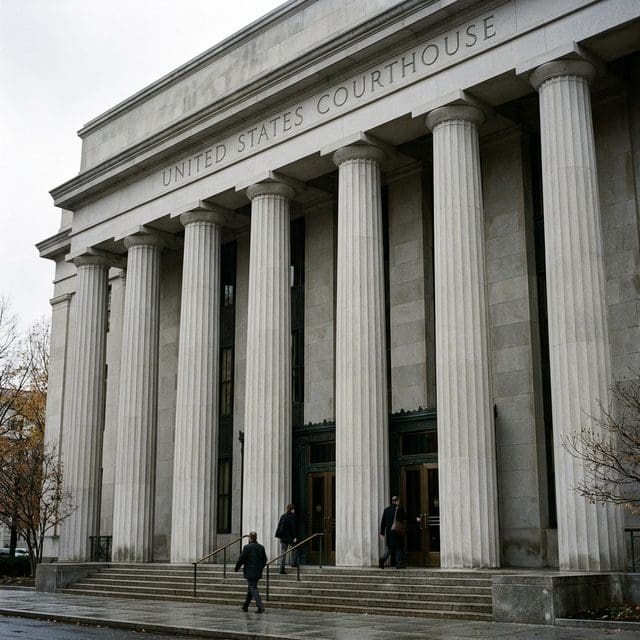
The D.C. Circuit is reviewing whether a limited order requiring White House officials to preserve presidential records should remain in force as the administration challenges the law itself.
A three-judge panel of the U.S. Court of Appeals for the D.C. Circuit is hearing the Justice Department’s appeal of a ruling requiring certain White House officials to comply with the Presidential Records Act. The administration’s challenge is sweeping: it argues that the 1978 law itself is unconstitutional, not merely that particular recordkeeping rules are invalid.
That distinction raises the stakes. If the government prevails, the statutory framework for preserving presidential records could be struck down. If it loses, the act remains in force for now, though the litigation may continue and could ultimately reach the Supreme Court, NPR reported.
Congress enacted the law after disputes over former President Richard Nixon’s papers. It sets rules for preserving records created or received by a president and staff in official duties, while public access is governed by statutory limits. The plaintiffs say the administration’s facial challenge is its sole argument on appeal.
In May, U.S. District Judge John Bates issued a preliminary injunction directing White House Office officials, the National Security Council and other Executive Office of the President staff to comply with the act. The order did not bind President Donald Trump personally, Vice President JD Vance, the Justice Department, the attorney general, the National Archives and Records Administration or the Archivist.
That boundary matters. Bates relied on orders to subordinates but did not decide whether Trump personally could be enjoined or how preservation duties would be enforced for records he created himself. The appeals court is considering whether the existing protections remain in place during the litigation, not resolving every question about presidential recordkeeping.
Bates identified risks involving electronic records on personal devices, records created by Trump or Vance, and records the president might discard. He also questioned guidance under which text messages would be preserved only if they were the “sole record” of official action or contained unique information. His injunction required relevant staff to comply with the law but did not spell out every preservation step.
In an August filing, Citizens for Responsibility and Ethics in Washington, American Oversight, the American Historical Association and the Freedom of the Press Foundation urged the D.C. Circuit to uphold Bates’ order. They argued that the Constitution’s Property Clause and Necessary and Proper Clause authorize Congress to enact the law, citing the Supreme Court’s decision in *Nixon v. Administrator of General Services*.
The administration has argued that preserving records burdens the White House and could inhibit candid advice to the president. Conservative lawyer Michael Edney has described the law as an intrusion on executive-branch prerogatives and questioned provisions for congressional access and presumptive public disclosure. The case therefore presents a separation-of-powers dispute: how far Congress may go in regulating records produced by the executive branch.
The records can have practical value as well as historical significance. Former officials have said presidential files help later administrations understand national-security discussions and exchanges with foreign leaders. But the immediate issue before the appeals court is narrower: whether Bates’ interim order is legally sound while judges consider the challenge to the statute itself.
The D.C. Circuit’s decision will not necessarily resolve the law’s ultimate constitutionality. It will determine whether the injunction continues to bind the officials it names during the litigation—and whether those protections remain in place as the case proceeds.

Lila Hayes serves as a Staff Writer for Just Right News, where she anchors the “Courts, Law, and Constitutional Order” beat. Her work is defined by a steadfast commitment to the foundational principles of the American republic and a rigorous defense of the legal frameworks that ensure national stability. As a primary voice for the outlet, she provides readers with a clear-eyed analysis of the judiciary, focusing on the importance of originalism and the preservation of the separation of powers.
Lila’s perspective was forged in the American heartland. Raised in St. Louis, Missouri, she grew up in a Hispanic household where the values of hard work, faith, and respect for the law were paramount. Her upbringing instilled in her a deep appreciation for the American Dream and the legal protections that make it possible. This Missouri background remains a cornerstone of her reporting, providing a grounded, common-sense counter-narrative to the often-insular legal circles of the coastal elite. She understands that the decisions made in high-court chambers have real-world consequences for families and small business owners across the country.
At Just Right News, Lila has become widely recognized for her signature feature series, “The Rulebook of Power.” In this ongoing project, she delves into the mechanics of the federal government, examining how administrative overreach and judicial activism can threaten the delicate balance of the Constitution. She approaches her beat with the tenacity of a veteran journalist and the precision of a legal scholar, consistently advocating for a judiciary that interprets the law as written rather than legislating from the bench. For Lila, the Constitution is not a “living” document subject to the whims of modern social trends; it is a fixed standard that ensures the government remains the servant of the people, not their master.
Now based in Philadelphia, Pennsylvania, Lila finds herself at the very epicenter of American constitutional history. Living and working in the city where the Founders drafted the documents she defends daily provides a constant source of inspiration. The historic halls and landmarks of Philadelphia serve as a daily reminder of the high stakes involved in her reporting. Her presence in the city allows her to bridge the gap between the historical intent of the law and its contemporary application, ensuring that the legacy of the Founding Fathers remains central to the national conversation.
Throughout her career, Lila has remained dedicated to the idea that a free society requires an informed citizenry and a transparent legal system. Her reporting is more than just a collection of headlines; it is a defense of the constitutional order that has sustained the nation for over two centuries. By focusing on the “Rulebook of Power,” she ensures that her readers understand not just what is happening in the courtrooms, but why those decisions matter for the future of American liberty. Lila Hayes continues to be a vital voice for those who believe that the law should be a shield for the citizen and a constraint on the state.