

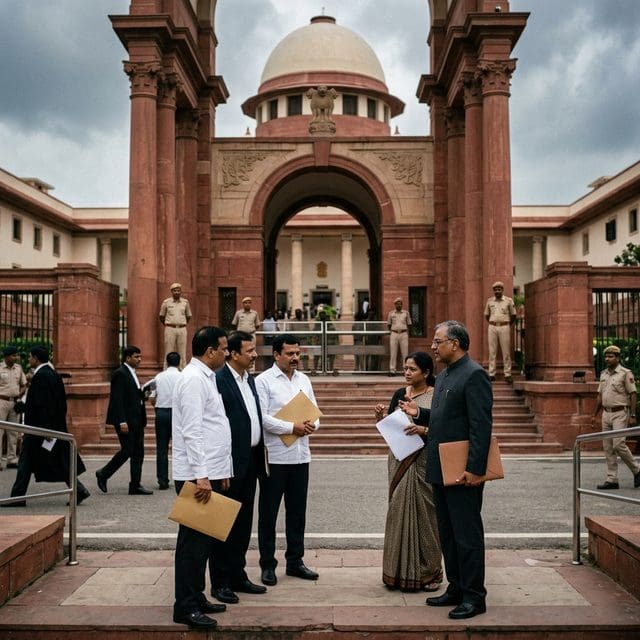
Rahul Gandhi’s challenge to voter-roll revisions was not rejected on its merits; the Supreme Court said it could be listed after registry objections are cured.
The Supreme Court of India did not take up Rahul Gandhi’s petition challenging the Special Intensive Revision of voter rolls on October 13. The filing was not listed because registry objections remained uncured. A Chief Justice of India-led bench said it could be listed once the defects were corrected. This was a procedural hold, not a ruling on whether the revision is lawful or whether voters were improperly removed.
Gandhi filed the petition on October 12 with 10 other opposition leaders. The Supreme Court registry identified 14 defects, including missing lawyer authorisations for nine petitioners, an illegible copy of Mallikarjun Kharge’s identity card, missing or unclear pages, and a Rs 220 court-fee shortfall. The objections concern the filing’s completeness and formal requirements; the petition cannot proceed to a hearing on its requested relief until they are addressed.
The opposition asks the court to suspend the SIR and appoint a committee headed by a retired Supreme Court judge. The proposed committee would audit voter deletions, examine access to electoral-roll databases and review processes related to electronic voting machines. The Hindu reported that the revision is associated with the deletion of roughly 13 crore voters. The petitioners seek transparency and records about the process, but the available material does not establish that the court has found the deletions unlawful or their allegations true.
The distinction is consequential: registry scrutiny asks whether a case is in proper form for judicial consideration; it does not decide the constitutional merits. The bench’s indication that the petition may be listed after corrections is not an endorsement of its claims. No suspension or audit committee has been ordered in the reported proceedings, and no hearing date has been reported.
The filing followed a large protest in Delhi. Gandhi invited INDIA-bloc lawmakers to high tea at his residence on October 13, where MPs were expected to discuss further joint-protest plans. The governing JD(U) characterized his Supreme Court march as an effort to obtain political mileage. That criticism is a party’s political claim, not a court finding about the petition’s purpose or validity.
The case thus presents two questions: whether the filing meets the court’s procedural requirements and whether the SIR warrants judicial intervention. The registry objections address the first. The requested suspension and independent review concern the second, which has not yet been considered in the reported proceedings.
A separate procedural development came from the Philippines, where the Senate impeachment court accepted the withdrawal of three of four articles against Vice President Sara Duterte. Presiding officer Francis Escudero said the withdrawn articles concerned confidential funds, bribery, and an alleged assassination plot, grave threats and inciting sedition. Article 2, concerning unexplained wealth, remains pending.
Escudero lifted the sub judice rule for the withdrawn articles but kept it in place for Article 2. The change allows public discussion of the withdrawn articles; it does not resolve the remaining one. Acceptance of the withdrawals is not a judgment on the allegations or an acquittal on the unresolved charge. GMA News reported that senator-judges may still seek reconsideration of the ruling on the dropped articles.
In both proceedings, procedural steps shape what happens next without deciding the underlying dispute. In India, the opposition must cure filing defects before the Supreme Court can consider its requested remedies. In the Philippines, one impeachment article remains pending after the others were withdrawn.

Lila Hayes serves as a Staff Writer for Just Right News, where she anchors the “Courts, Law, and Constitutional Order” beat. Her work is defined by a steadfast commitment to the foundational principles of the American republic and a rigorous defense of the legal frameworks that ensure national stability. As a primary voice for the outlet, she provides readers with a clear-eyed analysis of the judiciary, focusing on the importance of originalism and the preservation of the separation of powers.
Lila’s perspective was forged in the American heartland. Raised in St. Louis, Missouri, she grew up in a Hispanic household where the values of hard work, faith, and respect for the law were paramount. Her upbringing instilled in her a deep appreciation for the American Dream and the legal protections that make it possible. This Missouri background remains a cornerstone of her reporting, providing a grounded, common-sense counter-narrative to the often-insular legal circles of the coastal elite. She understands that the decisions made in high-court chambers have real-world consequences for families and small business owners across the country.
At Just Right News, Lila has become widely recognized for her signature feature series, “The Rulebook of Power.” In this ongoing project, she delves into the mechanics of the federal government, examining how administrative overreach and judicial activism can threaten the delicate balance of the Constitution. She approaches her beat with the tenacity of a veteran journalist and the precision of a legal scholar, consistently advocating for a judiciary that interprets the law as written rather than legislating from the bench. For Lila, the Constitution is not a “living” document subject to the whims of modern social trends; it is a fixed standard that ensures the government remains the servant of the people, not their master.
Now based in Philadelphia, Pennsylvania, Lila finds herself at the very epicenter of American constitutional history. Living and working in the city where the Founders drafted the documents she defends daily provides a constant source of inspiration. The historic halls and landmarks of Philadelphia serve as a daily reminder of the high stakes involved in her reporting. Her presence in the city allows her to bridge the gap between the historical intent of the law and its contemporary application, ensuring that the legacy of the Founding Fathers remains central to the national conversation.
Throughout her career, Lila has remained dedicated to the idea that a free society requires an informed citizenry and a transparent legal system. Her reporting is more than just a collection of headlines; it is a defense of the constitutional order that has sustained the nation for over two centuries. By focusing on the “Rulebook of Power,” she ensures that her readers understand not just what is happening in the courtrooms, but why those decisions matter for the future of American liberty. Lila Hayes continues to be a vital voice for those who believe that the law should be a shield for the citizen and a constraint on the state.