

The Justice Department says a judge authorized the search of Rep. Ilhan Omar’s home, but has disclosed little about an investigation reportedly involving documents, whistleblowers and witness testimony.
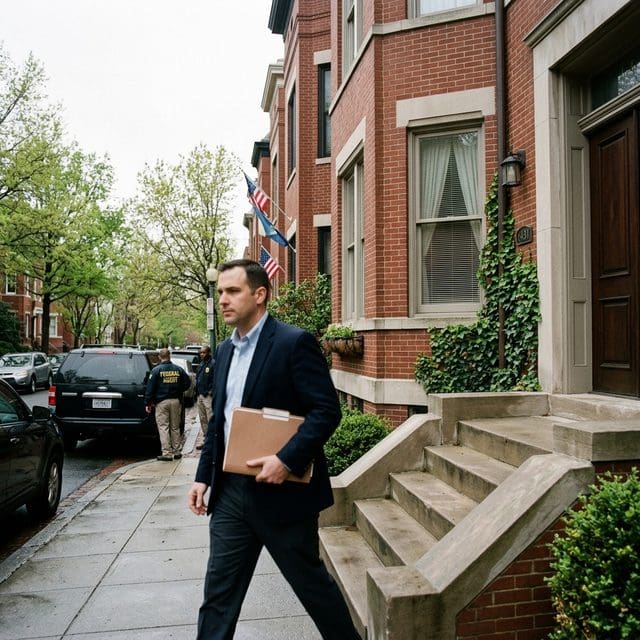
Federal agents searched Rep. Ilhan Omar’s Washington home under a judicially authorized warrant, but the Justice Department has disclosed little about the investigation behind it. The department said it secured the warrant; it did not identify Omar or provide further investigative details in its statement, according to the Associated Press and PBS NewsHour.
No criminal charges against Omar had been announced as of Monday, Oct. 12. A search warrant is an investigative step, not a finding of wrongdoing. The public record described in the available reporting does not include the warrant or an affidavit explaining what investigators presented to the judge.
NBC News, citing a source familiar with the matter, reported that the yearslong investigation involves Homeland Security Investigations, the U.S. attorney in Minneapolis and the Justice Department. The inquiry reportedly draws on whistleblowers, documents and witness testimony, and extends beyond immigration and fraud allegations. The underlying materials have not been made public in the source material.
That leaves key questions unanswered: what conduct is under investigation, what evidence led to the warrant, and what agents were authorized to seize. A source’s account of the probe is not a substitute for the warrant or court filings that would let the public examine its scope and legal basis. DHS referred questions to DOJ, which offered no additional details in its statement.
Omar called the search an effort to “target political enemies” and “weaponize federal law enforcement.” She said, “I will not be silenced,” and described President Donald Trump’s conduct as an escalation of political intimidation. House Democratic leaders called the search “deeply disturbing” and pledged accountability for what they characterized as abuse of power by DHS and DOJ. Those are political responses, not findings about the investigation’s merits.
The search follows public comments about Omar from administration officials. Border czar Tom Homan said last month that DHS was investigating her and that no one was above the law in possible immigration or marriage-fraud cases. Trump again criticized Omar and Somali immigrants at a Tennessee rally Saturday, NBC News reported. These remarks provide political context; they do not establish what evidence investigators relied on or whether political considerations shaped the search.
NBC News also reported that Justice Department policy bars investigative steps or public statements intended to influence an election and calls for guidance when timing could raise concerns. The department’s inspector general recommended related guidance late last month, the report said. The available material does not establish a policy violation or say whether officials sought guidance in Omar’s case.
The next meaningful public evidence would be the warrant and any supporting papers, if filed or later unsealed. Those records could clarify the alleged conduct and the judge’s limits on the search, but allegations in them would not prove a crime. For now, the established account is narrow: agents searched Omar’s home under a judge-authorized warrant, the investigation reportedly involves several federal offices, and no charges have been announced.
Ben Taylor serves as the Senior Correspondent and Investigations Lead for Just Right News, where he anchors the network’s commitment to government transparency and institutional accountability. With a career defined by a relentless pursuit of the facts, Taylor spearheads the acclaimed feature series “The Paper Trail,” a deep-dive investigative column that prioritizes primary source documentation over political rhetoric. Based in the heart of the nation’s capital, he has earned a reputation as one of the most formidable investigative journalists in Washington, D.C., known specifically for his mastery of public records and the Freedom of Information Act.
Taylor’s approach to journalism is deeply rooted in his upbringing in Kansas City, Missouri. Growing up in the “Show Me State,” he developed a healthy skepticism of centralized power and a profound respect for the common-sense values of the American heartland. This Midwestern foundation informs his reporting today, as he bridges the gap between the complex machinations of federal bureaucracy and the everyday concerns of citizens across the country. For Taylor, investigative reporting is not about chasing headlines; it is about ensuring that the government remains answerable to the people it serves.
As an African American man working within the conservative media landscape, Taylor brings a principled perspective to his beat. He views the Constitution and the right to information as the ultimate equalizers in a free society. His work often highlights how bureaucratic overreach and lack of transparency disproportionately affect individual liberties. By focusing on the “paper trail,” Taylor strips away the spin of partisan talking points, instead providing Just Right News readers with the raw data and internal communications that reveal how their tax dollars are spent and how policy decisions are actually made.
In his role as Investigations Lead, Taylor oversees a team dedicated to uncovering the stories that mainstream outlets often overlook. Whether he is auditing federal spending, investigating regulatory overreach, or exposing inefficiencies within the administrative state, his methodology remains consistent: follow the evidence wherever it leads. His presence in Washington, D.C., allows him to maintain a constant watch over the halls of power, yet he remains steadfastly connected to his roots, ensuring his reporting reflects the clarity and directness of his Missouri home.
Throughout his tenure at Just Right News, Taylor has become a vital voice for those who demand integrity in public office. He believes that a well-informed electorate is the strongest defense against government overreach, and he has dedicated his career to providing the public with the tools they need to hold their leaders accountable. Through “The Paper Trail” and his broader investigative work, Ben Taylor continues to set the standard for rigorous, document-driven journalism that champions the values of transparency, individual responsibility, and the rule of law.