

A judicially authorized search of Rep. Ilhan Omar’s Washington home has prompted competing claims of political intimidation and legitimate investigation, while key details remain undisclosed.
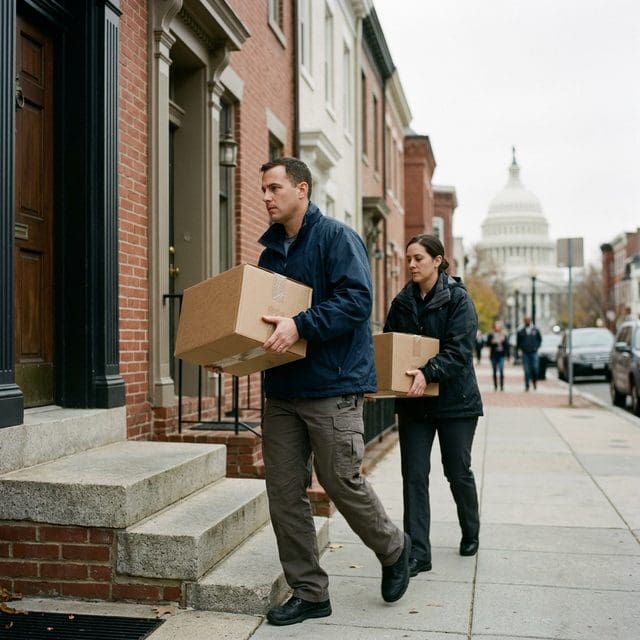
Federal agents searched Rep. Ilhan Omar’s Washington home Monday under a judicially authorized warrant, putting an opaque criminal investigation at the center of an election-year dispute over the Justice Department’s independence and the limits of presidential power.
The Justice Department said Homeland Security Investigations executed the warrant as part of an ongoing federal criminal investigation. It did not specify what agents sought or identify suspected offenses. No charges against Omar had been announced as of Monday; a search warrant is not itself an accusation of wrongdoing.
Omar, a Minnesota Democrat, called the search an escalation of President Donald Trump’s campaign of intimidation. “I will not be silenced,” she said. Her spokesperson described the search as an abuse of federal law enforcement. Trump criticized Omar publicly but said he had “nothing to do” with the investigation and that it was up to the Justice Department.
Reporting offers additional contours, but not a full account. NPR reported that a current official described the inquiry as a multi-year probe that includes whistleblower complaints; a former official said it concerns immigration-fraud allegations, which Omar has denied. NBC News reported that HSI, the U.S. attorney in Minneapolis and the Justice Department are involved, and that the probe includes documents and witness testimony. A source told NBC the investigation extends beyond immigration and fraud.
NPR also reported that senior Justice Department officials, including Acting Deputy Attorney General Trent McCotter, were consulted before the search and approved it, citing sources familiar with the matter. That account is institutionally significant: a high-profile investigative step involving a sitting member of Congress should rest on a documented legal basis and proceed through ordinary channels. Reported approval, however, does not disclose what evidence supported the warrant or settle questions about the probe’s scope.
The public record remains limited. The Justice Department has confirmed the warrant and the agency that executed it, but has not described the evidence or the specific focus of the investigation. The search took place in Washington, while Omar represents Minnesota’s 5th Congressional District. The location alone establishes nothing about the case; NBC’s reporting on Minnesota prosecutors suggests the inquiry is not confined to where agents searched.
Political reactions have moved faster than the available facts. House Democrats and the Congressional Black Caucus condemned the search as politically motivated. Republicans cited Omar’s past statement that “no one is above the law.” Neither argument answers the central questions: what evidence supported the warrant, whether investigators followed department policy, and whether decisions were insulated from political direction.
The timing invites scrutiny. The search came in the final weeks before the Nov. 3 midterm elections, when control of Congress is at stake. Democratic leaders say the proximity raises concerns about Justice Department practices involving candidates. The reporting provided does not establish that the search violated policy or that its timing was politically chosen. Those conclusions require evidence, not the calendar alone.
Trump’s public attacks on Omar—including calling her a “terrible person”—help explain why the investigation will face heightened scrutiny. His denial of involvement is relevant, but it cannot replace safeguards that keep law enforcement decisions independent. The question is not whether the president approves of Omar or whether allegations are politically convenient; it is whether investigators acted on evidence and followed the law.
For now, the search is a consequential use of federal authority, with important facts still undisclosed. Judicial authorization means a judge approved the search under applicable legal standards; it does not establish Omar’s guilt. Until the government provides more information through appropriate proceedings, claims of political persecution and assumptions of wrongdoing both remain unproven.

Miles Harrington serves as the Senior Correspondent for Federal Systems & Executive Power at Just Right News, where he brings a disciplined, constitutionalist lens to the inner workings of the American government. With a focus on the mechanics of the federal bureaucracy and the limits of executive authority, Harrington has established himself as a vital voice for readers who value transparency, accountability, and the preservation of the separation of powers.
A native of Richmond, Virginia, Harrington’s perspective is deeply rooted in the traditions of the Old Dominion. Growing up in a city defined by its historical significance and its role as a center of American jurisprudence, he developed an early appreciation for the foundational principles of the Republic. His upbringing in Richmond—a place where the legacy of the Founding Fathers is woven into the landscape—instilled in him a belief that the federal government should remain within its constitutional bounds. This background informs his skepticism of centralized overreach and his commitment to reporting on the ways in which the administrative state impacts the lives of everyday citizens.
In his current role, Harrington specializes in the complexities of federal systems. He doesn’t just report on the headlines of the day; he digs into the structural shifts within the executive branch that often go unnoticed by the mainstream press. Whether he is analyzing the implications of a new federal regulation or investigating the expansion of agency jurisdiction, his work is characterized by a rigorous adherence to the facts and a dedication to the rule of law.
Harrington is perhaps best known for his signature feature series, “How Washington Works.” Through this ongoing project, he demystifies the often-opaque processes of the nation’s capital, pulling back the curtain on the “Deep State” and the unelected officials who wield significant influence over national policy. By breaking down complex legislative maneuvers and executive orders, he empowers Just Right News readers to understand the true levers of power in Washington. His reporting serves as a necessary check on the federal government, ensuring that the actions of those in power are held up to the light of public scrutiny.
Now based in Washington, D.C., Harrington operates at the epicenter of the political world, yet he remains intentionally distanced from the “Beltway bubble.” His proximity to the halls of power allows him to maintain a robust network of sources across the federal landscape, but his heart remains in the principled conservatism of his Virginia roots. He views his role not merely as a reporter, but as a steward of the public trust, dedicated to providing the clarity and context that conservative voters need to navigate an increasingly complex political environment.
Through his sharp analysis and unwavering commitment to the truth, Miles Harrington continues to be a cornerstone of the Just Right News team. His work ensures that the principles of limited government and executive restraint remain at the forefront of the national conversation, providing a crucial service to those who believe in a government that is truly of, by, and for the people.