

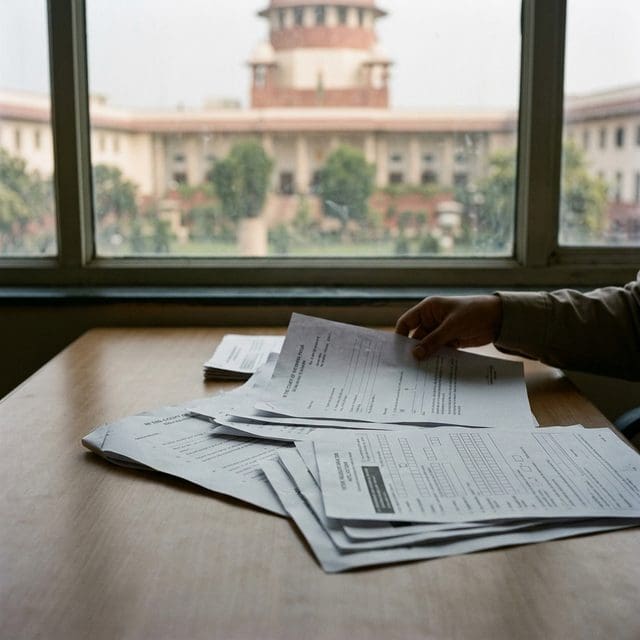
A Bombay High Court entry confirms a Tata Trusts-related caveat, while Karnataka voter-roll data and a Public Citizen analysis document issues that available records do not fully resolve.
Official records establish a limited procedural fact in the Tata Trusts row: a caveat was filed in the Bombay High Court on October 7. The court’s online record identifies Noel N. Tata and another person as caveators, and Venu Srinivasan and three others as caveatees. The filing was made through Cyril Amarchand Mangaldas, according to the record.
A caveat is not a court ruling on the merits. CNBC-TV18 reported that the filings were made under Section 148A of the Code of Civil Procedure and remain effective for 90 days. The procedure requires notice and a hearing before the court passes an order covered by the caveat. The filing documents a request for advance notice and an opportunity to be heard; it does not establish the parties’ claims or the court’s view of them.
The Hindu reported that Noel Tata and his son Neville Tata moved the Bombay High Court and a Mumbai civil court with caveats on October 7. The Bombay High Court entry supplied here, however, names Noel N. Tata and “another person” as caveators. It does not identify that second person. The distinction between the broader report and the specific court entry is important: the entry supports only the names and procedural details it contains. The available material does not establish what relief the parties may seek or how either court will respond.
In Karnataka, election officials are preparing final rolls due October 27. The chief electoral officer’s office had received 10,07,392 Form 6 applications for voter inclusion and 4,777 Form 6A applications for non-resident Indian inclusion as of October 15. Form 8 applications, used to request changes to voter records, had crossed 12 lakh.
Officials said 7.86 lakh Form 6 applications were submitted before the September 23 claims deadline and will be processed for the final rolls. They said only applications received during the August 24–September 23 claims-and-objections period will be considered for additions or deletions in the October 27 publication. A mop-up enrolment exercise is planned afterward for eligible voters who were missed.
Officials also said they cannot determine how many Form 6 applicants were among voters deleted under the ASDDO process because the database is now with the Election Commission of India. That leaves a key question unanswered: how many people omitted from the rolls reapplied for inclusion? The Hindu’s October 17 headline reported that 29,000 deletion-related records were missing from an online portal for public scrutiny. The available material does not include the underlying forms or enough detail to independently establish the extent of the portal gap.
Public Citizen’s October 14 analysis offers another example of what a dataset can show. It identified 110 super PACs that raised at least $1 million in the 2026 cycle and received at least half their funding from a single donor. Those committees raised more than $1 billion, including $913 million from those majority donors. Public Citizen separately reported that five ultra-wealthy donors directed about $336 million to aligned super PACs and that corporations contributed about $646 million to influence the 2026 federal elections.
Those are findings and estimates attributed to Public Citizen; they do not, by themselves, prove that a contribution changed a government decision. The same evidentiary limit applies across these records. A court entry can establish who filed and when. Election data can count applications without identifying every applicant’s history. A campaign-finance analysis can describe funding patterns without showing what those contributions bought. Where the documents do not answer the next question, the uncertainty belongs in the account.
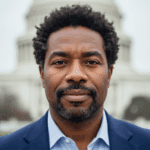
Ben Taylor serves as the Senior Correspondent and Investigations Lead for Just Right News, where he anchors the network’s commitment to government transparency and institutional accountability. With a career defined by a relentless pursuit of the facts, Taylor spearheads the acclaimed feature series “The Paper Trail,” a deep-dive investigative column that prioritizes primary source documentation over political rhetoric. Based in the heart of the nation’s capital, he has earned a reputation as one of the most formidable investigative journalists in Washington, D.C., known specifically for his mastery of public records and the Freedom of Information Act.
Taylor’s approach to journalism is deeply rooted in his upbringing in Kansas City, Missouri. Growing up in the “Show Me State,” he developed a healthy skepticism of centralized power and a profound respect for the common-sense values of the American heartland. This Midwestern foundation informs his reporting today, as he bridges the gap between the complex machinations of federal bureaucracy and the everyday concerns of citizens across the country. For Taylor, investigative reporting is not about chasing headlines; it is about ensuring that the government remains answerable to the people it serves.
As an African American man working within the conservative media landscape, Taylor brings a principled perspective to his beat. He views the Constitution and the right to information as the ultimate equalizers in a free society. His work often highlights how bureaucratic overreach and lack of transparency disproportionately affect individual liberties. By focusing on the “paper trail,” Taylor strips away the spin of partisan talking points, instead providing Just Right News readers with the raw data and internal communications that reveal how their tax dollars are spent and how policy decisions are actually made.
In his role as Investigations Lead, Taylor oversees a team dedicated to uncovering the stories that mainstream outlets often overlook. Whether he is auditing federal spending, investigating regulatory overreach, or exposing inefficiencies within the administrative state, his methodology remains consistent: follow the evidence wherever it leads. His presence in Washington, D.C., allows him to maintain a constant watch over the halls of power, yet he remains steadfastly connected to his roots, ensuring his reporting reflects the clarity and directness of his Missouri home.
Throughout his tenure at Just Right News, Taylor has become a vital voice for those who demand integrity in public office. He believes that a well-informed electorate is the strongest defense against government overreach, and he has dedicated his career to providing the public with the tools they need to hold their leaders accountable. Through “The Paper Trail” and his broader investigative work, Ben Taylor continues to set the standard for rigorous, document-driven journalism that champions the values of transparency, individual responsibility, and the rule of law.