

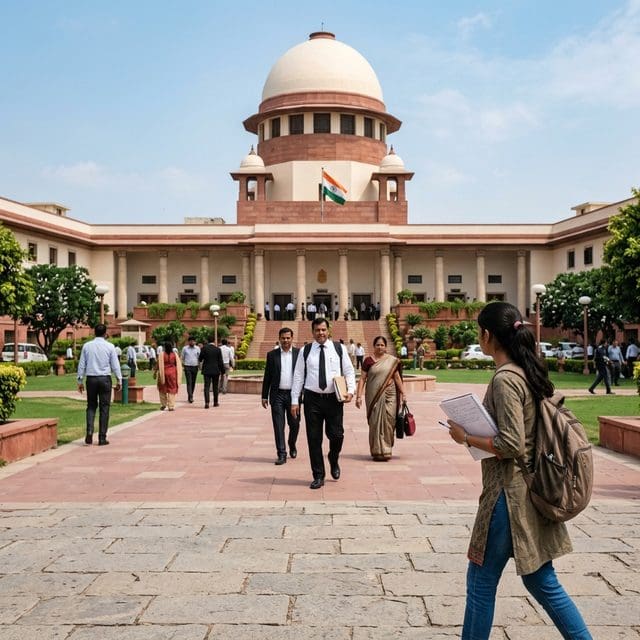
The Court ordered States and Union Territories to provide comprehensive implementation details by the next hearing, warning that continued non-compliance could bring contempt notices for Chief Secretaries.
The Supreme Court of India has given States and Union Territories a final opportunity to explain how they are carrying out its menstrual-hygiene ruling, warning that continued non-compliance could lead to contempt notices against the Chief Secretaries concerned.
At a hearing on October 13, Additional Solicitor General Aishwarya Bhati told the Bench that the Government of India had sought implementation details from every State and Union Territory but had received no responses, according to India Today’s October 18 report. The Court directed the Centre to seek written information from each jurisdiction on every aspect of the judgment and to study the verdict again before collecting the responses.
The next hearing is scheduled for December 14, 2026. The reported order focuses on obtaining a complete account of implementation; it does not announce a new standard or issue contempt notices. The Court warned that continued non-compliance could lead to notices against the relevant Chief Secretaries, leaving that enforcement step for a possible later stage.
The distinction matters. The original judgment sets out the Court’s ruling; this latest direction seeks information about whether governments have carried it out. The reports available do not describe the full terms of the underlying judgment, so they do not establish which particular facilities or services each jurisdiction must provide. The Court’s immediate demand, as reported, is for written answers covering every aspect of that verdict.
The Bench said the ruling was intended to address girls leaving education, particularly in remote areas, because of menstrual-hygiene difficulties. That stated purpose links the implementation inquiry to educational access as well as hygiene. The Court’s direction to gather information from every State and Union Territory signals that it wants a jurisdiction-by-jurisdiction account, rather than a general assurance that progress is being made.
The Centre reported that, as of September 1, 30,458 separate school toilets with washing facilities had been built and another 4,236 were under construction. Those figures provide information about infrastructure, but they do not alone answer the Court’s broader request. The reported data does not show whether the facilities address the deficiencies identified by the Court or how coverage varies across jurisdictions.
The instruction to review the judgment before collecting responses is also significant. It is intended, according to the report, to make the Centre’s inquiry track the full scope of the verdict. The source material does not specify the questions the Centre will send or give a separate deadline for the written submissions ahead of the December hearing.
The next phase will test whether the States and Union Territories provide the requested details and whether the Court considers those reports adequate. The Court has not, based on the information reported, found any particular Chief Secretary in contempt. Its warning instead puts officials on notice that continued failure to comply with judicial directions may trigger proceedings.
The practical change is procedural but consequential: the governments have been given a final opportunity to account for their actions before the Court considers stronger enforcement. The December 14 hearing will show whether the Centre has gathered responses from each jurisdiction and whether the Bench believes they answer the judgment’s requirements. For now, the order underscores that implementation is not established by the mere existence of a ruling; governments must report what they have done.

Lila Hayes serves as a Staff Writer for Just Right News, where she anchors the “Courts, Law, and Constitutional Order” beat. Her work is defined by a steadfast commitment to the foundational principles of the American republic and a rigorous defense of the legal frameworks that ensure national stability. As a primary voice for the outlet, she provides readers with a clear-eyed analysis of the judiciary, focusing on the importance of originalism and the preservation of the separation of powers.
Lila’s perspective was forged in the American heartland. Raised in St. Louis, Missouri, she grew up in a Hispanic household where the values of hard work, faith, and respect for the law were paramount. Her upbringing instilled in her a deep appreciation for the American Dream and the legal protections that make it possible. This Missouri background remains a cornerstone of her reporting, providing a grounded, common-sense counter-narrative to the often-insular legal circles of the coastal elite. She understands that the decisions made in high-court chambers have real-world consequences for families and small business owners across the country.
At Just Right News, Lila has become widely recognized for her signature feature series, “The Rulebook of Power.” In this ongoing project, she delves into the mechanics of the federal government, examining how administrative overreach and judicial activism can threaten the delicate balance of the Constitution. She approaches her beat with the tenacity of a veteran journalist and the precision of a legal scholar, consistently advocating for a judiciary that interprets the law as written rather than legislating from the bench. For Lila, the Constitution is not a “living” document subject to the whims of modern social trends; it is a fixed standard that ensures the government remains the servant of the people, not their master.
Now based in Philadelphia, Pennsylvania, Lila finds herself at the very epicenter of American constitutional history. Living and working in the city where the Founders drafted the documents she defends daily provides a constant source of inspiration. The historic halls and landmarks of Philadelphia serve as a daily reminder of the high stakes involved in her reporting. Her presence in the city allows her to bridge the gap between the historical intent of the law and its contemporary application, ensuring that the legacy of the Founding Fathers remains central to the national conversation.
Throughout her career, Lila has remained dedicated to the idea that a free society requires an informed citizenry and a transparent legal system. Her reporting is more than just a collection of headlines; it is a defense of the constitutional order that has sustained the nation for over two centuries. By focusing on the “Rulebook of Power,” she ensures that her readers understand not just what is happening in the courtrooms, but why those decisions matter for the future of American liberty. Lila Hayes continues to be a vital voice for those who believe that the law should be a shield for the citizen and a constraint on the state.