

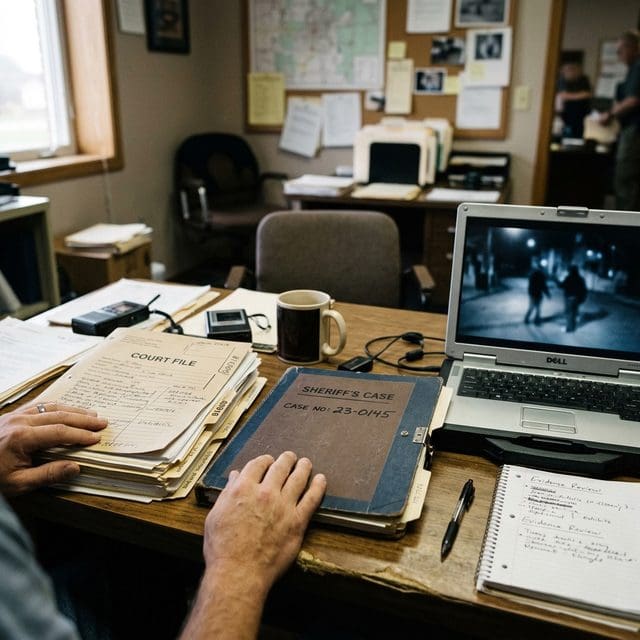
A court record, an unauthenticated game trailer and a sheriff’s death investigation illustrate how much can—and cannot—be established from the documents currently available.
Three recent developments offer different tests of what the available record can establish: a court’s account of a missing order, an unverified video said to show a canceled game project, and a death investigation with no official cause reported.
The clearest documentary point comes from a court ruling reported by The Hindu on Thursday. Police had filed a third application seeking further investigation after submitting a final report, but the court said the record contained no order granting permission, the newspaper reported.
That is a statement about what was—or was not—placed on the record. The available report does not identify the case or provide the court’s full reasoning, and it does not establish whether permission is legally required in every such circumstance. The narrow question addressed by the ruling is whether police need court permission to continue investigating after filing a final report. Without the order itself, broader conclusions about the ruling would go beyond the information provided.
A very different kind of record surfaced around BioWare and Electronic Arts. Kotaku reported Thursday that a video presented as a trailer for a Mass Effect project appeared a day after EA shut down the developer. GamesRadar+ described the video as just over two minutes long, with no gameplay, and said it was posted by a new Reddit account that called itself a “new burner.” Its authenticity remains unverified.
The trailer reportedly opens with a disclaimer saying it uses pre-production assets but is in-engine. Those details, if accurately represented, would distinguish a rendered, in-engine presentation from footage of playable game content. They do not establish who made the video, whether EA or BioWare authorized its release, or whether it depicts a project that was actually in development. Kotaku said EA had not responded to its request for comment by publication.
That leaves a sizable gap between a convincing-looking leak and a verified account of what the company planned. The available reporting does not authenticate the file or identify its source. Nor does the material supplied establish that the video is definitively tied to Mass Effect 5. Those limits matter, particularly when a leak appears amid news of a studio closure and can quickly be mistaken for an official announcement.
The case of former NFL player Allen Bailey is also unresolved, but for a different reason. The Clay County Sheriff’s Office has opened a death investigation, according to the reporting provided. Bailey’s brother, Alford Bailey Jr., told TMZ that Bailey’s wife found him inside the home and that the family believes he died of natural causes. No official cause of death has been reported.
The family’s belief is relevant and attributable; it is not an official finding. The investigation’s existence likewise does not, on its own, establish suspicious circumstances. The available reports do not provide a public investigative file, medical examiner’s determination or sheriff’s statement explaining what investigators have concluded.
Across the three stories, the distinction is between a record’s contents and the conclusions people may want to draw from them. A court’s statement that an order was absent from the record is not the same as a complete account of the governing law. A leaked video is not authenticated simply because it looks plausible. And a family’s understanding of a death is not a formal cause-of-death finding.
For now, the public record supports those limited conclusions—and no more. The next useful documents would be the full court order, confirmation from EA or BioWare about the video, and an official update from the sheriff or medical examiner in Bailey’s case.

Ben Taylor serves as the Senior Correspondent and Investigations Lead for Just Right News, where he anchors the network’s commitment to government transparency and institutional accountability. With a career defined by a relentless pursuit of the facts, Taylor spearheads the acclaimed feature series “The Paper Trail,” a deep-dive investigative column that prioritizes primary source documentation over political rhetoric. Based in the heart of the nation’s capital, he has earned a reputation as one of the most formidable investigative journalists in Washington, D.C., known specifically for his mastery of public records and the Freedom of Information Act.
Taylor’s approach to journalism is deeply rooted in his upbringing in Kansas City, Missouri. Growing up in the “Show Me State,” he developed a healthy skepticism of centralized power and a profound respect for the common-sense values of the American heartland. This Midwestern foundation informs his reporting today, as he bridges the gap between the complex machinations of federal bureaucracy and the everyday concerns of citizens across the country. For Taylor, investigative reporting is not about chasing headlines; it is about ensuring that the government remains answerable to the people it serves.
As an African American man working within the conservative media landscape, Taylor brings a principled perspective to his beat. He views the Constitution and the right to information as the ultimate equalizers in a free society. His work often highlights how bureaucratic overreach and lack of transparency disproportionately affect individual liberties. By focusing on the “paper trail,” Taylor strips away the spin of partisan talking points, instead providing Just Right News readers with the raw data and internal communications that reveal how their tax dollars are spent and how policy decisions are actually made.
In his role as Investigations Lead, Taylor oversees a team dedicated to uncovering the stories that mainstream outlets often overlook. Whether he is auditing federal spending, investigating regulatory overreach, or exposing inefficiencies within the administrative state, his methodology remains consistent: follow the evidence wherever it leads. His presence in Washington, D.C., allows him to maintain a constant watch over the halls of power, yet he remains steadfastly connected to his roots, ensuring his reporting reflects the clarity and directness of his Missouri home.
Throughout his tenure at Just Right News, Taylor has become a vital voice for those who demand integrity in public office. He believes that a well-informed electorate is the strongest defense against government overreach, and he has dedicated his career to providing the public with the tools they need to hold their leaders accountable. Through “The Paper Trail” and his broader investigative work, Ben Taylor continues to set the standard for rigorous, document-driven journalism that champions the values of transparency, individual responsibility, and the rule of law.