

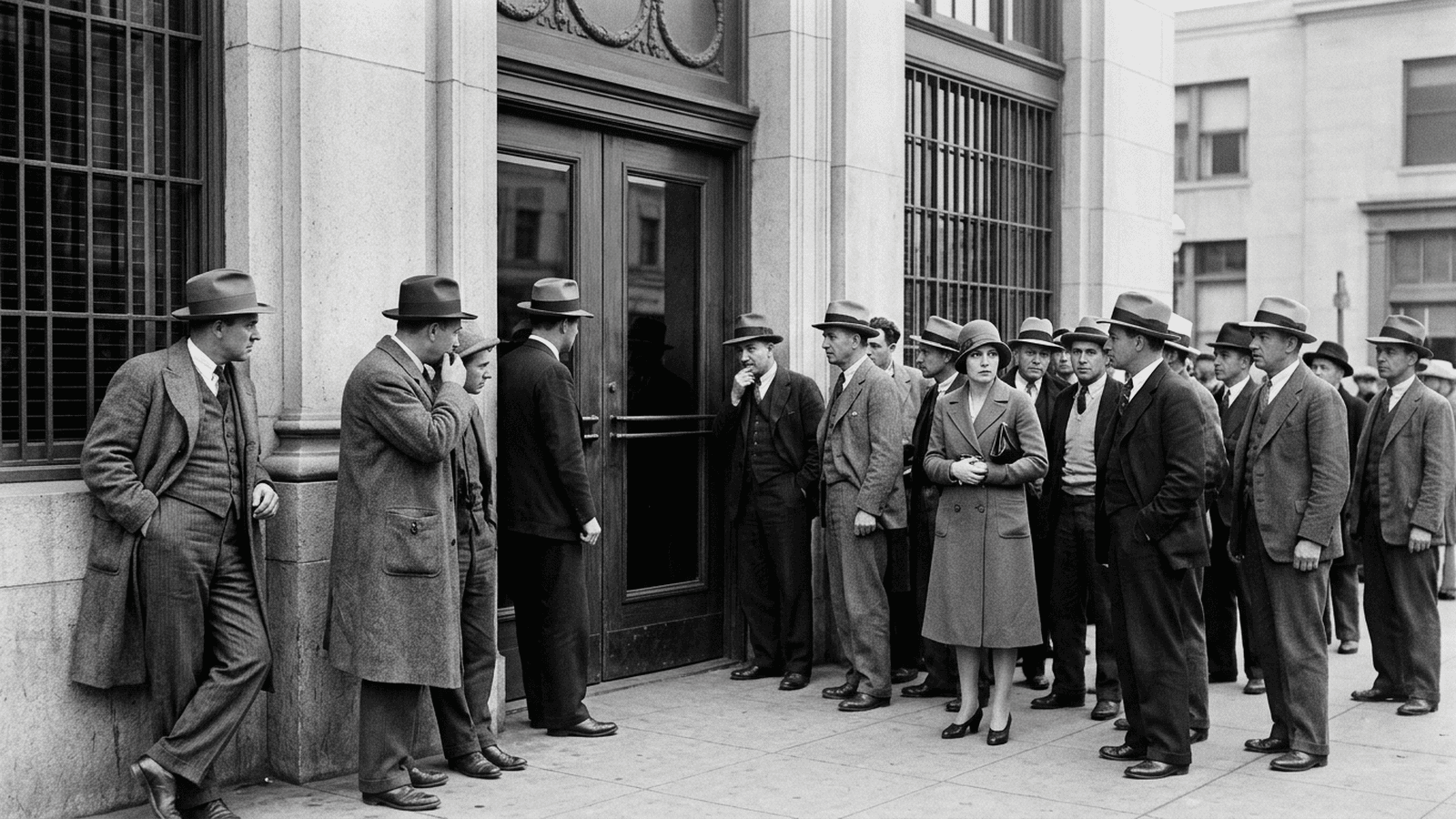
In March 1933, California Governor James Rolph closed the state’s banks amid a wave of withdrawals, acting before President Franklin D. Roosevelt’s nationwide bank holiday. The episode tested state emergency authority and helped illustrate how legislative action and federal oversight would shape the United States’ response to the banking crisis.
TLDR: California Governor James Rolph declared a bank holiday on March 2, 1933, before President Roosevelt ordered a nationwide closure. State lawmakers then enacted emergency banking measures, while federal legislation established a broader system for inspecting and reopening banks. The crisis tested executive authority and highlighted the importance of legislative and federal oversight.
In early March 1933, California’s banks faced a crisis that quickly became a test of government authority. Depositors, alarmed by bank failures and financial panic, sought to withdraw cash faster than many institutions could pay it out. Governor James Rolph Jr. moved to close the state’s banks before President Franklin D. Roosevelt announced a nationwide shutdown. The episode exposed an urgent question: who could legally halt ordinary banking when the financial system appeared close to collapse?
California was not alone. Bank runs had spread across the country, and Michigan had already imposed a statewide banking holiday in February. In California, withdrawals intensified as the inauguration of Roosevelt approached. Banks faced the danger that public fear could turn uncertainty into insolvency, even for institutions that might otherwise have remained open. Officials argued that a temporary closure could stop the rush for cash and give banks time to assess their accounts.
Rolph proclaimed a California banking holiday on March 2, 1933, closing banks across the state. His action came before Roosevelt’s national proclamation, issued on March 6, which ordered banks closed throughout the United States. The timing mattered: California’s emergency measures were not simply an implementation of the president’s order. They raised questions about the governor’s authority, the legislature’s role, and the limits of state action over institutions operating within a national financial system.
The state’s response soon moved beyond the governor’s proclamation. During a special session, California lawmakers enacted emergency measures to support the closure and regulate banking activity. The legislation provided a state legal framework for restrictions that had initially rested on executive action. This transition helped address a basic constitutional concern: an emergency could demand immediate action, but lasting restrictions on private business and access to deposits required more than a governor’s unilateral declaration.
The crisis unfolded as federal officials prepared a national response. Roosevelt’s March 6 proclamation closed banks across the country, and Congress passed the Emergency Banking Act on March 9. The federal law authorized the Treasury Department to examine banks and permit sound institutions to reopen. California’s shutdown therefore became part of a broader effort, in which state and federal authorities used distinct legal powers to interrupt withdrawals, restore confidence, and reopen the banking system under supervision.
The closure imposed real costs. Businesses and households could not freely access deposits during the holiday, and uncertainty persisted while officials determined which banks could resume operations. Yet the pause was designed to prevent a disorderly collapse, not to permanently confiscate deposits. Banks reopened in stages after federal review, and public confidence improved as cash withdrawals slowed and deposits returned. California’s action thus operated within an emergency whose solution depended increasingly on federal oversight.
The episode did not produce a landmark Supreme Court ruling defining the precise boundaries of gubernatorial power. Instead, it demonstrated how constitutional practice can be shaped by fast-moving crises, legislative authorization, and cooperation between levels of government. Rolph’s proclamation tested executive authority; the state legislature supplied legal support; and federal action established a nationwide framework. The sequence underscored that emergency powers could be consequential while remaining subject to political and statutory checks.
The banking emergency also helped transform federal financial regulation. The Emergency Banking Act and subsequent reforms strengthened federal supervision, while the 1933 Glass-Steagall Act separated commercial and investment banking and created federal deposit insurance through the FDIC. California’s short-lived holiday was one state episode in a national breakdown, but it made the constitutional stakes visible: protecting the financial system required rapid intervention, and durable authority depended on laws, oversight, and coordination rather than executive action alone.

Lila Hayes serves as a Staff Writer for Just Right News, where she anchors the “Courts, Law, and Constitutional Order” beat. Her work is defined by a steadfast commitment to the foundational principles of the American republic and a rigorous defense of the legal frameworks that ensure national stability. As a primary voice for the outlet, she provides readers with a clear-eyed analysis of the judiciary, focusing on the importance of originalism and the preservation of the separation of powers.
Lila’s perspective was forged in the American heartland. Raised in St. Louis, Missouri, she grew up in a Hispanic household where the values of hard work, faith, and respect for the law were paramount. Her upbringing instilled in her a deep appreciation for the American Dream and the legal protections that make it possible. This Missouri background remains a cornerstone of her reporting, providing a grounded, common-sense counter-narrative to the often-insular legal circles of the coastal elite. She understands that the decisions made in high-court chambers have real-world consequences for families and small business owners across the country.
At Just Right News, Lila has become widely recognized for her signature feature series, “The Rulebook of Power.” In this ongoing project, she delves into the mechanics of the federal government, examining how administrative overreach and judicial activism can threaten the delicate balance of the Constitution. She approaches her beat with the tenacity of a veteran journalist and the precision of a legal scholar, consistently advocating for a judiciary that interprets the law as written rather than legislating from the bench. For Lila, the Constitution is not a “living” document subject to the whims of modern social trends; it is a fixed standard that ensures the government remains the servant of the people, not their master.
Now based in Philadelphia, Pennsylvania, Lila finds herself at the very epicenter of American constitutional history. Living and working in the city where the Founders drafted the documents she defends daily provides a constant source of inspiration. The historic halls and landmarks of Philadelphia serve as a daily reminder of the high stakes involved in her reporting. Her presence in the city allows her to bridge the gap between the historical intent of the law and its contemporary application, ensuring that the legacy of the Founding Fathers remains central to the national conversation.
Throughout her career, Lila has remained dedicated to the idea that a free society requires an informed citizenry and a transparent legal system. Her reporting is more than just a collection of headlines; it is a defense of the constitutional order that has sustained the nation for over two centuries. By focusing on the “Rulebook of Power,” she ensures that her readers understand not just what is happening in the courtrooms, but why those decisions matter for the future of American liberty. Lila Hayes continues to be a vital voice for those who believe that the law should be a shield for the citizen and a constraint on the state.