

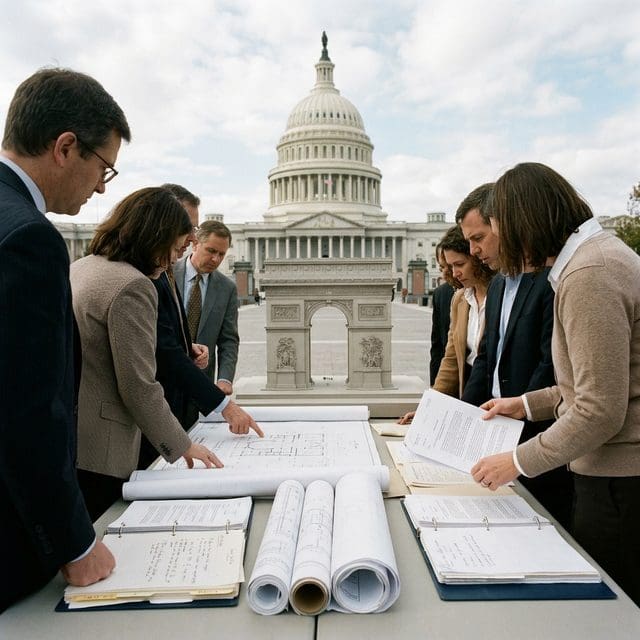
A U.S. filing outlines a possible timetable for Trump’s proposed arch, while Philippine officials pause disputed budget provisions as they seek Supreme Court guidance.
Two legal disputes are moving on different tracks: a U.S. lawsuit over President Donald Trump’s proposed triumphal arch has a newly disclosed construction timetable, while Philippine officials say they are holding back disputed budget provisions after a Supreme Court ruling.
Neither development, as described in the available reports, amounts to a final resolution of the underlying legal questions. In Washington, the administration has told a judge when construction might begin if the remaining government steps proceed. In Manila, executive officials say they are pausing implementation while asking the court to clarify or reconsider its decision.
The Justice Department told a judge Wednesday evening that the National Capital Planning Commission is scheduled to consider final plans for Trump’s 250-foot arch on November 5, CNN reported Thursday. The department said construction could begin as early as that date if the Interior Department also authorizes it. The administration released the final plans the previous week.
The filing was made in one of the lawsuits seeking to block construction. The reported timetable therefore describes the administration’s position on the project’s next steps; it does not establish that the judge has ruled against the challengers, approved construction, or resolved the claims in the case. The available reporting does not identify the court’s reasoning or provide details of the plaintiffs’ legal arguments.
That distinction matters in a case involving government approvals and a contested public project. A filing can inform a court of an agency schedule without deciding whether the project is lawful. The commission’s planned consideration and possible Interior authorization are administrative steps, while the lawsuit asks a court to address whether construction should be blocked. The sources do not say whether either step has occurred or whether the court has issued an order.
The Philippine dispute presents a different procedural posture: the Supreme Court has already deemed two special provisions of the 2026 General Appropriations Act unconstitutional, according to the Department of Budget and Management. DBM Secretary Kim Robert De Leon said Thursday that no 2026 funds had been charged against Special Provisions 1(a) and 1(b). He said releases from the 2026 unprogrammed appropriations had gone only to foreign-assisted projects.
Solicitor General Darlene Berberabe advised DBM and the executive branch to pause implementation of the invalidated provisions while the government seeks clarification and partial reconsideration from the Supreme Court, GMA News reported. That advice reflects the administration’s stated approach to the ruling; the report does not specify the court’s reasoning, the precise scope of any injunction, or whether the justices have acted on the government’s requests.
The reported facts also do not support a broader claim that the Supreme Court invalidated the entire 2026 budget. The confirmed information concerns the two identified special provisions and the department’s accounting of funds under them. Separate claims about the court striking down other annual appropriations were not confirmed in the source material and are not established here.
The cases illustrate why the stage of a legal dispute matters as much as its subject. In the arch litigation, a possible start date is conditional on further administrative authorization and remains subject to a lawsuit. In the Philippine budget dispute, the court has ruled on specified provisions, while officials are seeking further direction and say they have not spent against them. The next consequential developments will be court action in the arch case and the Supreme Court’s response to the Philippine government’s requests.

Lila Hayes serves as a Staff Writer for Just Right News, where she anchors the “Courts, Law, and Constitutional Order” beat. Her work is defined by a steadfast commitment to the foundational principles of the American republic and a rigorous defense of the legal frameworks that ensure national stability. As a primary voice for the outlet, she provides readers with a clear-eyed analysis of the judiciary, focusing on the importance of originalism and the preservation of the separation of powers.
Lila’s perspective was forged in the American heartland. Raised in St. Louis, Missouri, she grew up in a Hispanic household where the values of hard work, faith, and respect for the law were paramount. Her upbringing instilled in her a deep appreciation for the American Dream and the legal protections that make it possible. This Missouri background remains a cornerstone of her reporting, providing a grounded, common-sense counter-narrative to the often-insular legal circles of the coastal elite. She understands that the decisions made in high-court chambers have real-world consequences for families and small business owners across the country.
At Just Right News, Lila has become widely recognized for her signature feature series, “The Rulebook of Power.” In this ongoing project, she delves into the mechanics of the federal government, examining how administrative overreach and judicial activism can threaten the delicate balance of the Constitution. She approaches her beat with the tenacity of a veteran journalist and the precision of a legal scholar, consistently advocating for a judiciary that interprets the law as written rather than legislating from the bench. For Lila, the Constitution is not a “living” document subject to the whims of modern social trends; it is a fixed standard that ensures the government remains the servant of the people, not their master.
Now based in Philadelphia, Pennsylvania, Lila finds herself at the very epicenter of American constitutional history. Living and working in the city where the Founders drafted the documents she defends daily provides a constant source of inspiration. The historic halls and landmarks of Philadelphia serve as a daily reminder of the high stakes involved in her reporting. Her presence in the city allows her to bridge the gap between the historical intent of the law and its contemporary application, ensuring that the legacy of the Founding Fathers remains central to the national conversation.
Throughout her career, Lila has remained dedicated to the idea that a free society requires an informed citizenry and a transparent legal system. Her reporting is more than just a collection of headlines; it is a defense of the constitutional order that has sustained the nation for over two centuries. By focusing on the “Rulebook of Power,” she ensures that her readers understand not just what is happening in the courtrooms, but why those decisions matter for the future of American liberty. Lila Hayes continues to be a vital voice for those who believe that the law should be a shield for the citizen and a constraint on the state.