

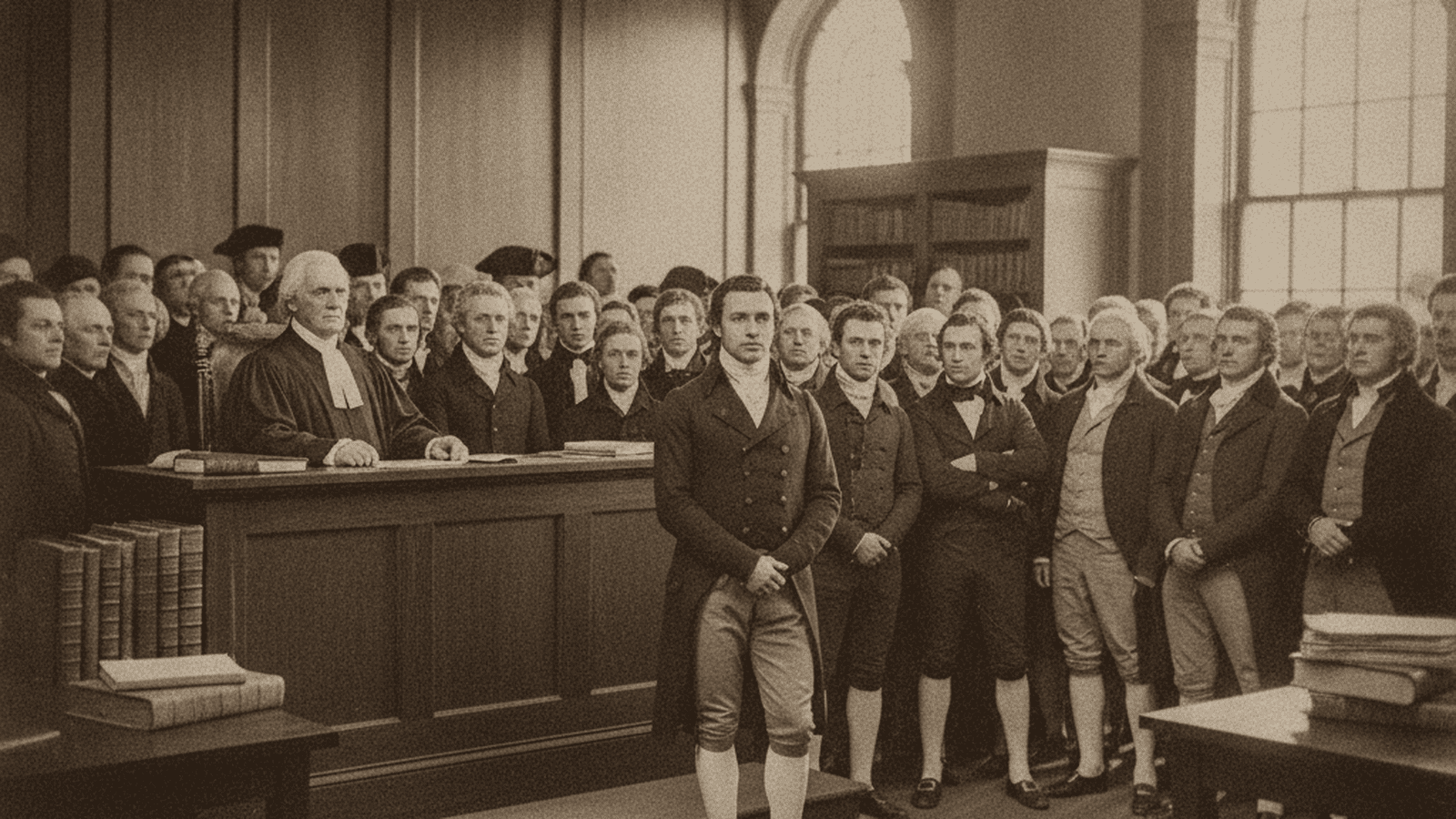
The 1807 treason trial of Aaron Burr established critical precedents for the definition of treason and the limits of executive power in the United States. Presided over by Chief Justice John Marshall, the case resulted in Burr’s acquittal and reinforced the necessity of overt acts for treason convictions.
TLDR: In 1807, former Vice President Aaron Burr faced treason charges for an alleged plot to create a western empire. Chief Justice John Marshall’s ruling required proof of an overt act of war, leading to Burr’s acquittal. The trial solidified the constitutional definition of treason and checked President Jefferson’s executive influence.
In 1807, the United States faced one of its first major constitutional tests when former Vice President Aaron Burr was brought to trial for treason. The proceedings, held in the U.S. Circuit Court in Richmond, Virginia, pitted the executive power of President Thomas Jefferson against the judicial independence of Chief Justice John Marshall. The case arose from allegations that Burr intended to lead a private military expedition to conquer parts of Spanish Mexico or detach the western territories of the United States to form an independent empire. This alleged plot, often referred to as the Burr Conspiracy, threatened the stability of the young nation and its newly acquired Louisiana Purchase.
The crisis began in late 1806 when Jefferson received reports from General James Wilkinson, a Burr associate who secretly served as a double agent for Spain. Wilkinson’s letters claimed a massive criminal enterprise was in progress, prompting Jefferson to issue a proclamation declaring the conspiracy and ordering the arrest of Burr and his followers. Burr was eventually captured in the Mississippi Territory and transported to Virginia for trial. The charges were exceptionally grave, as treason was the only crime specifically defined in the U.S. Constitution to prevent its use as a political weapon.
Chief Justice Marshall presided over the trial, which became a national spectacle of early American politics. Jefferson, convinced of Burr’s guilt, took an active role in the prosecution, providing documents and directing strategy from the White House. This involvement led to a significant legal clash when Burr’s defense team requested a subpoena duces tecum for the President to produce a specific letter from Wilkinson. Marshall granted the request, asserting that the President was not above the law and could be required to provide evidence, though Jefferson largely ignored the subpoena, citing the need for executive independence.
The legal heart of the trial centered on the interpretation of Article III, Section 3 of the Constitution, which states that treason consists only in “levying war” against the United States or “adhering to their enemies.” Marshall’s ruling on the definition of “levying war” proved decisive for the future of American jurisprudence. He argued that for a person to be convicted of treason, there must be an actual assemblage of men for a treasonable purpose and an overt act of war. Marshall emphasized that mere conspiracy or the intention to levy war did not meet the constitutional threshold required for a conviction.
Because the prosecution could not prove that Burr was present at the alleged gathering of armed men on Blennerhassett Island or that an overt act of war had occurred, the jury acquitted him in September 1807. The verdict infuriated Jefferson, who viewed the ruling as a political maneuver by his Federalist rival, Marshall. Despite the President’s public condemnation, the acquittal stood, demonstrating the court’s ability to resist executive pressure. The trial effectively ended Burr’s political career, forcing him into a period of self-imposed exile in Europe.
The Burr trial left a lasting legacy on the American legal system by clarifying the separation of powers and reinforcing the principle that the judiciary serves as a check on executive overreach. Marshall’s narrow construction of treason remains the standard in U.S. law today, ensuring that political dissent or unfulfilled plots are not equated with the highest crime against the state. This precedent has protected countless individuals from politically motivated charges throughout American history. Furthermore, the case highlighted the fragility of the early republic’s western borders and the intense personal rivalries that shaped the nation’s founding era.

Lila Hayes serves as a Staff Writer for Just Right News, where she anchors the “Courts, Law, and Constitutional Order” beat. Her work is defined by a steadfast commitment to the foundational principles of the American republic and a rigorous defense of the legal frameworks that ensure national stability. As a primary voice for the outlet, she provides readers with a clear-eyed analysis of the judiciary, focusing on the importance of originalism and the preservation of the separation of powers.
Lila’s perspective was forged in the American heartland. Raised in St. Louis, Missouri, she grew up in a Hispanic household where the values of hard work, faith, and respect for the law were paramount. Her upbringing instilled in her a deep appreciation for the American Dream and the legal protections that make it possible. This Missouri background remains a cornerstone of her reporting, providing a grounded, common-sense counter-narrative to the often-insular legal circles of the coastal elite. She understands that the decisions made in high-court chambers have real-world consequences for families and small business owners across the country.
At Just Right News, Lila has become widely recognized for her signature feature series, “The Rulebook of Power.” In this ongoing project, she delves into the mechanics of the federal government, examining how administrative overreach and judicial activism can threaten the delicate balance of the Constitution. She approaches her beat with the tenacity of a veteran journalist and the precision of a legal scholar, consistently advocating for a judiciary that interprets the law as written rather than legislating from the bench. For Lila, the Constitution is not a “living” document subject to the whims of modern social trends; it is a fixed standard that ensures the government remains the servant of the people, not their master.
Now based in Philadelphia, Pennsylvania, Lila finds herself at the very epicenter of American constitutional history. Living and working in the city where the Founders drafted the documents she defends daily provides a constant source of inspiration. The historic halls and landmarks of Philadelphia serve as a daily reminder of the high stakes involved in her reporting. Her presence in the city allows her to bridge the gap between the historical intent of the law and its contemporary application, ensuring that the legacy of the Founding Fathers remains central to the national conversation.
Throughout her career, Lila has remained dedicated to the idea that a free society requires an informed citizenry and a transparent legal system. Her reporting is more than just a collection of headlines; it is a defense of the constitutional order that has sustained the nation for over two centuries. By focusing on the “Rulebook of Power,” she ensures that her readers understand not just what is happening in the courtrooms, but why those decisions matter for the future of American liberty. Lila Hayes continues to be a vital voice for those who believe that the law should be a shield for the citizen and a constraint on the state.