

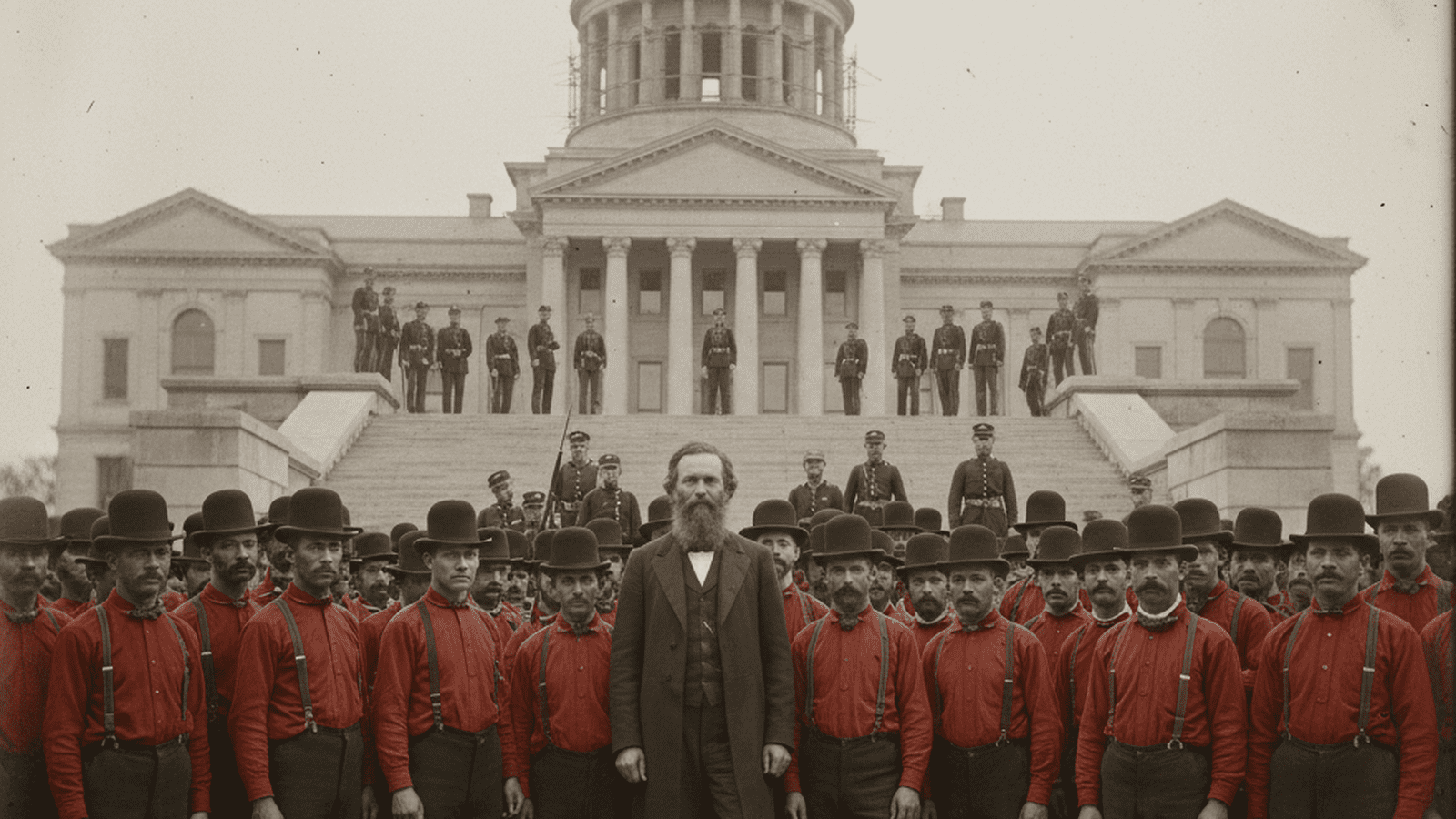
In 1876, South Carolina faced a profound constitutional crisis when both Wade Hampton III and Daniel Henry Chamberlain claimed the governorship. This standoff in the United States led to the simultaneous operation of two rival state legislatures, nearly sparking a renewed civil conflict before federal intervention ceased.
TLDR: Following the disputed 1876 election, South Carolina operated under two competing state governments for months. The crisis ended only after the federal government withdrew troops as part of the Compromise of 1877, effectively ending Reconstruction and allowing the Democratic Redeemers to seize total control of the state.
The 1876 gubernatorial election in South Carolina stands as one of the most volatile and consequential episodes in United States political history. As the nation approached its centennial, the state became the epicenter of a constitutional crisis that threatened to reignite civil warfare. The contest pitted the incumbent Republican Governor Daniel Henry Chamberlain, a New England-born reformer, against the Democratic challenger Wade Hampton III, a former Confederate lieutenant general and one of the wealthiest men in the South. This election was not merely a political race but a struggle for the very soul of the state’s post-war identity.
The campaign was defined by unprecedented levels of violence and fraud. Democratic supporters organized into paramilitary groups known as “Red Shirts,” employing what was called the “Shotgun Policy” to intimidate Black voters and white Republicans. These groups disrupted Republican rallies and patrolled polling places to ensure a Democratic victory. Conversely, Republicans were accused of using their control over the state’s election machinery to manipulate returns. When the votes were tallied, the results were so contested that the state canvassing board took the extraordinary step of throwing out the entire returns from Edgefield and Laurens counties, citing massive irregularities and systemic violence.
This decision gave the Republicans a narrow majority in the state legislature, but the Democrats refused to yield. On November 28, 1876, the conflict reached a fever pitch at the State House in Columbia. Two rival bodies attempted to organize the House of Representatives simultaneously. The Republican faction, known as the “Mackey House” after Speaker Samuel J. Mackey, and the Democratic faction, the “Wallace House” led by William H. Wallace, both occupied the same legislative hall. For four grueling days and nights, the rival legislators lived, ate, and slept on the floor of the chamber, each side refusing to leave for fear of losing their legal claim to the floor. Outside, federal troops stood guard, tasked with maintaining a fragile peace while thousands of armed Hampton supporters gathered in the streets.
By December, the crisis had escalated into a full-scale dual government. Both Chamberlain and Hampton were inaugurated as governor by their respective legislatures. South Carolina effectively functioned with two governors, two sets of laws, and two competing administrative hierarchies. To break the deadlock, Hampton’s supporters launched a campaign of passive resistance. They urged citizens to withhold tax payments from the “illegal” Chamberlain administration and instead contribute to a voluntary fund for the Hampton government. This strategy proved devastatingly effective; the Republican government was starved of revenue, while Hampton’s treasury grew, allowing him to pay state employees and maintain a semblance of authority.
The resolution of this local crisis was ultimately dictated by national politics. The 1876 U.S. presidential election between Rutherford B. Hayes and Samuel Tilden was also in dispute. The resulting Compromise of 1877 settled the presidency for Hayes in exchange for the withdrawal of federal troops from the South. In April 1877, President Hayes followed through, ordering the removal of the soldiers protecting the State House in Columbia. Deprived of federal military support, Chamberlain’s government collapsed almost instantly. On April 11, 1877, Chamberlain surrendered the governor’s office to Hampton, marking the end of the dual-government era.
The aftermath of the 1876 crisis was profound. It signaled the formal end of Reconstruction in South Carolina and the beginning of the “Redeemer” era. The Democratic Party seized total control, eventually implementing the 1895 state constitution which systematically disenfranchised Black citizens and established the legal framework for Jim Crow. This period of constitutional instability remains a stark reminder of the fragility of democratic institutions when faced with deep-seated social division and the withdrawal of federal oversight.

Lila Hayes serves as a Staff Writer for Just Right News, where she anchors the “Courts, Law, and Constitutional Order” beat. Her work is defined by a steadfast commitment to the foundational principles of the American republic and a rigorous defense of the legal frameworks that ensure national stability. As a primary voice for the outlet, she provides readers with a clear-eyed analysis of the judiciary, focusing on the importance of originalism and the preservation of the separation of powers.
Lila’s perspective was forged in the American heartland. Raised in St. Louis, Missouri, she grew up in a Hispanic household where the values of hard work, faith, and respect for the law were paramount. Her upbringing instilled in her a deep appreciation for the American Dream and the legal protections that make it possible. This Missouri background remains a cornerstone of her reporting, providing a grounded, common-sense counter-narrative to the often-insular legal circles of the coastal elite. She understands that the decisions made in high-court chambers have real-world consequences for families and small business owners across the country.
At Just Right News, Lila has become widely recognized for her signature feature series, “The Rulebook of Power.” In this ongoing project, she delves into the mechanics of the federal government, examining how administrative overreach and judicial activism can threaten the delicate balance of the Constitution. She approaches her beat with the tenacity of a veteran journalist and the precision of a legal scholar, consistently advocating for a judiciary that interprets the law as written rather than legislating from the bench. For Lila, the Constitution is not a “living” document subject to the whims of modern social trends; it is a fixed standard that ensures the government remains the servant of the people, not their master.
Now based in Philadelphia, Pennsylvania, Lila finds herself at the very epicenter of American constitutional history. Living and working in the city where the Founders drafted the documents she defends daily provides a constant source of inspiration. The historic halls and landmarks of Philadelphia serve as a daily reminder of the high stakes involved in her reporting. Her presence in the city allows her to bridge the gap between the historical intent of the law and its contemporary application, ensuring that the legacy of the Founding Fathers remains central to the national conversation.
Throughout her career, Lila has remained dedicated to the idea that a free society requires an informed citizenry and a transparent legal system. Her reporting is more than just a collection of headlines; it is a defense of the constitutional order that has sustained the nation for over two centuries. By focusing on the “Rulebook of Power,” she ensures that her readers understand not just what is happening in the courtrooms, but why those decisions matter for the future of American liberty. Lila Hayes continues to be a vital voice for those who believe that the law should be a shield for the citizen and a constraint on the state.