

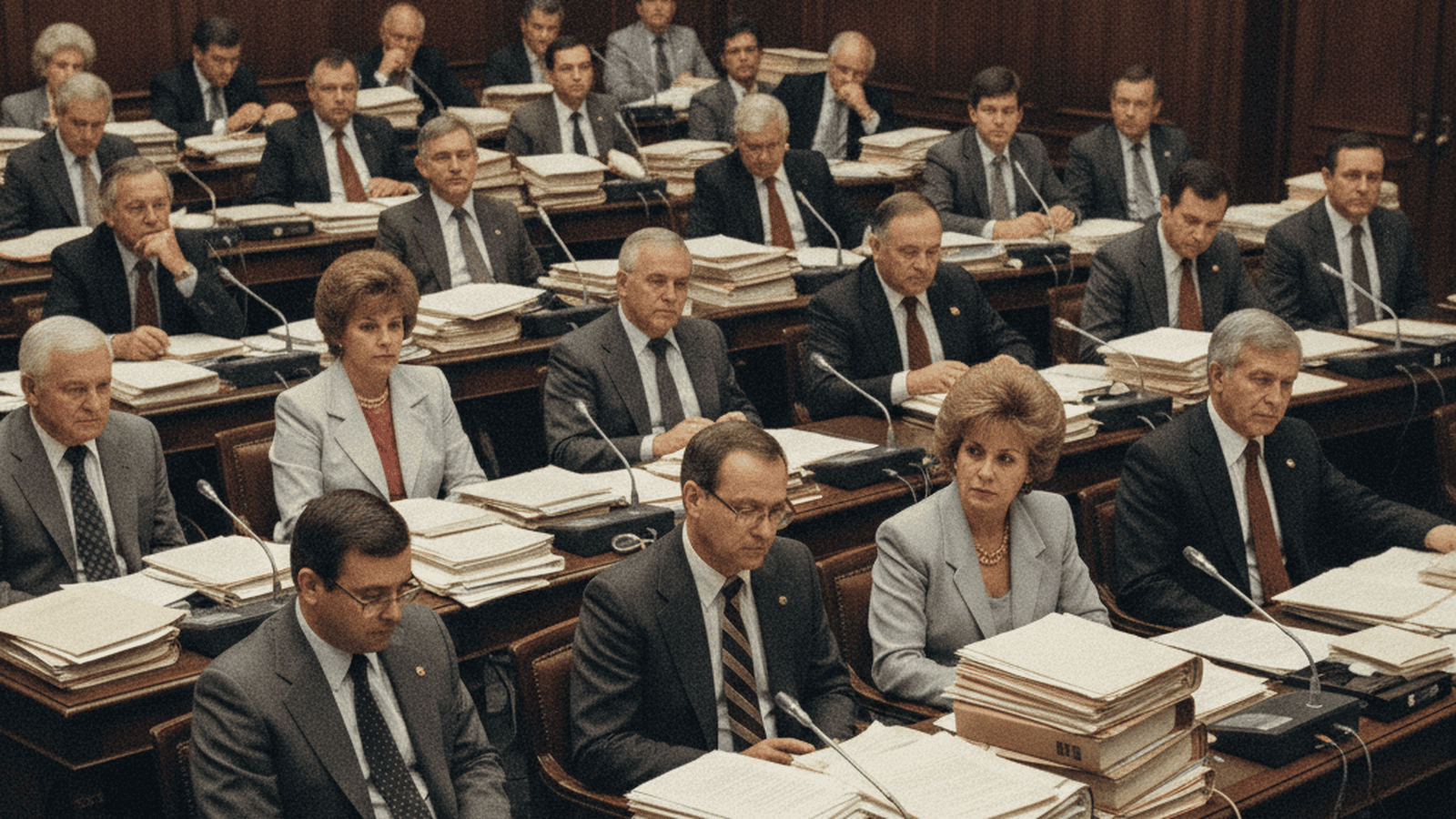
In 1988, Arizona faced a significant constitutional crisis when Governor Evan Mecham became the first governor in the United States to be removed from office via impeachment in nearly sixty years. The proceedings tested the state’s legal framework and resulted in the elevation of Secretary of State Rose Mofford to the governorship.
TLDR: In 1988, Arizona Governor Evan Mecham was impeached and removed from office following allegations of financial misconduct and obstruction of justice. This landmark event marked the first time an Arizona governor was removed via impeachment, triggering a transition of power to Rose Mofford and reshaping state ethics laws.
In early 1988, the state of Arizona entered a period of unprecedented political and legal turmoil that tested the durability of its constitution. Governor Evan Mecham, a conservative Republican and former car dealer who had won a three-way race in 1986 with only 40 percent of the vote, faced a mounting series of scandals that culminated in his impeachment and removal from office. This event marked the first time in Arizona history that a chief executive was forcibly removed through the legislative process, creating a significant constitutional precedent for the Mountain West region and the United States.
The crisis began to accelerate in January 1988 when a grand jury indicted Mecham on six felony counts related to perjury and fraud. The charges centered on a concealed $350,000 loan from a local developer to his campaign, which Mecham had failed to report as required by state law. This legal pressure coincided with a massive grassroots “Recall Mecham” movement, which had successfully gathered more than 300,000 signatures—far more than the number required to force a new election. The state was effectively paralyzed as the governor fought battles on three fronts: the criminal courts, the legislature, and the court of public opinion.
Simultaneously, allegations surfaced that the governor had obstructed justice by attempting to prevent an investigation into a death threat made by one of his aides against a government official. As the criminal proceedings loomed, the Arizona House of Representatives initiated an impeachment inquiry led by special counsel. On February 8, 1988, the House voted 46-14 to impeach Mecham on three counts: obstruction of justice, filing a false campaign contribution report, and the unauthorized use of state funds. Under the Arizona Constitution, the act of impeachment by the House automatically suspended Mecham from his duties, elevating Secretary of State Rose Mofford to the position of acting governor.
The subsequent trial in the Arizona Senate was a somber and highly publicized affair that gripped the nation. For weeks, senators heard testimony regarding the governor’s financial dealings and his administration’s internal conduct. Mecham’s defense argued that the charges were politically motivated and did not meet the “high crimes and misdemeanors” standard required for removal. They contended that the loan was a private matter and that the obstruction charges were based on hearsay. However, the evidence of the concealed loan and the interference with the Attorney General’s investigation proved decisive for many legislators who felt the governor had compromised the integrity of his office.
On April 4, 1988, the Senate convicted Mecham on two of the three counts. The vote on the obstruction of justice charge was 21-9, while the count regarding the concealed loan passed 26-4. With these votes, Mecham was officially removed from office, and Rose Mofford was sworn in as the state’s first female governor. Although Mecham was later acquitted of the criminal charges in a separate jury trial, the impeachment remained a final and binding political judgment. The state supreme court later ruled that the scheduled recall election was moot because the office was no longer held by the person being recalled.
The Mecham crisis prompted significant changes in Arizona’s political infrastructure and electoral laws. In the years following the removal, the state legislature passed stricter campaign finance disclosure laws and ethics regulations to prevent similar financial opacity. Arizona also eventually moved to a runoff system for gubernatorial elections to ensure winners held a majority of the vote, though this was later repealed. The event remains a landmark case study in the use of legislative oversight to address executive misconduct, highlighting the tension between popular mandates and constitutional accountability.

Lila Hayes serves as a Staff Writer for Just Right News, where she anchors the “Courts, Law, and Constitutional Order” beat. Her work is defined by a steadfast commitment to the foundational principles of the American republic and a rigorous defense of the legal frameworks that ensure national stability. As a primary voice for the outlet, she provides readers with a clear-eyed analysis of the judiciary, focusing on the importance of originalism and the preservation of the separation of powers.
Lila’s perspective was forged in the American heartland. Raised in St. Louis, Missouri, she grew up in a Hispanic household where the values of hard work, faith, and respect for the law were paramount. Her upbringing instilled in her a deep appreciation for the American Dream and the legal protections that make it possible. This Missouri background remains a cornerstone of her reporting, providing a grounded, common-sense counter-narrative to the often-insular legal circles of the coastal elite. She understands that the decisions made in high-court chambers have real-world consequences for families and small business owners across the country.
At Just Right News, Lila has become widely recognized for her signature feature series, “The Rulebook of Power.” In this ongoing project, she delves into the mechanics of the federal government, examining how administrative overreach and judicial activism can threaten the delicate balance of the Constitution. She approaches her beat with the tenacity of a veteran journalist and the precision of a legal scholar, consistently advocating for a judiciary that interprets the law as written rather than legislating from the bench. For Lila, the Constitution is not a “living” document subject to the whims of modern social trends; it is a fixed standard that ensures the government remains the servant of the people, not their master.
Now based in Philadelphia, Pennsylvania, Lila finds herself at the very epicenter of American constitutional history. Living and working in the city where the Founders drafted the documents she defends daily provides a constant source of inspiration. The historic halls and landmarks of Philadelphia serve as a daily reminder of the high stakes involved in her reporting. Her presence in the city allows her to bridge the gap between the historical intent of the law and its contemporary application, ensuring that the legacy of the Founding Fathers remains central to the national conversation.
Throughout her career, Lila has remained dedicated to the idea that a free society requires an informed citizenry and a transparent legal system. Her reporting is more than just a collection of headlines; it is a defense of the constitutional order that has sustained the nation for over two centuries. By focusing on the “Rulebook of Power,” she ensures that her readers understand not just what is happening in the courtrooms, but why those decisions matter for the future of American liberty. Lila Hayes continues to be a vital voice for those who believe that the law should be a shield for the citizen and a constraint on the state.