

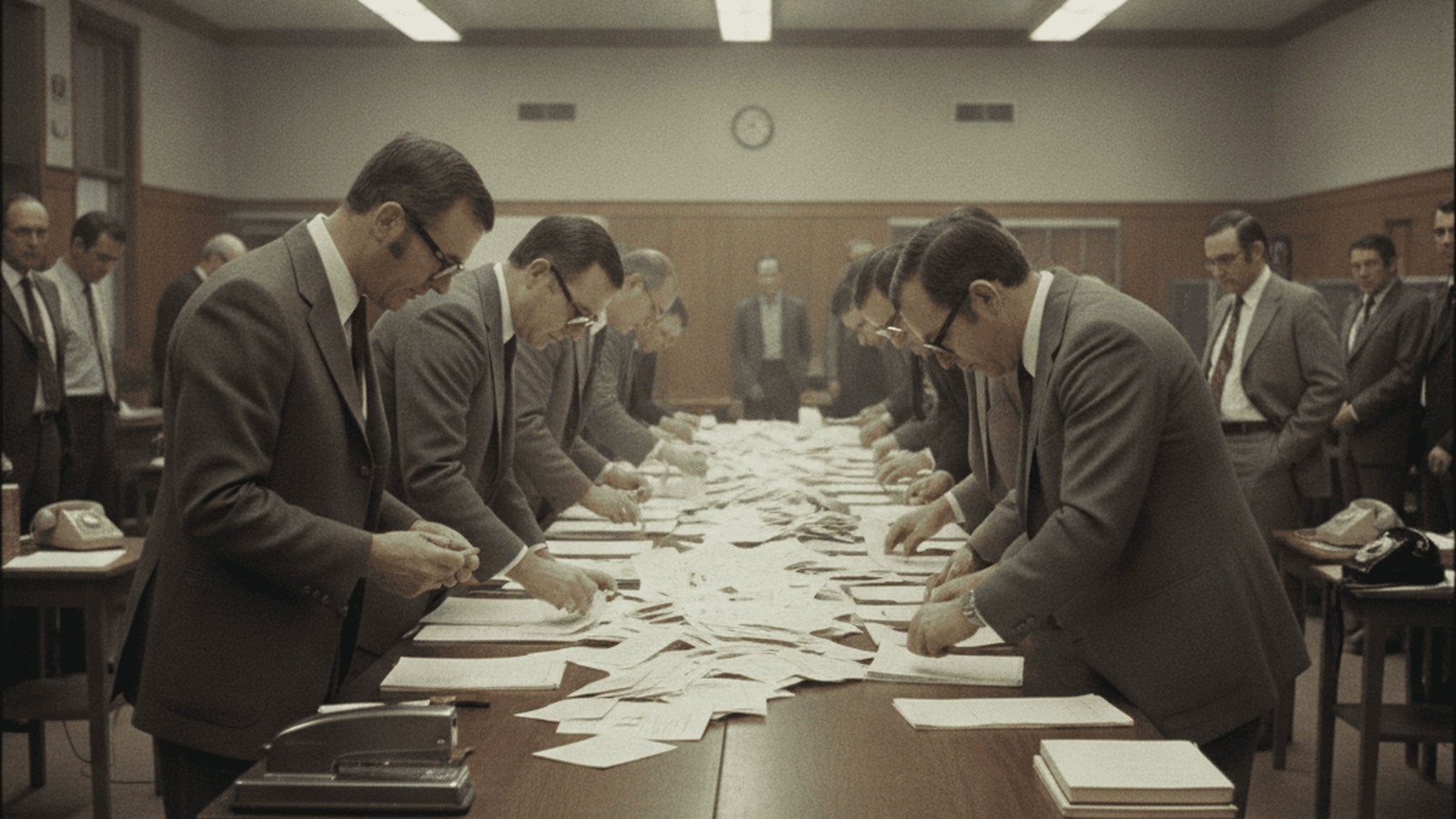
The 1975 New Hampshire Senate election dispute between Louis Wyman and John Durkin created a months-long constitutional crisis over the U.S. Senate’s power to judge its own elections. The vacancy lasted until a special election was held, marking a significant moment in United States electoral history.
TLDR: Following a razor-thin 1974 margin, the New Hampshire Senate seat remained vacant for seven months as the U.S. Senate deadlocked over conflicting recount results. The crisis tested constitutional boundaries regarding federal oversight of state elections, eventually requiring a special election to resolve the unprecedented partisan stalemate.
The 1974 midterm elections in the United States were held under the long shadow of the Watergate scandal and the resignation of Richard Nixon. This political climate created a volatile environment for Republicans, who faced significant losses across the country. In New Hampshire, the race for the United States Senate seat vacated by retiring Republican Norris Cotton became the epicenter of a national political storm. The contest pitted Republican Congressman Louis Wyman, a seasoned politician, against Democratic challenger John Durkin, a former state insurance commissioner. The initial results were incredibly close, with the first tally showing Wyman winning by a razor-thin margin of 355 votes.
Durkin immediately exercised his right to a recount. This initial state-level recount flipped the results, placing Durkin ahead by a mere 10 votes. The see-saw nature of the results continued when Wyman appealed to the New Hampshire Ballot Law Commission. After a meticulous review of disputed ballots, the commission reversed the outcome once again, declaring Wyman the victor by just two votes. Governor Meldrim Thomson subsequently certified Wyman’s victory, but the battle was far from over. Durkin petitioned the U.S. Senate to intervene, invoking Article I, Section 5 of the Constitution, which states that each House shall be the “Judge of the Elections, Returns and Qualifications of its own Members.”
When the 94th Congress convened in January 1975, the Senate was thrust into a constitutional crisis. The Republican minority argued that the Senate was bound to honor the official certification provided by the Governor of New Hampshire. Conversely, the Democratic majority, holding a significant numerical advantage, insisted that the Senate had a constitutional duty to conduct its own independent investigation into the disputed ballots. Rather than seating either man, the Senate voted to refer the matter to the Committee on Rules and Administration. This decision effectively left New Hampshire with only one senator, creating a vacancy that would persist for seven months.
The Senate Rules Committee spent months reviewing over 3,500 individual ballots that had been challenged during the various state-level recounts. The process was agonizingly slow and deeply partisan. Senators and staff spent hours debating the intent of voters based on ambiguous marks—whether a checkmark instead of a cross constituted a valid vote, or how to interpret stray marks on a page. By June 1975, the matter reached the full Senate floor. The ensuing debate lasted for six weeks and featured an unprecedented 41 roll-call votes. Despite the exhaustive effort, the chamber remained deadlocked.
The stalemate highlighted a fundamental tension in the American federal system. Republicans utilized the filibuster to prevent the Democratic majority from seating Durkin, arguing that doing so would be a partisan power grab that ignored state sovereignty. Democrats, meanwhile, lacked the two-thirds majority required to invoke cloture and end the debate. The functional crisis left the citizens of New Hampshire without full representation during a period of economic instability and international tension.
In July 1975, John Durkin took the initiative to break the impasse by requesting a new special election. Louis Wyman, recognizing that the Senate was unlikely to ever reach a consensus and sensing the public’s frustration with the delay, agreed to the proposal. The Senate subsequently declared the seat vacant, and New Hampshire held a special election in September 1975. This time, the result was unambiguous; Durkin won the second contest by a decisive margin of approximately 27,000 votes. His victory finally ended the longest contested election vacancy in the history of the U.S. Senate. The 1975 crisis remains a landmark case in election law, demonstrating the potential for partisan gridlock to paralyze constitutional processes and leading to more robust standards for ballot auditing and election certification.

Lila Hayes serves as a Staff Writer for Just Right News, where she anchors the “Courts, Law, and Constitutional Order” beat. Her work is defined by a steadfast commitment to the foundational principles of the American republic and a rigorous defense of the legal frameworks that ensure national stability. As a primary voice for the outlet, she provides readers with a clear-eyed analysis of the judiciary, focusing on the importance of originalism and the preservation of the separation of powers.
Lila’s perspective was forged in the American heartland. Raised in St. Louis, Missouri, she grew up in a Hispanic household where the values of hard work, faith, and respect for the law were paramount. Her upbringing instilled in her a deep appreciation for the American Dream and the legal protections that make it possible. This Missouri background remains a cornerstone of her reporting, providing a grounded, common-sense counter-narrative to the often-insular legal circles of the coastal elite. She understands that the decisions made in high-court chambers have real-world consequences for families and small business owners across the country.
At Just Right News, Lila has become widely recognized for her signature feature series, “The Rulebook of Power.” In this ongoing project, she delves into the mechanics of the federal government, examining how administrative overreach and judicial activism can threaten the delicate balance of the Constitution. She approaches her beat with the tenacity of a veteran journalist and the precision of a legal scholar, consistently advocating for a judiciary that interprets the law as written rather than legislating from the bench. For Lila, the Constitution is not a “living” document subject to the whims of modern social trends; it is a fixed standard that ensures the government remains the servant of the people, not their master.
Now based in Philadelphia, Pennsylvania, Lila finds herself at the very epicenter of American constitutional history. Living and working in the city where the Founders drafted the documents she defends daily provides a constant source of inspiration. The historic halls and landmarks of Philadelphia serve as a daily reminder of the high stakes involved in her reporting. Her presence in the city allows her to bridge the gap between the historical intent of the law and its contemporary application, ensuring that the legacy of the Founding Fathers remains central to the national conversation.
Throughout her career, Lila has remained dedicated to the idea that a free society requires an informed citizenry and a transparent legal system. Her reporting is more than just a collection of headlines; it is a defense of the constitutional order that has sustained the nation for over two centuries. By focusing on the “Rulebook of Power,” she ensures that her readers understand not just what is happening in the courtrooms, but why those decisions matter for the future of American liberty. Lila Hayes continues to be a vital voice for those who believe that the law should be a shield for the citizen and a constraint on the state.