

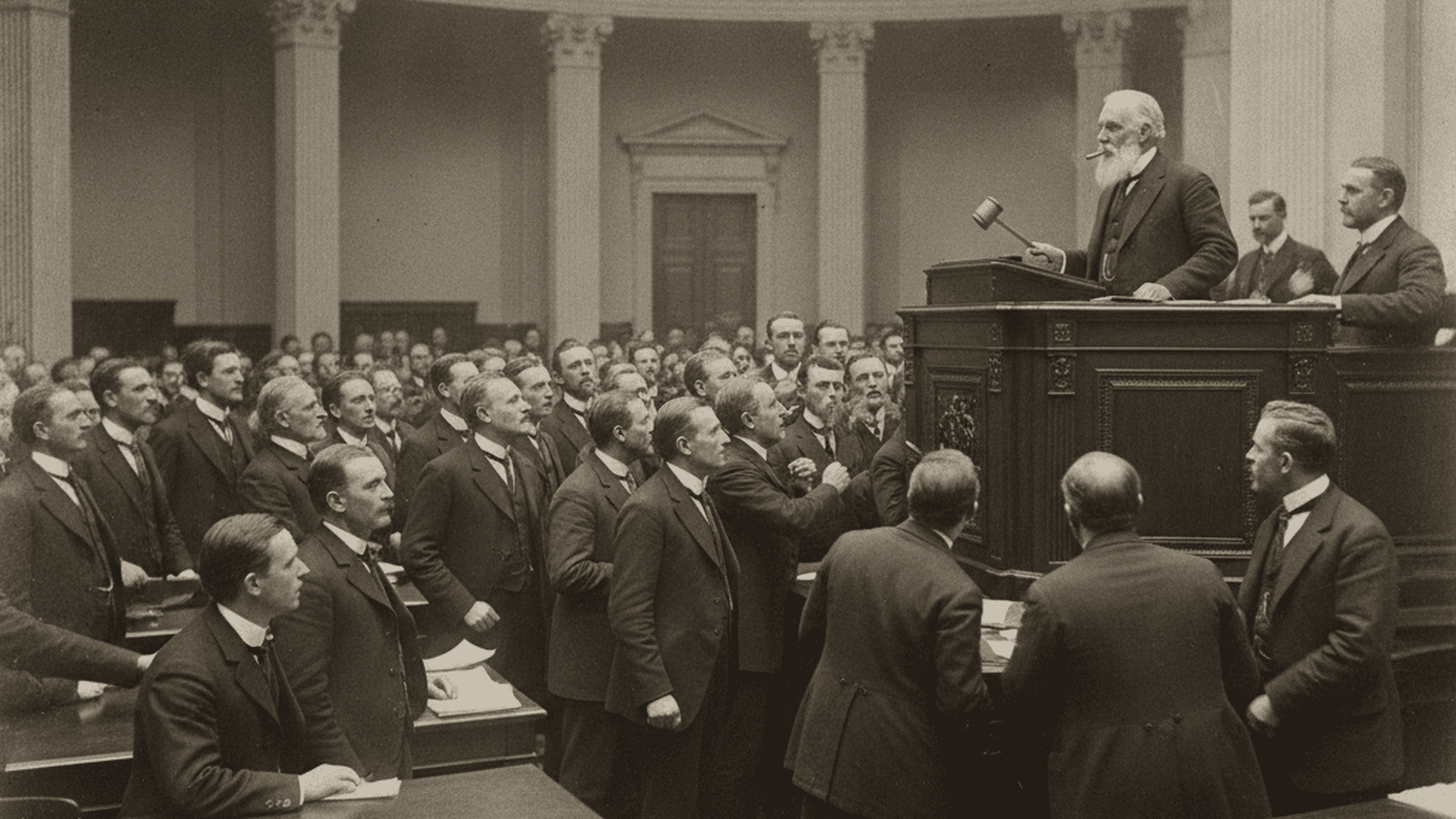
In 1910, a coalition of Progressive Republicans and Democrats staged a legislative revolt against Speaker of the House Joseph Gurney Cannon in Washington, D.C. This constitutional crisis over the concentration of legislative power resulted in a fundamental restructuring of House rules, stripping the Speaker of the authority to appoint committees and chair the Rules Committee in the United States.
TLDR: In March 1910, the U.S. House of Representatives underwent a “parliamentary revolution” to end the autocratic rule of Speaker Joseph Cannon. Led by George Norris, a bipartisan coalition stripped the Speaker of his seat on the Rules Committee, decentralizing power and permanently altering the governance of the United States legislative branch.
The early 20th century in Washington, D.C., was defined by a growing tension between traditional party machines and the rising tide of the Progressive movement. At the center of this friction stood Joseph Gurney Cannon, the Republican Speaker of the House from Illinois. Known as “Uncle Joe,” Cannon exercised a level of control over the legislative process that critics described as “Cannonism.” By 1910, this concentration of power triggered a constitutional crisis that fundamentally reshaped the internal mechanics of the United States House of Representatives.
Under the rules of the time, the Speaker held three primary levers of control. First, he appointed the chairs and members of all standing committees, allowing him to reward loyalty and punish dissent. Second, he served as the chairman of the powerful Rules Committee, which determined which bills reached the floor for a vote. Third, he possessed the absolute power of recognition, meaning no member could speak or introduce a motion without his prior approval. This system effectively turned the House into a top-down autocracy where the Speaker’s personal preferences dictated national policy.
The breaking point arrived in March 1910. A group of approximately 40 “Insurgent” Republicans, led by Representative George Norris of Nebraska, sought to break the Speaker’s grip. These Progressives felt that Cannon was blocking essential reforms related to labor, conservation, and corporate regulation. They found natural allies in the Democratic minority, who were eager to weaken the Republican leadership ahead of the midterm elections.
On March 17, 1910, taking advantage of a thin Republican presence on the floor during St. Patrick’s Day celebrations, Norris introduced a resolution. He called for a reorganization of the Rules Committee, proposing that it be expanded and that the Speaker be excluded from its membership. Norris argued that the resolution was a matter of high constitutional privilege, which would allow it to bypass the very committee it sought to reform.
Cannon, a master of parliamentary procedure, immediately realized the threat. He refused to rule on the resolution’s admissibility, initiating a marathon session that lasted through the night. For twenty-six hours, members slept on benches and in cloakrooms while the Speaker waited for his loyalists to return to the city. The atmosphere in the chamber was electric, marked by shouting matches and intense negotiations in the hallways of the Capitol.
When the vote finally occurred on March 19, the coalition of Democrats and Insurgent Republicans held firm. The resolution passed 191 to 156. In a final act of defiance, Cannon invited a motion to vacate the chair, effectively daring the House to remove him from office entirely. However, the Insurgents, having achieved their goal of structural reform, declined to oust him, preferring to keep a weakened Cannon as a figurehead rather than risk a new leadership struggle.
The aftermath of the 1910 revolt was transformative for the United States legislative branch. The Speaker was stripped of the power to appoint committees, and the Rules Committee became an elective body. This shift decentralized authority, empowering committee chairs and giving individual members more influence over the legislative agenda. While it ended the era of the “Czar” Speakers, it also led to the rise of the seniority system, which would dominate House politics for the next sixty years.
The legacy of the revolt against Cannonism remains a cornerstone of American institutional history. It demonstrated that the internal rules of Congress are as vital to the functioning of democracy as the Constitution itself. Later reforms in the 1970s would further refine these power dynamics, but the 1910 crisis established the precedent that no single individual should hold absolute gatekeeping authority over the people’s representatives.

Lila Hayes serves as a Staff Writer for Just Right News, where she anchors the “Courts, Law, and Constitutional Order” beat. Her work is defined by a steadfast commitment to the foundational principles of the American republic and a rigorous defense of the legal frameworks that ensure national stability. As a primary voice for the outlet, she provides readers with a clear-eyed analysis of the judiciary, focusing on the importance of originalism and the preservation of the separation of powers.
Lila’s perspective was forged in the American heartland. Raised in St. Louis, Missouri, she grew up in a Hispanic household where the values of hard work, faith, and respect for the law were paramount. Her upbringing instilled in her a deep appreciation for the American Dream and the legal protections that make it possible. This Missouri background remains a cornerstone of her reporting, providing a grounded, common-sense counter-narrative to the often-insular legal circles of the coastal elite. She understands that the decisions made in high-court chambers have real-world consequences for families and small business owners across the country.
At Just Right News, Lila has become widely recognized for her signature feature series, “The Rulebook of Power.” In this ongoing project, she delves into the mechanics of the federal government, examining how administrative overreach and judicial activism can threaten the delicate balance of the Constitution. She approaches her beat with the tenacity of a veteran journalist and the precision of a legal scholar, consistently advocating for a judiciary that interprets the law as written rather than legislating from the bench. For Lila, the Constitution is not a “living” document subject to the whims of modern social trends; it is a fixed standard that ensures the government remains the servant of the people, not their master.
Now based in Philadelphia, Pennsylvania, Lila finds herself at the very epicenter of American constitutional history. Living and working in the city where the Founders drafted the documents she defends daily provides a constant source of inspiration. The historic halls and landmarks of Philadelphia serve as a daily reminder of the high stakes involved in her reporting. Her presence in the city allows her to bridge the gap between the historical intent of the law and its contemporary application, ensuring that the legacy of the Founding Fathers remains central to the national conversation.
Throughout her career, Lila has remained dedicated to the idea that a free society requires an informed citizenry and a transparent legal system. Her reporting is more than just a collection of headlines; it is a defense of the constitutional order that has sustained the nation for over two centuries. By focusing on the “Rulebook of Power,” she ensures that her readers understand not just what is happening in the courtrooms, but why those decisions matter for the future of American liberty. Lila Hayes continues to be a vital voice for those who believe that the law should be a shield for the citizen and a constraint on the state.