

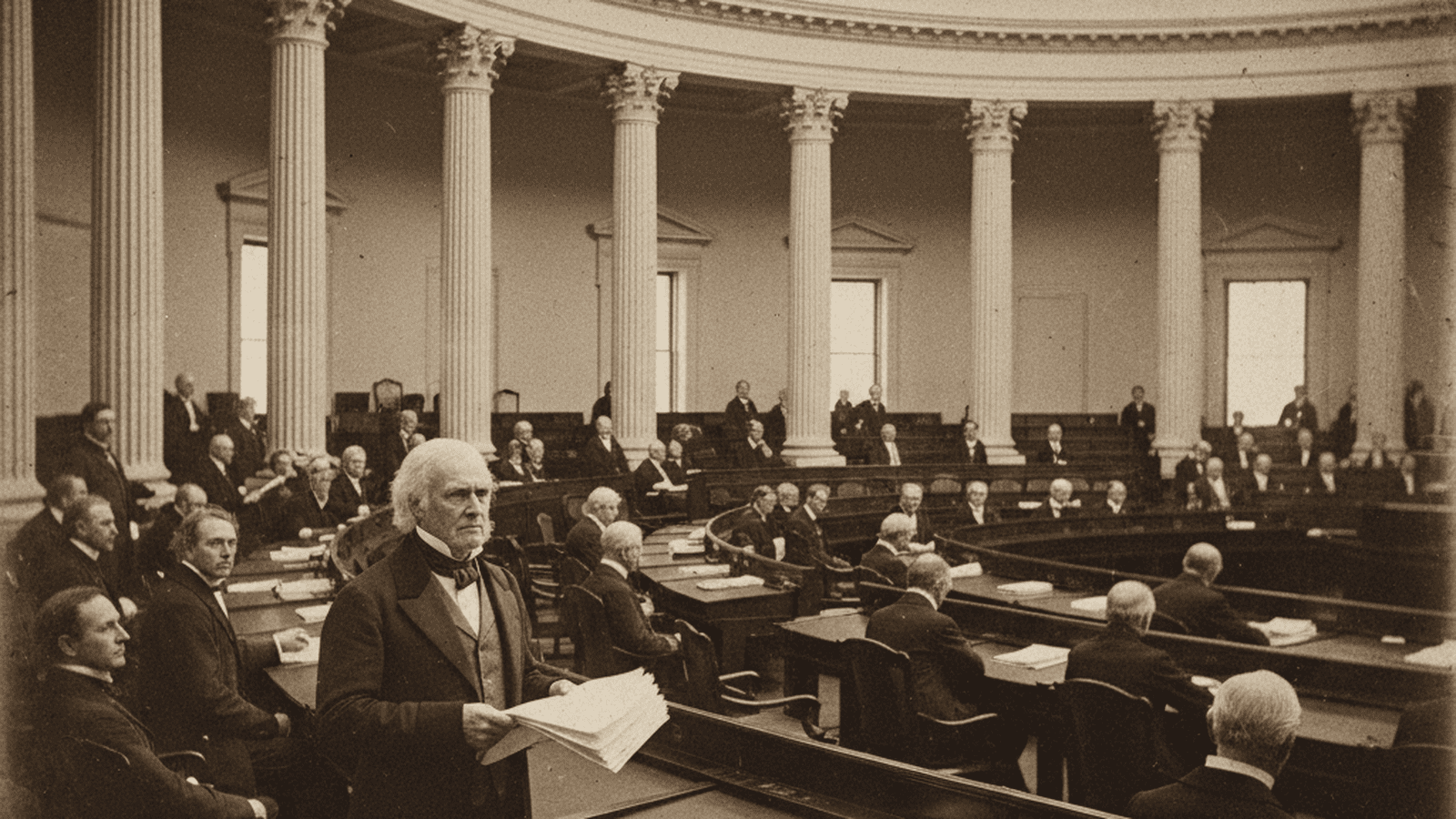
In 1836, the United States House of Representatives adopted the “Gag Rule” to automatically table all anti-slavery petitions without discussion. This procedural maneuver, championed by Southern legislators, sparked a decade-long constitutional battle led by John Quincy Adams over the First Amendment right to petition the government.
TLDR: From 1836 to 1844, the U.S. House of Representatives enforced the “Gag Rule,” a series of resolutions that prevented the reading or consideration of anti-slavery petitions. Led by John Quincy Adams, opponents argued the rule violated the First Amendment, eventually securing its repeal as sectional tensions intensified.
In the mid-1830s, the United States Capitol became the epicenter of a fierce constitutional struggle that pitted the procedural power of Congress against the fundamental right of citizens to petition their government. As the abolitionist movement gained momentum in the North, thousands of petitions calling for the end of slavery and the slave trade in the District of Columbia began flooding the House of Representatives. These documents, often signed by women and religious groups, presented a direct challenge to the political stability of a legislature deeply divided by sectional interests.
Southern representatives viewed these petitions as an existential threat to their social and economic order. They argued that the mere discussion of abolition on the House floor was an inflammatory act that could incite slave rebellions. In early 1836, Representative Henry L. Pinckney of South Carolina proposed a series of resolutions designed to suppress the debate. The most controversial of these, which became known as the “Gag Rule,” mandated that all petitions relating to slavery be laid upon the table without being printed, referred to committee, or even read.
The adoption of the Gag Rule on May 26, 1836, transformed the nature of the anti-slavery struggle. It shifted the focus from the morality of slavery itself to the preservation of civil liberties for white citizens. Abolitionists argued that if the government could silence petitions regarding slavery, it could eventually silence any grievance. This tactical shift allowed the movement to broaden its appeal, framing the Gag Rule as an assault on the First Amendment rights of all Americans.
Former President John Quincy Adams, then serving as a representative from Massachusetts, emerged as the primary antagonist of the rule. Known as “Old Man Eloquent,” Adams utilized his deep knowledge of parliamentary procedure to harass the pro-slavery majority. He frequently rose to present petitions that he claimed were not covered by the rule, such as a petition from “twenty-two slaves” or petitions from citizens of foreign countries. His persistent defiance often brought the House to the brink of chaos, leading to several unsuccessful attempts by Southern members to censure him.
The Gag Rule was not a single permanent law but a series of resolutions that had to be renewed at the start of each new session. Over time, the political cost of maintaining the rule increased. Northern Whigs and even some Northern Democrats began to see the rule as a liability. They realized that the suppression of debate was only serving to radicalize Northern public opinion and strengthen the abolitionist cause. The rule was eventually made a standing rule of the House in 1840, but the margin of support continued to dwindle as sectional tensions over westward expansion and the annexation of Texas grew.
By 1844, the political landscape had shifted sufficiently to allow for a successful challenge. On December 3, 1844, the House voted 108 to 80 to rescind the Gag Rule. The repeal marked a significant victory for the right of petition and signaled a growing unwillingness among Northern legislators to accommodate Southern demands for silence on the issue of slavery. While the repeal did not lead to immediate legislative action against slavery, it ensured that the “peculiar institution” would remain a central, unavoidable topic of national debate.
The legacy of the Gag Rule remains a cautionary tale in American political history regarding the dangers of using procedural maneuvers to suppress unpopular or controversial speech. It demonstrated that attempts to stifle political discourse often result in the amplification of the very ideas being suppressed. Modern congressional rules regarding the reception of petitions and the management of floor debate continue to reflect the lessons learned during this antebellum crisis, emphasizing the necessity of maintaining open channels between the citizenry and their elected representatives.

Lila Hayes serves as a Staff Writer for Just Right News, where she anchors the “Courts, Law, and Constitutional Order” beat. Her work is defined by a steadfast commitment to the foundational principles of the American republic and a rigorous defense of the legal frameworks that ensure national stability. As a primary voice for the outlet, she provides readers with a clear-eyed analysis of the judiciary, focusing on the importance of originalism and the preservation of the separation of powers.
Lila’s perspective was forged in the American heartland. Raised in St. Louis, Missouri, she grew up in a Hispanic household where the values of hard work, faith, and respect for the law were paramount. Her upbringing instilled in her a deep appreciation for the American Dream and the legal protections that make it possible. This Missouri background remains a cornerstone of her reporting, providing a grounded, common-sense counter-narrative to the often-insular legal circles of the coastal elite. She understands that the decisions made in high-court chambers have real-world consequences for families and small business owners across the country.
At Just Right News, Lila has become widely recognized for her signature feature series, “The Rulebook of Power.” In this ongoing project, she delves into the mechanics of the federal government, examining how administrative overreach and judicial activism can threaten the delicate balance of the Constitution. She approaches her beat with the tenacity of a veteran journalist and the precision of a legal scholar, consistently advocating for a judiciary that interprets the law as written rather than legislating from the bench. For Lila, the Constitution is not a “living” document subject to the whims of modern social trends; it is a fixed standard that ensures the government remains the servant of the people, not their master.
Now based in Philadelphia, Pennsylvania, Lila finds herself at the very epicenter of American constitutional history. Living and working in the city where the Founders drafted the documents she defends daily provides a constant source of inspiration. The historic halls and landmarks of Philadelphia serve as a daily reminder of the high stakes involved in her reporting. Her presence in the city allows her to bridge the gap between the historical intent of the law and its contemporary application, ensuring that the legacy of the Founding Fathers remains central to the national conversation.
Throughout her career, Lila has remained dedicated to the idea that a free society requires an informed citizenry and a transparent legal system. Her reporting is more than just a collection of headlines; it is a defense of the constitutional order that has sustained the nation for over two centuries. By focusing on the “Rulebook of Power,” she ensures that her readers understand not just what is happening in the courtrooms, but why those decisions matter for the future of American liberty. Lila Hayes continues to be a vital voice for those who believe that the law should be a shield for the citizen and a constraint on the state.