

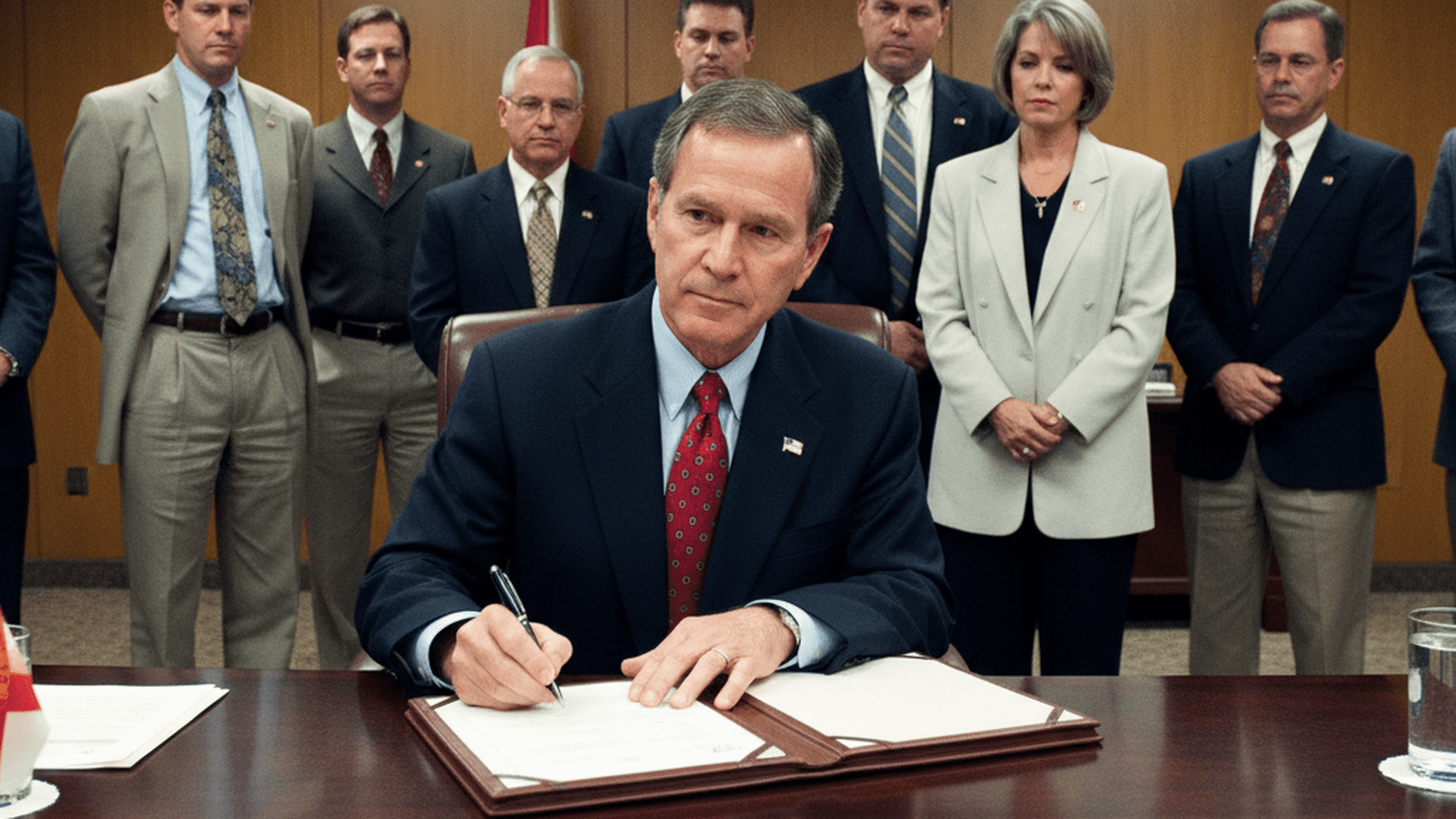
In 2003, Florida Governor Jeb Bush signed “Terri’s Law,” an executive intervention designed to override a court order regarding the medical treatment of Terri Schiavo. This event sparked a major constitutional crisis in the United States over the separation of powers between the executive and judicial branches.
TLDR: In 2003, Florida Governor Jeb Bush exercised unprecedented executive power by signing “Terri’s Law” to override a judicial order in the Terri Schiavo case. The move triggered a national debate on the separation of powers, eventually leading the Florida Supreme Court to strike down the law as an unconstitutional executive encroachment.
In October 2003, the state of Florida became the epicenter of a profound constitutional confrontation that tested the boundaries of executive power in the United States. The controversy centered on Terri Schiavo, a woman who had been in a persistent vegetative state for over a decade. After years of exhaustive litigation, a Florida circuit court had authorized the removal of her life-sustaining feeding tube, concluding that she would not have wished to be kept alive in such a condition. However, the decision sparked an unprecedented intervention by the Florida executive and legislative branches, leading to the passage of House Bill 35-E, commonly known as “Terri’s Law.”
The legislative maneuver was remarkably swift. On October 21, 2003, just six days after the feeding tube had been removed, the Florida Legislature convened in a special session to grant Governor Jeb Bush the authority to intervene. The resulting statute was narrowly tailored, applying only to patients who were in a persistent vegetative state, had no written advance directive, and whose nutrition and hydration had been ordered withheld by a court. Within hours of the bill’s passage, Governor Bush signed it into law and issued Executive Order 03-201, which mandated the immediate reinsertion of Schiavo’s feeding tube.
This exercise of executive authority was framed by supporters as a necessary protection of the right to life and a check against “judicial activism.” Governor Bush argued that the state had a duty to protect vulnerable citizens and that the executive branch possessed the moral and legal standing to pause judicial orders in extraordinary circumstances. Conversely, legal experts and civil libertarians viewed the move as a dangerous breach of the separation of powers. They argued that the Governor was effectively acting as a one-man appellate court, nullifying a final judicial determination that had been reached after years of evidentiary hearings and appeals.
The legal challenge to “Terri’s Law” moved quickly through the state court system. Michael Schiavo, Terri’s husband and legal guardian, sued the state, alleging that the law violated the Florida Constitution. The case, Bush v. Schiavo, eventually reached the Florida Supreme Court. The central question was whether the legislature could constitutionally delegate to the Governor the power to set aside a specific judicial order. The court’s deliberation focused on the fundamental structure of the state government and the independence of the judiciary.
In September 2004, the Florida Supreme Court issued a unanimous ruling striking down “Terri’s Law.” Justice Barbara Pariente, writing for the court, stated that the law was an unconstitutional encroachment on the judicial branch. The court held that the separation of powers doctrine prohibits the legislature from passing laws that allow the executive to vacate or stay a final judgment of a court. Furthermore, the court found that the law unconstitutionally delegated legislative power to the Governor by providing no criteria for when he should exercise his discretion to issue a stay.
The resolution of the case in Florida did not end the national debate. In 2005, the United States Congress passed the “Palm Sunday Compromise,” a federal version of the intervention signed by President George W. Bush. However, federal courts followed the precedent of judicial independence, refusing to overturn the original state court findings. The Schiavo saga ultimately reinforced the principle that executive and legislative branches cannot simply override judicial decisions in individual cases. It led to increased public awareness of advance directives and prompted several states to refine their laws regarding end-of-life care and the limits of executive intervention in private civil matters.

Miles Harrington serves as the Senior Correspondent for Federal Systems & Executive Power at Just Right News, where he brings a disciplined, constitutionalist lens to the inner workings of the American government. With a focus on the mechanics of the federal bureaucracy and the limits of executive authority, Harrington has established himself as a vital voice for readers who value transparency, accountability, and the preservation of the separation of powers.
A native of Richmond, Virginia, Harrington’s perspective is deeply rooted in the traditions of the Old Dominion. Growing up in a city defined by its historical significance and its role as a center of American jurisprudence, he developed an early appreciation for the foundational principles of the Republic. His upbringing in Richmond—a place where the legacy of the Founding Fathers is woven into the landscape—instilled in him a belief that the federal government should remain within its constitutional bounds. This background informs his skepticism of centralized overreach and his commitment to reporting on the ways in which the administrative state impacts the lives of everyday citizens.
In his current role, Harrington specializes in the complexities of federal systems. He doesn’t just report on the headlines of the day; he digs into the structural shifts within the executive branch that often go unnoticed by the mainstream press. Whether he is analyzing the implications of a new federal regulation or investigating the expansion of agency jurisdiction, his work is characterized by a rigorous adherence to the facts and a dedication to the rule of law.
Harrington is perhaps best known for his signature feature series, “How Washington Works.” Through this ongoing project, he demystifies the often-opaque processes of the nation’s capital, pulling back the curtain on the “Deep State” and the unelected officials who wield significant influence over national policy. By breaking down complex legislative maneuvers and executive orders, he empowers Just Right News readers to understand the true levers of power in Washington. His reporting serves as a necessary check on the federal government, ensuring that the actions of those in power are held up to the light of public scrutiny.
Now based in Washington, D.C., Harrington operates at the epicenter of the political world, yet he remains intentionally distanced from the “Beltway bubble.” His proximity to the halls of power allows him to maintain a robust network of sources across the federal landscape, but his heart remains in the principled conservatism of his Virginia roots. He views his role not merely as a reporter, but as a steward of the public trust, dedicated to providing the clarity and context that conservative voters need to navigate an increasingly complex political environment.
Through his sharp analysis and unwavering commitment to the truth, Miles Harrington continues to be a cornerstone of the Just Right News team. His work ensures that the principles of limited government and executive restraint remain at the forefront of the national conversation, providing a crucial service to those who believe in a government that is truly of, by, and for the people.