

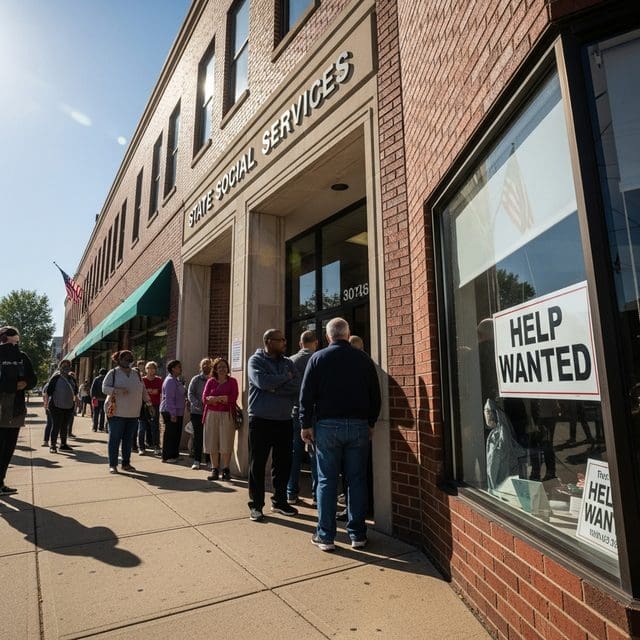
New federal cost-sharing requirements and expanded work rules for SNAP and Medicaid are transferring billions in administrative burdens to state governments while millions lose benefit eligibility.
The American social safety net is undergoing its most significant structural transformation since the 1990s. Federal mandates are shifting the burden of funding and enforcement from Washington to state capitals, a transition framed by proponents as a return to individual responsibility. As of June 2026, the implementation of expanded work requirements for the Supplemental Nutrition Assistance Program (SNAP) and Medicaid has reached a critical point, testing the capacity of local bureaucracies to manage an evolving system.
Data from the USDA indicate the scale of this contraction is substantial. More than 3.5 million SNAP participants have lost assistance since last July, bringing total participation to approximately 42 million for fiscal year 2025. This decline is largely attributed to the rollout of new work rules. Under the current framework, work requirements now include adults aged 55 to 64 and parents of minors aged 14 and older. Furthermore, new regulations have removed certain categorical protections for homeless individuals, veterans, and former foster youth.
In states like California, these changes became fully enforceable on June 1, 2026. Rules generally mandate at least 80 hours of work or qualifying vocational activity per month, with eligibility checks required every six months. While the policy aims to foster economic mobility by tethering assistance to labor, the administrative machinery required to track millions of workers is proving costly. States now face an immediate pressure point regarding cost-shifts. By fiscal year 2027, states must shoulder 75% of SNAP administrative costs, and by 2028, they could be responsible for 15% of actual benefit payouts. This represents a seismic shift in the federal-state partnership.
The fiscal implications for state treasuries are stark. Early projections suggest an average added cost of $218 million per state. This comes as the Urban Institute reports a persistent coverage gap, noting that 3.2 million eligible young adults already do not receive the benefits they are entitled to. Researchers suggest this gap may widen as state agencies, overwhelmed by 80-hour-per-month enforcement protocols, struggle to maintain accurate rolls. The complexity is mirrored in Medicaid, where the CMS has issued interim guidance for work-rule implementation for adults aged 19 to 64.
From a principled conservative perspective, these reforms move away from top-down federal dependency toward a model prioritizing local oversight and the restorative power of work. However, the transition occurs during broader instability. While the administration recently announced a 10-day ceasefire in Lebanon and saw oil prices drop after the opening of the Strait of Hormuz, domestic pressures remain high. President Trump’s net approval rating reached a historic low in June 2026, driven by high prices and the lingering effects of international conflict. For many, the safety net is being reconfigured into a springboard for mobility while economic waters remain turbulent.
As states grapple with these multi-million dollar shifts, the focus turns to local civic institutions to fill the gaps. The success of this policy overhaul will depend on whether the private sector and local charities can support those transitioning from government rolls into the workforce, ensuring that the push for fiscal discipline does not result in a permanent decline in the standard of living for the working poor.

James Foster serves as the Senior Correspondent for Inequality and the Social Safety Net at Just Right News, where he brings a principled and nuanced perspective to the most pressing economic challenges facing the nation. With a career dedicated to exploring the intersection of policy and personal responsibility, Foster has become a leading voice in documenting how government programs and economic shifts impact the American family. His reporting is characterized by a commitment to the “human element,” moving beyond cold statistics to highlight the stories of resilience, work, and community that define the modern American experience.
Foster’s perspective is deeply rooted in his upbringing in Birmingham, Alabama. Growing up in a city with a rich industrial heritage and a history of economic transformation, he witnessed firsthand the importance of the dignity of work and the strength of local institutions. In Birmingham, he saw how the most effective safety nets were often those woven by neighbors, faith-based organizations, and local civic groups. This background instilled in him a lifelong skepticism of “one-size-fits-all” solutions from distant bureaucracies, favoring instead the localized, community-driven support systems that he frequently champions in his writing.
Now based in Atlanta, Georgia, Foster operates from one of the most dynamic and rapidly evolving metropolitan hubs in the South. His location provides a front-row seat to the stark contrasts of the modern economy. From the gleaming towers of Atlanta’s financial districts to the struggling neighborhoods on the city’s periphery, Foster finds the stories that illustrate the complexities of upward mobility. His reporting from the Sun Belt serves as a microcosm for the national debate on poverty, highlighting how inflation, housing costs, and labor market shifts affect the working class in real-time.
As the lead for the acclaimed feature series “America’s Balancing Act,” Foster explores the delicate tension between providing a necessary hand up and fostering long-term independence. The series has become a cornerstone of Just Right News, offering a deep dive into the unintended consequences of social welfare policies. Foster’s work often focuses on the “cliff effect” and other systemic hurdles that can inadvertently discourage employment, arguing that true compassion is measured by how many people are empowered to leave the safety net, rather than how many are added to it.
Throughout his tenure, Foster has remained dedicated to the mission of Just Right News, providing a clear-eyed, conservative analysis of social issues. He believes that a free society thrives when individuals are empowered and the private sector is allowed to innovate. Whether he is interviewing small business owners about the challenges of a changing workforce or documenting the success of private charitable initiatives, Foster’s goal is to provide readers with the truth about the state of the American Dream. His work serves as a vital reminder that while the challenges of inequality are great, the solutions are often found in the strength of the American spirit and the preservation of traditional values.