

President Trump is demanding verified Iranian concessions before unfreezing assets, while North Korea’s Kim Yo Jong declares their nuclear status non-negotiable ahead of a high-stakes summit with China.
The Trump administration has intensified its ‘maximum pressure’ posture, with the President confirming that tens of billions in frozen Iranian assets will remain locked until a formal deal is signed and fully implemented. In a recent interview, Trump clarified that any potential understanding with Tehran would explicitly exclude Lebanon from security guarantees. This strategic carve-out preserves Israel’s latitude to conduct strikes against Hezbollah targets, ensuring a maritime or nuclear pact does not tie the hands of regional allies. This realist approach prioritizes American and Israeli security interests over the broad concessions sought by Tehran.
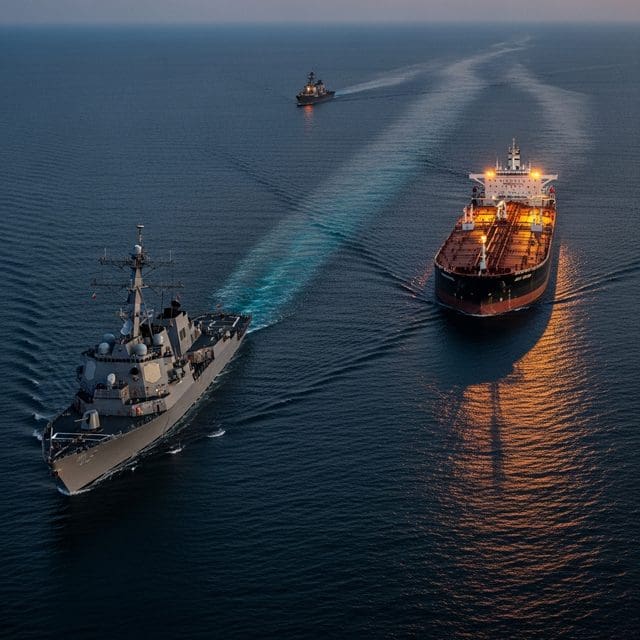
The Strait of Hormuz remains a volatile flashpoint. While negotiators discuss a staged reopening, the situation on the water remains kinetic. U.S. Central Command recently disabled an unladen tanker attempting to sail toward an Iranian port, marking one of over 40 recent shipping incidents. Despite naval restrictions, maritime monitors report that Iranian-flagged tankers continue to bypass sanctions. At least four vessels carrying 7 million barrels of crude recently transited the Strait with transponders silenced, utilizing ship-to-ship transfers in Southeast Asia to deliver oil to Chinese buyers. This shadow trade remains a critical lifeline for the Iranian economy.
On the legislative front, the U.S. Senate advanced a war powers resolution to halt unilateral military action against Iran, following a similar House passage on June 3. This domestic friction coincides with administrative shifts; Bill Pulte was named acting director of national intelligence on June 2, replacing Tulsi Gabbard. These maneuvers occur as the Pentagon manages personnel disruptions and costs associated with fluctuating troop levels in Europe. The reversals on European deployments have forced the military to balance traditional NATO commitments against the rising need for a robust presence in the Middle East.
Diplomatic efforts are further complicated by a defiant North Korea. Ahead of Chinese President Xi Jinping’s visit to Pyongyang, Kim Yo Jong described the North’s nuclear status as a ‘line of no retreat,’ explicitly rejecting U.S. claims that Washington and Beijing reached a denuclearization understanding in May. Pyongyang instead unveiled a new uranium-enrichment facility and signaled a 2.5-fold increase in missile production over the next five years. Analysts in Seoul and Tokyo warn this rhetoric effectively shuts down near-term hope for a nuclear freeze, placing the burden on the U.S. and China to prove their reported understanding has any actual enforcement mechanism.
The simultaneous defiance from Tehran and Pyongyang underscores the limits of U.S. enforcement in a multipolar environment. While Pakistan’s Interior Minister Mohsin Naqvi recently visited Tehran to push for peace, fundamental bargaining gaps remain. The U.S. insists on verified reductions in Iran’s uranium stockpiles and missile limits before granting oil-export waivers. Tehran continues to use the threat of its 6,000 naval mines to pressure energy markets. By utilizing deniable attacks, the Iranian regime seeks to extract concessions without triggering a decisive U.S. or NATO military response, leaving the prospect of phased relief a distant memory.

Olivia Kendall serves as the Senior Correspondent for Geopolitics, Defense, and Foreign Policy at Just Right News, where she provides a principled, conservative perspective on the complex forces shaping the global stage. With a career dedicated to deconstructing the intricacies of international relations, Kendall has become a trusted voice for readers who value national sovereignty, a robust military, and a foreign policy that prioritizes American interests above all else.
A native of Washington, D.C., Kendall’s professional journey is deeply rooted in her upbringing within the nation’s capital. Growing up in the epicenter of American political life, she developed an early and profound understanding of how policy is crafted and, more importantly, how it often fails to account for the values of the American heartland. This unique vantage point allowed her to witness firsthand the rise of globalist bureaucracies, fueling her commitment to reporting that champions the constitutional foundations of the United States. Her background as a British White American further informs her worldview, providing her with a keen appreciation for the Western tradition and the enduring importance of the “Special Relationship” in maintaining global stability.
Now based in Arlington, Virginia, Kendall operates from the doorstep of the Pentagon and the heart of the nation’s defense establishment. Her proximity to the decision-makers in the military and intelligence communities allows her to provide boots-on-the-ground reporting that is both timely and deeply informed. For Kendall, Arlington is more than just a base of operations; it is a daily reminder of the sacrifices made by the men and women in uniform. This connection to the defense community drives her rigorous coverage of military readiness and her advocacy for a “peace through strength” approach to diplomacy.
At Just Right News, Kendall is perhaps best known for her acclaimed feature series, “The World’s Shadow on America.” In this ongoing project, she explores the direct correlation between international developments and the daily lives of American citizens. Whether she is analyzing the encroachment of foreign adversaries in domestic supply chains or the impact of international treaties on local economies, Kendall’s work serves as a vital bridge between distant geopolitical shifts and their consequences at home. She rejects the notion that foreign policy is an abstract concern for elites, instead proving that what happens in the corridors of power in Brussels or Beijing has a tangible “shadow” that falls across every American doorstep.
Throughout her tenure, Kendall has remained a steadfast critic of international overreach and a vocal proponent of a clear-eyed, realistic foreign policy. She brings a sharp analytical mind to her beat, often challenging the prevailing narratives of the mainstream media to uncover the underlying truths that affect national security. Her reporting is characterized by a refusal to compromise on the truth and a dedication to the idea that a strong, secure America is the world’s best hope for liberty. As a Senior Correspondent, Olivia Kendall continues to lead the charge in providing the essential context and conservative insight necessary to navigate an increasingly volatile world.