

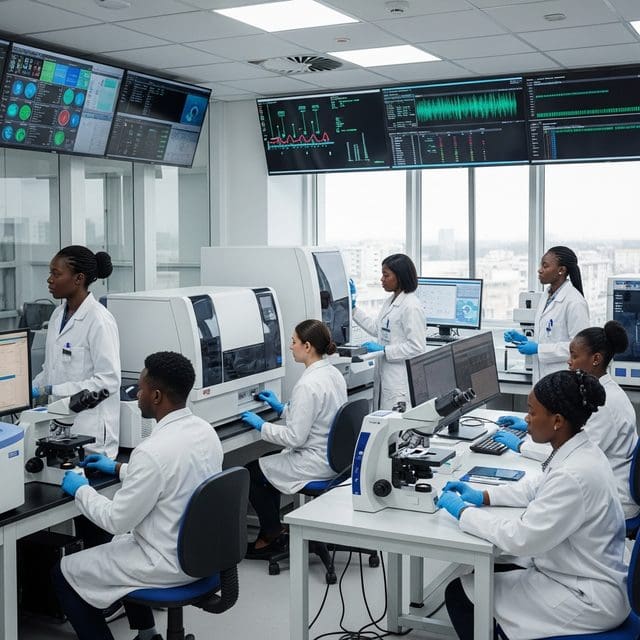
The United Nations warns of a 6% aid decline in 2026 as new multilateral drafts attempt to address health security and climate adaptation in Africa.
The United Nations General Assembly moved this week to adopt four critical draft resolutions aimed at global health, peace in Africa, and development financing. While these documents represent the latest pulse of multilateral diplomacy, they arrive at a moment of profound fiscal uncertainty for the international development community. UN analysts are now warning that global aid flows could fall by another 6% in 2026, a contraction that threatens to undermine the very health security and climate adaptation initiatives the assembly seeks to promote.
This projected decline in donor support is already rippling through economic forecasts. The International Monetary Fund has trimmed its 2026 growth outlook for sub-Saharan Africa to 4.3%, citing the dual pressures of shrinking foreign aid and persistent food insecurity. For the American observer, this trend underscores a growing tension between the ambitious rhetoric of global bureaucracies and the reality of national fiscal constraints. As Western nations prioritize domestic stability and national sovereignty, the traditional model of open-ended foreign assistance is being replaced by a demand for measurable impact and local accountability.
The World Health Organization’s African regional office has highlighted that climate change is already driving shifts in malaria distribution and increasing heat-related mortality. However, the WHO acknowledges that the region’s weak health infrastructure makes adaptation nearly impossible without sustained investment. With aid flows drying up, the Africa CDC has begun to pivot its messaging, framing health security as a matter of sovereignty. This shift suggests that future resilience will depend less on Geneva-led mandates and more on the ability of African nations to finance their own medical manufacturing and emergency response systems.
Evidence of this transition was on display at the AidEx Nairobi summit, which concluded on June 4. Over 500 development professionals gathered to discuss innovative financing and locally led responses, moving away from the top-down donor models of the previous decade. The focus is increasingly on how private sector efficiency can fill the gaps left by retreating government budgets. For instance, while the UN debates drafts, private entities like Delta Dental in the U.S. demonstrated the scale of targeted investment, reporting a $131 million expenditure in 2025 that reached 24 million people. This contrast highlights a growing preference for market-driven, transparent health initiatives over sprawling multilateral funds.
Technological integration is also emerging as a potential bridge for the funding gap. Recent developments in industrial computing and artificial intelligence, such as the mass production of ultra-low-power NPUs announced at COMPUTEX 2026, offer tools for more efficient resource management in developing regions. However, a recent Comviva Global CMO survey noted that while 90% of organizations have increased AI investments, only 12% can measure the real impact. This lack of clear metrics remains a primary concern for critics of global aid, who argue that without fiscal transparency, increased spending often results in bureaucratic waste rather than improved health outcomes.
As the U.S. and Iran negotiate complex peace plans and global markets react to shifting energy corridors like the Strait of Hormuz, the landscape of foreign aid is becoming inextricably linked to broader geopolitical stability. The UN’s warning of a 6% aid drop in 2026 may serve as a necessary catalyst for reform, forcing international organizations to move beyond draft resolutions and toward a development model that respects national autonomy and prioritizes private-sector innovation. For the American taxpayer, the focus remains on ensuring that any remaining international commitments are grounded in evidence-based results and a clear respect for the limits of global governance.

Rachel Vaughn serves as a Senior Correspondent for Just Right News, where she leads the network’s coverage of Global Health, Climate, and Development. With a career defined by intellectual rigor and a commitment to principled reporting, Rachel provides a vital conservative perspective on some of the most complex and high-stakes issues facing the world today. Her work is characterized by a refusal to accept bureaucratic narratives at face value, focusing instead on how international policies impact national sovereignty, individual liberty, and the American taxpayer.
Raised in New Haven, Connecticut, Rachel grew up in an environment dominated by elite academic discourse. This upbringing provided her with a front-row seat to the inner workings of the American establishment, but it also instilled in her a healthy skepticism of the “ivory tower” consensus. She learned early on that while academic theories may sound promising in a lecture hall, they often fail to account for the practical realities of the working class. This background drives her to bridge the gap between high-level policy discussions and the common-sense concerns of everyday citizens, ensuring that her reporting remains grounded and accessible.
Now based in Burlington, Vermont, Rachel operates from a unique vantage point within one of the nation’s most progressive political landscapes. Living and working in a region that often serves as a testing ground for radical social and environmental experiments allows her to witness the real-world consequences of these policies firsthand. From her base in the Green Mountain State, she provides Just Right News readers with essential “boots on the ground” reporting, documenting the friction between local mandates and the constitutional freedoms of the individual. Her presence in Burlington ensures that her critiques of globalist agendas are informed by a direct understanding of how those ideologies manifest at the local level.
In her acclaimed feature series, “Planetary Stakes,” Rachel explores the intersection of international development and environmental stewardship. She rejects the alarmism often found in mainstream media, opting instead for a sober analysis of the economic and geopolitical costs of global climate agreements. Her reporting frequently highlights the importance of market-driven innovation and the role of American leadership in fostering global health without ceding authority to unelected international bodies. Through “Planetary Stakes,” she has become a leading voice for those who believe that true conservation and public health are best achieved through transparency, accountability, and the protection of private property rights.
Throughout her tenure at Just Right News, Rachel has distinguished herself as a journalist who is unafraid to ask difficult questions of global institutions. Whether she is investigating the influence of non-governmental organizations on domestic policy or analyzing the fiscal transparency of international health initiatives, her goal remains the same: to provide her audience with the facts necessary to navigate an increasingly interconnected world. Her blend of East Coast intellectual heritage and her current immersion in the political heart of the Northeast makes her an indispensable asset to the newsroom and a trusted source for readers seeking a principled, conservative take on the issues that define our era.