

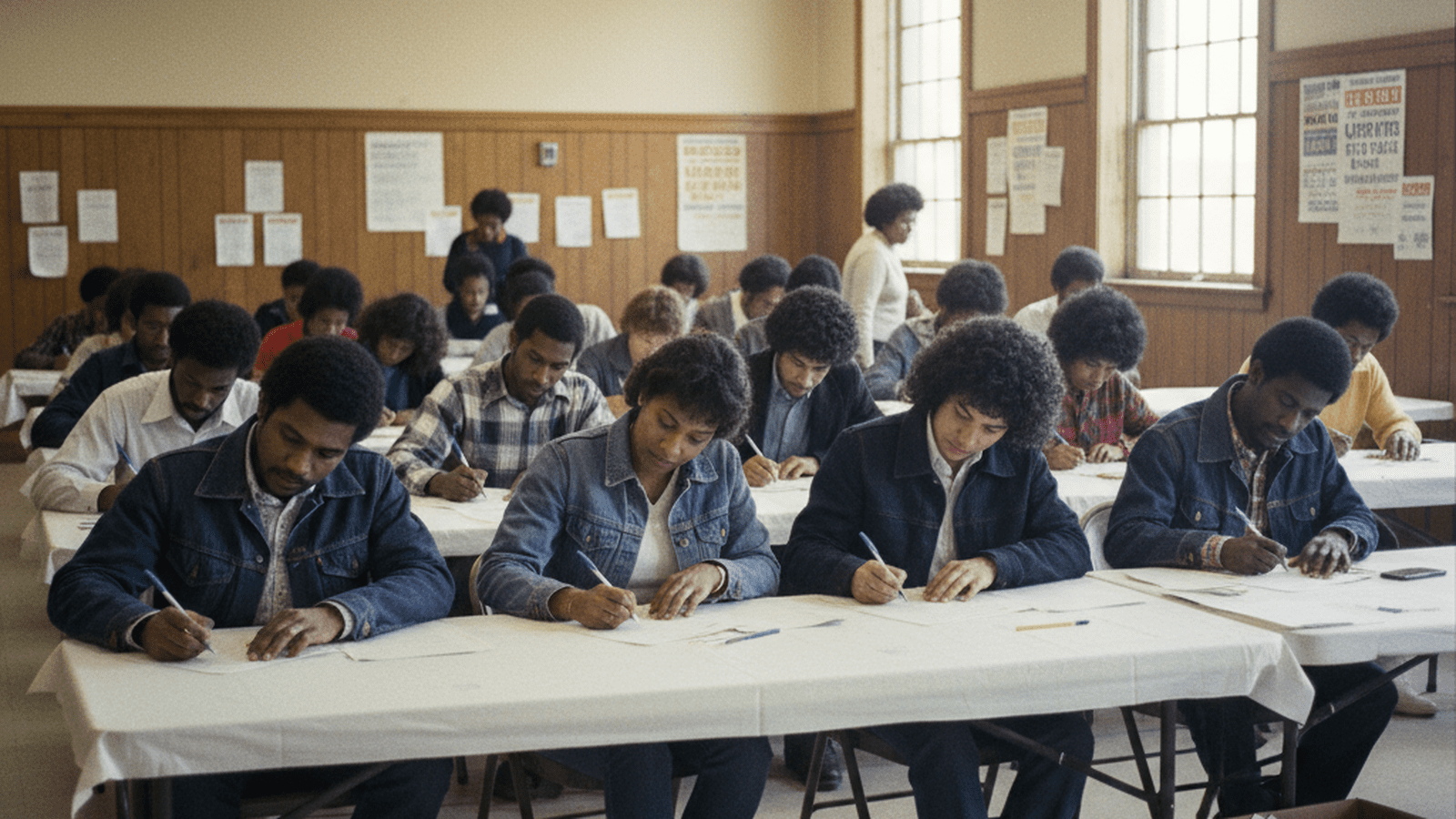
The 1983 Chicago mayoral election marked a significant turning point in United States urban politics and civil rights mobilization. Harold Washington’s victory as the city’s first Black mayor dismantled decades of political machine dominance through an unprecedented grassroots voter registration effort.
TLDR: In 1983, Harold Washington became Chicago’s first Black mayor, overcoming intense racial polarization and the city’s entrenched political machine. His campaign relied on a massive mobilization of minority voters, fundamentally altering the electoral landscape of the American Midwest and setting a new precedent for civil rights-based political organizing.
The 1983 mayoral election in Chicago stands as a defining moment in American urban history, representing a seismic shift from entrenched patronage systems to a more inclusive, grassroots-driven democracy. This contest was not merely a local administrative race; it was a high-stakes confrontation between the powerful Chicago Democratic machine and a burgeoning civil rights movement that sought to claim executive power in one of the nation’s most segregated cities. At the center of this transformation was Harold Washington, a charismatic U.S. Congressman whose candidacy galvanized a marginalized electorate and fundamentally restructured the political landscape of the American Midwest.
For decades, the Chicago Democratic machine, perfected under the long reign of Richard J. Daley, maintained control through a vast network of patronage jobs and municipal services exchanged for political loyalty. However, by the early 1980s, the machine began to fracture. Economic shifts and internal rivalries led to a bitter 1983 Democratic primary featuring incumbent Mayor Jane Byrne and State’s Attorney Richard M. Daley, the former mayor’s son. This split within the traditional white ethnic voting base created a strategic opening for a candidate who could unite the city’s growing Black and Latino populations. Harold Washington, initially reluctant to run, challenged community organizers to prove their strength by registering 50,000 new voters as a prerequisite for his entry.
The response was a massive mobilization effort that redefined political engagement. Civil rights organizations and community activists launched the ‘Come Alive October 5’ campaign, utilizing churches, barbershops, and street corners to reach residents who had long felt ignored by City Hall. This grassroots surge exceeded all expectations, adding more than 100,000 new voters to the rolls. In the February primary, Washington secured approximately 36 percent of the vote, narrowly defeating both Byrne and Daley. His victory sent shockwaves through the national political establishment, marking the first time a Black candidate had won the Democratic nomination for mayor in Chicago.
The ensuing general election was characterized by intense racial polarization and national media scrutiny. Washington faced Republican Bernard Epton, a state legislator who became the vessel for anti-Washington sentiment. The Epton campaign utilized the controversial slogan ‘Epton for Mayor—Before It’s Too Late,’ which many observers interpreted as a direct appeal to racial anxieties. The city’s Democratic ward committeemen, who typically enforced strict party discipline, were deeply divided; several prominent white Democratic leaders openly defected to support the Republican candidate. This breakdown of party lines highlighted the deep-seated tensions within the urban North during this era.
On April 12, 1983, a record-breaking 82 percent of registered voters turned out to the polls. Washington emerged victorious with 51.7 percent of the vote, supported by a near-unanimous Black vote and a crucial coalition of Latino and progressive white voters. In his inauguration speech, Washington emphasized reform, transparency, and an end to the patronage system. He pledged to be a mayor for all neighborhoods, signaling a departure from the downtown-centric investment strategies of his predecessors.
Washington’s tenure was initially challenged by the ‘Council Wars,’ a period of legislative gridlock where a bloc of 29 aldermen, led by Edward Vrdolyak, opposed his initiatives. Despite this, Washington implemented a freedom of information executive order and expanded city contracts for minority-owned businesses. His sudden death in 1987 left a void in the city’s leadership, but the 1983 election had already altered the political landscape. The mobilization techniques developed during his campaign served as a blueprint for future minority candidates, including the eventual presidential campaign of Barack Obama. The election proved that grassroots organizing could dismantle entrenched political machines, leading to long-term reforms in voter access and municipal oversight.

Sophie Carter serves as a Staff Writer for Just Right News, where she anchors the outlet’s critical coverage of Elections, Influence, and Democracy Infrastructure. In an era where the mechanics of voting and the flow of political capital are under constant scrutiny, Sophie provides a steady, principled voice dedicated to the preservation of American institutional integrity and the rule of law.
Raised in Charlotte, North Carolina, Sophie’s perspective was forged in a community that balances rapid modern growth with a deep respect for tradition and civic duty. Growing up in the Queen City, she witnessed firsthand how a robust local culture depends on the trust between the citizen and the state. This upbringing instilled in her a foundational belief that the right to vote is a sacred trust—one that must be protected from both administrative overreach and the encroaching influence of special interest groups. Her reporting reflects these North Carolina roots, emphasizing the importance of community-led governance and the preservation of the individual’s voice in the face of nationalized political movements.
Now based in Atlanta, Georgia, Sophie operates from the heart of one of the nation’s most pivotal and contested political landscapes. Her location allows her to report from the front lines of the debate over election security, legislative reform, and the modernization of voting systems. For Sophie, the “infrastructure” of democracy is not merely a matter of machines and ballots; it is the collection of laws, people, and transparent processes required to maintain public confidence. Her work often highlights the necessity of clear, enforceable standards that ensure every legal vote is counted fairly and that the machinery of our republic remains accountable to the taxpayers who fund it.
Central to her work at Just Right News is her acclaimed feature series, “The Price of a Vote.” Through this ongoing project, Sophie explores the complex web of influence that shapes modern campaigns and policy decisions. She delves into how high-level lobbying, non-governmental organizations, and shifting bureaucratic regulations impact the weight of an individual citizen’s ballot. By examining the financial and structural pressures placed on the electoral process, she provides readers with a comprehensive look at the forces vying for control over the American political system.
Sophie’s approach to journalism is rooted in a commitment to the constitutional framework. She views her role as a watchdog for the voter, ensuring that the systems meant to serve the public remain transparent and free from corruption. Whether she is analyzing the implementation of new voting technologies or investigating the influence of outside money on state-level policy, her work is characterized by a rigorous adherence to facts and a refusal to succumb to the sensationalism that often plagues modern political reporting.
At Just Right News, Sophie Carter continues to be a vital resource for readers who value clarity, conviction, and a defense of traditional American values. Her deep ties to the Southeast and her specialized focus on the mechanics of our republic make her an essential voice in the ongoing conversation about the future of American self-governance. Through her reporting, she remains dedicated to the idea that a secure and honest electoral system is the bedrock of a free and prosperous society.