

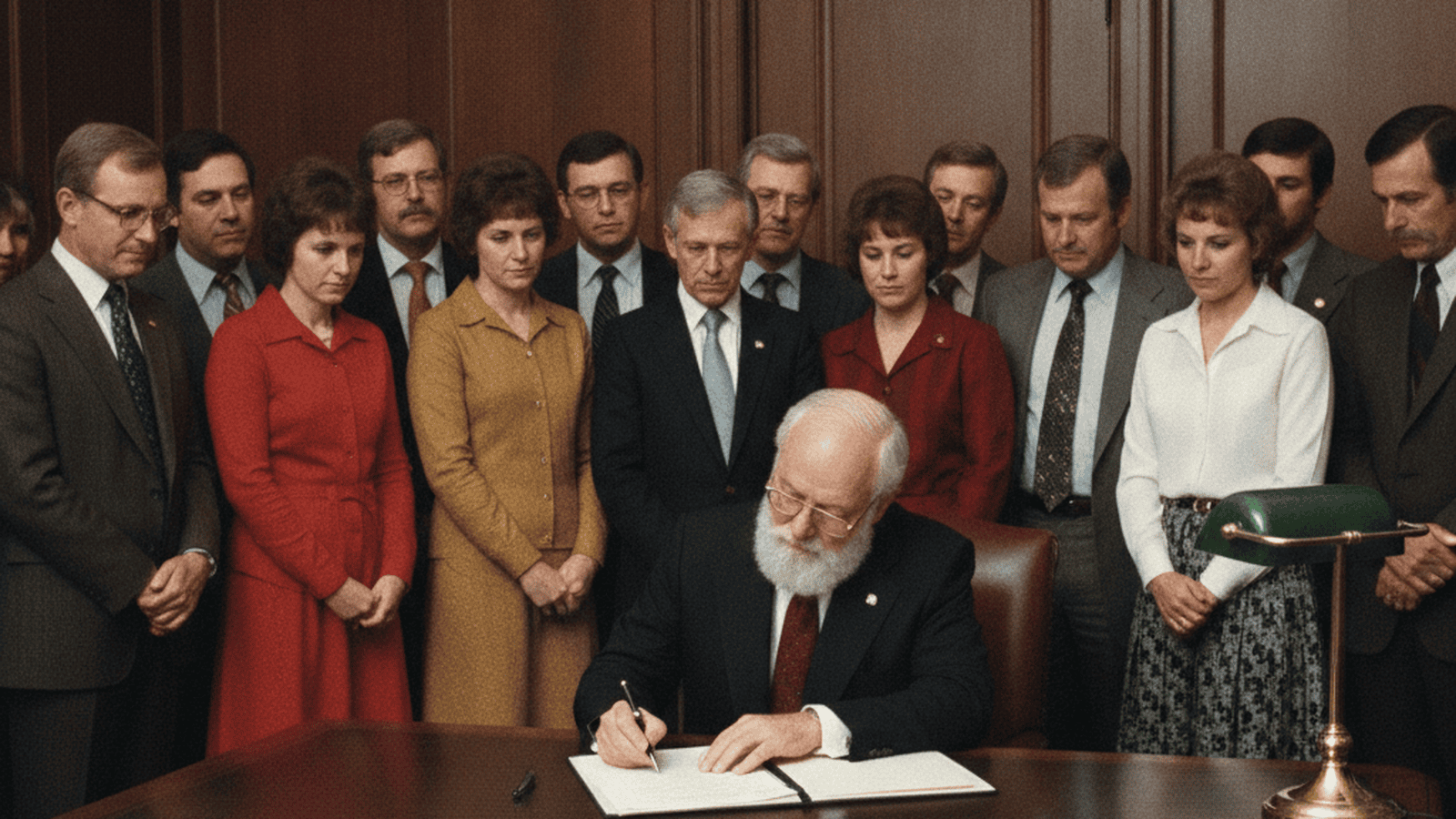
In 1982, Wisconsin became the first state in the United States to enact a comprehensive civil rights law protecting individuals from discrimination based on sexual orientation. Signed by Republican Governor Lee S. Dreyfus, the legislation prohibited bias in employment, housing, and public accommodations.
TLDR: Wisconsin made history in 1982 as the first U.S. state to pass a law banning discrimination based on sexual orientation. Despite intense opposition from national conservative groups, a bipartisan coalition and Governor Lee S. Dreyfus secured protections in housing and employment, setting a national civil rights precedent.
In the early 1980s, the political landscape of the United States was shifting under the influence of the New Right, yet Wisconsin maintained its reputation as a laboratory for progressive policy. On February 25, 1982, Republican Governor Lee S. Dreyfus signed Assembly Bill 70 into law. This act made Wisconsin the first state in the nation to provide comprehensive civil rights protections for gay and lesbian citizens. The law prohibited discrimination based on sexual orientation in employment, housing, and public accommodations, marking a watershed moment in American legislative history.
The path to the bill’s passage began years earlier through the efforts of activists and a handful of dedicated legislators. State Representative David Clarenbach, a Democrat from Madison, emerged as the primary architect of the legislation. Clarenbach spent nearly a decade building a broad coalition that included labor unions, religious leaders, and civil rights organizations. He framed the issue not as a radical social shift, but as a fundamental matter of privacy and individual liberty, which resonated with Wisconsin’s unique political culture.
Opposition to the bill was fierce and well-organized. National groups, including the Moral Majority led by Jerry Falwell, targeted Wisconsin as a battleground for traditional values. Opponents argued that the law would grant special rights and undermine the moral fabric of the community. Local religious leaders also voiced concerns, leading to heated public hearings in Madison. Despite this pressure, the coalition supporting the bill held firm, emphasizing that no citizen should fear losing their job or home because of their identity.
The legislative process required delicate maneuvering. Clarenbach and his allies worked to ensure the bill remained focused on civil protections rather than broader social endorsements. They successfully courted moderate Republicans who viewed the measure through the lens of limited government and personal freedom. When the bill finally reached the floor, it passed the Assembly with a vote of 50 to 46 and the Senate with a vote of 19 to 13. The bipartisan support was crucial in demonstrating that civil rights for gay individuals was not strictly a partisan issue.
Governor Lee S. Dreyfus, a former university chancellor known for his signature red vest and independent streak, faced immense pressure to veto the bill. Thousands of letters and phone calls flooded his office, the majority of which urged him to reject the measure. However, Dreyfus remained committed to the principle that the state should protect all its citizens from arbitrary discrimination. Upon signing the bill, he famously stated that the government has no business in the bedrooms of the state. He viewed the law as an extension of the state’s long-standing commitment to human rights.
The enactment of the 1982 law had immediate and long-term effects on Wisconsin’s legal and social environment. It provided a legal framework for individuals to challenge discriminatory practices through the state’s Department of Industry, Labor, and Human Relations. While the law did not end all prejudice, it established a clear public policy that discrimination was unacceptable. This move solidified Wisconsin’s role as a pioneer in civil rights, preceding similar laws in other states by several years.
In the decades following the bill’s passage, the Wisconsin Model served as a template for activists and lawmakers across the United States. It proved that state-level legislative action was a viable path for securing civil rights protections when federal action was stalled. The 1982 law remains a cornerstone of Wisconsin’s legal code, reflecting a moment when a bipartisan coalition prioritized individual dignity over prevailing national political winds. Subsequent reforms in other states often cited the Wisconsin experience as evidence that such protections could be implemented successfully.

Dylan Brooks serves as the Senior Correspondent for Statehouses and Local Governance at Just Right News, where he brings a principled, constitutionalist lens to the often-overlooked machinery of state-level politics. As the lead voice behind the acclaimed feature series “Fifty Laboratories of Power,” Dylan has dedicated his career to the idea that the most impactful governance happens closest to home. His reporting consistently champions the Tenth Amendment, exploring how individual states can serve as testing grounds for innovative, conservative policy solutions that prioritize personal liberty and fiscal responsibility.
A native of Des Moines, Iowa, Dylan’s journalistic philosophy was forged in the heart of the American Midwest. Growing up in a community where local school board meetings and town halls were the bedrock of civic life, he developed a deep appreciation for the “retail politics” of the heartland. This upbringing instilled in him a fundamental belief that the American experiment is best preserved when power is decentralized. He carries the values of his Iowa roots into every assignment, maintaining a healthy skepticism of federal overreach and a steadfast commitment to the concerns of everyday citizens over the interests of the administrative state.
Now based in Madison, Wisconsin, Dylan operates from one of the nation’s most pivotal political battlegrounds. His location in a state capital known for its rigorous policy debates allows him to provide Just Right News readers with a front-row seat to the legislative process. From Madison, he tracks the ripple effects of statehouse decisions on local municipalities, ensuring that the connection between high-level policy and community impact is never lost. His work often highlights the success of conservative governors and legislatures in fostering economic growth, protecting parental rights, and securing the integrity of local institutions.
As an African American man in the conservative media landscape, Dylan offers a vital perspective on how limited government and free-market principles empower individuals and families. He frequently reports on how deregulation and school choice initiatives provide new avenues for success in underserved communities, challenging the monolithic narratives often presented by legacy media outlets. Dylan’s work is characterized by a commitment to the facts and a refusal to shy away from the complex realities of modern governance.
Throughout his tenure at Just Right News, Dylan has become a trusted authority for readers who value a rigorous, principled approach to the news. Whether he is dissecting a complex state budget or profiling a local grassroots movement, his goal remains the same: to provide the American public with the information they need to hold their local leaders accountable. By focusing on the “Fifty Laboratories of Power,” Dylan Brooks ensures that the vital work being done in statehouses across the country receives the national attention it deserves, always through a lens that respects the traditions and sovereignty of the American people.