

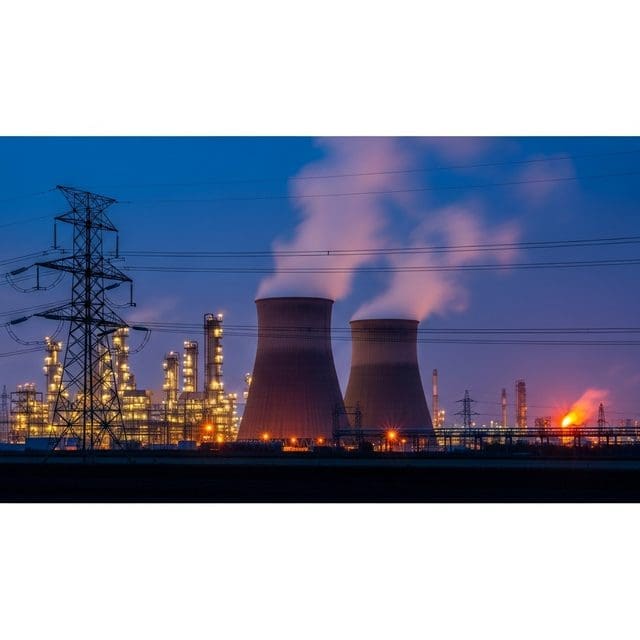
Supply disruptions in Australia and India, coupled with California refinery closures and the Iran conflict, are driving a pragmatic shift toward nuclear energy and domestic production to ensure grid reliability.
The global energy landscape is currently grappling with a series of high-impact disruptions that underscore the fragility of the international fuel supply chain. In Australia, a massive fire at Viva Energy’s Geelong refinery—one of only two remaining in the country—has severely curtailed domestic petrol output. The blaze, which lasted thirteen hours, forced the Australian government to secure 100 million liters of emergency diesel from South Korea and Brunei to mitigate immediate shortages.
Simultaneously, Indian authorities are investigating a fire at the HPCL Rajasthan greenfield refinery. While the fire at the crude distillation unit was controlled quickly, the incident has drawn scrutiny from the National Investigation Agency to determine if the disruption was part of a broader pattern of interference with global oil facilities. These localized infrastructure failures are compounding the broader market instability caused by the ongoing conflict in Iran, which has kept global oil supplies tight and prices elevated.
In the United States, the economic pressure of high energy costs has prompted significant federal intervention. President Trump recently invoked the Defense Production Act to stimulate domestic production of motor fuels and electricity. This move comes as Energy Secretary Chris Wright warned that gasoline prices could remain above $3 per gallon through 2027. To further ease the burden on consumers, the administration is considering extending the suspension of Jones Act waivers beyond the current war period to lower the cost of shipping oil between domestic ports.
Regional policy shifts are also reshaping the market. In California, the scheduled closure of major refineries owned by Phillips 66 and Valero is expected to remove 25% of the state’s refining capacity by late April 2026. Analysts project this reduction could push local gasoline prices as high as $8 per gallon, highlighting the tension between aggressive state-level environmental mandates and the practical necessity of affordable fuel for the working class.
On the international stage, the focus is shifting toward nuclear energy as a primary solution for balancing decarbonization with energy security. French President Emmanuel Macron recently hosted a Nuclear Energy Summit in Paris, advocating for nuclear power as a reliable baseload source that avoids the intermittency issues of renewables. This pragmatic pivot gains urgency as countries like India withdraw bids to host climate summits, focusing instead on internal energy stability and the distribution of essential resources like LPG cylinders amid global strains.
These developments suggest a move away from ideological energy policies in favor of a diversified approach that values reliability and cost-efficiency. As the American Lung Association reports that 33.5 million children live in areas with poor air quality, the challenge for policymakers remains achieving emissions reductions without compromising the economic stability provided by a robust and independent energy sector.
Mark Davis serves as the Senior Correspondent for Energy, Climate, and Resource Economics at Just Right News. In an era where the conversation around the environment is often dominated by alarmism and top-down mandates, Mark provides a vital, market-oriented perspective on the complex forces shaping our world. As the lead voice behind the acclaimed feature series “Power and the Planet,” he explores the intersection of environmental policy, global energy markets, and the fundamental economic principles that sustain modern civilization.
Mark’s pragmatic approach to resource management was forged in the high desert of his hometown, Albuquerque, New Mexico. Growing up in a region defined by both its breathtaking natural beauty and its rugged, resource-dependent landscape, he developed an early appreciation for the delicate balance between conservation and utilization. New Mexico’s unique position as a hub for both traditional energy production and cutting-edge scientific research provided Mark with a front-row seat to the evolution of the American energy sector. This upbringing instilled in him a deep-seated belief that true environmental stewardship is inseparable from economic prosperity and technological innovation.
Now based in Boulder, Colorado, Mark operates from the heart of the nation’s climate research community. While Boulder is often seen as a bastion of environmental idealism, Mark utilizes his post to provide a necessary counterweight, grounded in the realities of resource economics. He understands that energy policy does not exist in a vacuum; it has tangible consequences for the American taxpayer, the stability of the national power grid, and the strength of the domestic manufacturing sector. By reporting from the front lines of the climate debate, he is able to challenge prevailing narratives with hard data and a commitment to the principles of the free market.
Throughout his tenure at Just Right News, Mark has distinguished himself by focusing on the “Resource Economics” aspect of his beat. He frequently highlights the hidden costs of rapid energy transitions and advocates for an “all-of-the-above” energy strategy that prioritizes American energy independence. His work often shines a light on the geopolitical implications of resource scarcity, arguing that a secure nation must first be an energy-secure nation. Whether he is analyzing the impact of federal land-use regulations or investigating the supply chains required for new technologies, Mark remains focused on how policy decisions affect the lives and livelihoods of everyday citizens.
In “Power and the Planet,” Mark continues to bridge the gap between complex scientific concepts and the economic realities facing the country. He rejects the false choice between a healthy environment and a thriving economy, instead seeking out solutions that leverage American ingenuity and private-sector competition. For Mark, reporting on the climate is not about following the latest trends, but about ensuring that the conversation remains tethered to the foundational values of liberty, property rights, and fiscal responsibility. His contributions ensure that Just Right News readers receive a comprehensive, clear-eyed view of the challenges and opportunities defining the future of our planet.