

President Trump indefinitely extended a ceasefire with Iran following Pakistani mediation, despite fresh IRGC attacks on commercial shipping and a massive U.S. naval buildup in the region.
The fragile peace in the Middle East remains under severe strain as President Donald Trump announced an indefinite extension of the U.S.-Iran ceasefire on April 21, 2026. This reversal of his earlier stance—which signaled an expiration by Wednesday evening—comes at the request of Pakistani leadership, who are attempting to broker a second round of high-level negotiations in Islamabad.
Despite the diplomatic reprieve, the reality on the water tells a more volatile story. On April 22, the Islamic Revolutionary Guard Corps (IRGC) reportedly attacked three commercial ships in the Strait of Hormuz, seizing two for alleged blockade violations. The UK Maritime Trade Operations confirmed that one container ship sustained heavy damage while a cargo ship was forcibly stopped. These actions directly challenge the U.S. naval blockade, which the White House maintains is essential to strangling Tehran’s war-making capacity.
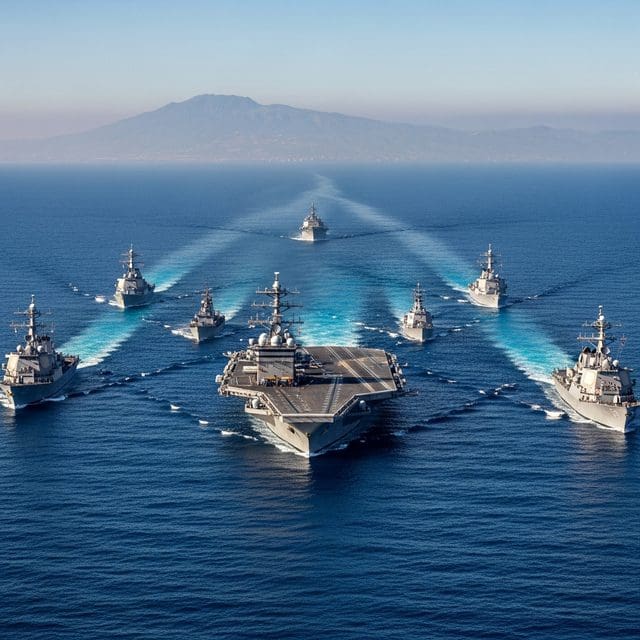
In Washington, the Pentagon has moved to reinforce its ‘peace through strength’ posture. The deployment of the USS George H.W. Bush, accompanied by three destroyers and an amphibious ship carrying 2,500 Marines, signals that the administration is prepared for the ceasefire’s collapse. While the Pentagon recently denied reports that two dozen Iranian tankers successfully bypassed the blockade, Treasury Secretary Scott Bessent noted that Iran’s oil storage capacity is nearing its limit, further tightening the economic noose.
The domestic stakes of this foreign policy crisis are mounting. An AP-NORC poll released this week shows a decline in President Trump’s economic approval ratings as the ongoing conflict drives up global energy costs. The impact is being felt acutely in Europe, where Lufthansa has canceled 20,000 flights through October due to jet fuel prices doubling. The disruption of the world’s most critical energy chokepoint has moved beyond a regional security concern to a primary driver of global inflation.
While Islamabad prepares for a potential second round of talks, Tehran’s participation remains uncertain. Iranian officials have dismissed the ceasefire extension as a tactical maneuver to buy time, while President Trump maintains that Iran is “collapsing financially,” losing an estimated $500 million per day. For the American heartland, the outcome of this standoff in the Strait will determine not just the stability of the Middle East, but the price of fuel and goods at home.
As the U.S. Navy maintains its blockade, the administration faces a delicate balancing act: sustaining economic pressure on the regime while avoiding a full-scale maritime war that could further destabilize the global economy. Vice President Vance’s canceled trip to Pakistan suggests that while the door to diplomacy remains cracked open, the White House is increasingly focused on the military and economic realities of a regime that shows little sign of total capitulation.

Olivia Kendall serves as the Senior Correspondent for Geopolitics, Defense, and Foreign Policy at Just Right News, where she provides a principled, conservative perspective on the complex forces shaping the global stage. With a career dedicated to deconstructing the intricacies of international relations, Kendall has become a trusted voice for readers who value national sovereignty, a robust military, and a foreign policy that prioritizes American interests above all else.
A native of Washington, D.C., Kendall’s professional journey is deeply rooted in her upbringing within the nation’s capital. Growing up in the epicenter of American political life, she developed an early and profound understanding of how policy is crafted and, more importantly, how it often fails to account for the values of the American heartland. This unique vantage point allowed her to witness firsthand the rise of globalist bureaucracies, fueling her commitment to reporting that champions the constitutional foundations of the United States. Her background as a British White American further informs her worldview, providing her with a keen appreciation for the Western tradition and the enduring importance of the “Special Relationship” in maintaining global stability.
Now based in Arlington, Virginia, Kendall operates from the doorstep of the Pentagon and the heart of the nation’s defense establishment. Her proximity to the decision-makers in the military and intelligence communities allows her to provide boots-on-the-ground reporting that is both timely and deeply informed. For Kendall, Arlington is more than just a base of operations; it is a daily reminder of the sacrifices made by the men and women in uniform. This connection to the defense community drives her rigorous coverage of military readiness and her advocacy for a “peace through strength” approach to diplomacy.
At Just Right News, Kendall is perhaps best known for her acclaimed feature series, “The World’s Shadow on America.” In this ongoing project, she explores the direct correlation between international developments and the daily lives of American citizens. Whether she is analyzing the encroachment of foreign adversaries in domestic supply chains or the impact of international treaties on local economies, Kendall’s work serves as a vital bridge between distant geopolitical shifts and their consequences at home. She rejects the notion that foreign policy is an abstract concern for elites, instead proving that what happens in the corridors of power in Brussels or Beijing has a tangible “shadow” that falls across every American doorstep.
Throughout her tenure, Kendall has remained a steadfast critic of international overreach and a vocal proponent of a clear-eyed, realistic foreign policy. She brings a sharp analytical mind to her beat, often challenging the prevailing narratives of the mainstream media to uncover the underlying truths that affect national security. Her reporting is characterized by a refusal to compromise on the truth and a dedication to the idea that a strong, secure America is the world’s best hope for liberty. As a Senior Correspondent, Olivia Kendall continues to lead the charge in providing the essential context and conservative insight necessary to navigate an increasingly volatile world.