

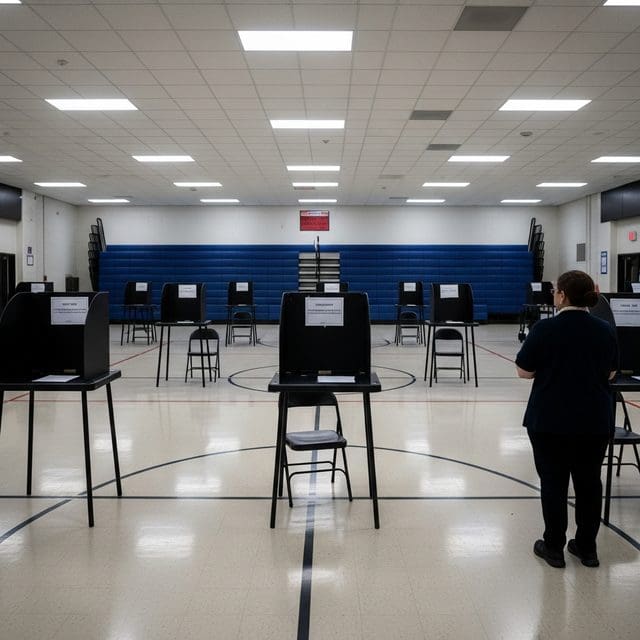
Virginia voters approved a controversial redistricting amendment as Election Day participation plummeted compared to the 2025 gubernatorial cycle.
The machinery of American democracy faced a dual test of participation and integrity this week as Virginia voters weighed in on the state’s constitutional framework while a sitting member of Congress resigned under the weight of a campaign finance scandal. In Virginia, a redistricting amendment passed on April 21 with 51.5% of the vote, fundamentally altering the map-making process for the 2026 midterms.
The amendment allows for a temporary legislative redraw that critics suggest could favor the current Democratic majority by a 10-1 margin before reverting to a commission-led process in 2031. This structural shift occurred against a backdrop of significantly diminished voter engagement. Data from midday Tuesday showed in-person turnout trailing far behind the record-setting 2025 gubernatorial race. Fairfax County reported a 25% decline, while Alexandria saw a 21% drop. While early voting reached approximately 1.4 million, the sharp decline in Election Day participation in Northern Virginia contrasts with a milder drop in the state’s southwestern regions.
Institutional integrity remains under scrutiny in Florida, where Representative Sheila Cherfilus-McCormick resigned on April 21. The resignation preceded a House Ethics Committee hearing regarding the alleged misuse of $5 million in COVID-19 relief funds. Investigators suggest a portion of these taxpayer dollars was diverted to bolster her campaign and purchase personal luxury items. The vacancy adds further volatility to a House already grappling with narrow margins and internal friction.
This friction was on public display as political commentators debated the shifting alliances within the Republican party. On CNN, analyst Scott Jennings criticized Tucker Carlson’s recent withdrawal of support for Donald Trump, labeling the media figure a “moron” for his public regret over a 2024 endorsement. The rift centers on the administration’s foreign policy, specifically the indefinite extension of the Iran ceasefire on April 21, a move that reversed the president’s earlier stated intentions.
International democratic processes are also showing signs of strain. In Peru, the head of the national election agency resigned Tuesday following logistical failures in a presidential contest where 93% of the tally shows Keiko Fujimori leading. With final results delayed until mid-May due to disputes, the situation mirrors a global trend of administrative instability. Whether through shifting district lines in Virginia or the collapse of electoral logistics in Lima, the rules of the game are increasingly as contested as the outcomes themselves.

Sophie Carter serves as a Staff Writer for Just Right News, where she anchors the outlet’s critical coverage of Elections, Influence, and Democracy Infrastructure. In an era where the mechanics of voting and the flow of political capital are under constant scrutiny, Sophie provides a steady, principled voice dedicated to the preservation of American institutional integrity and the rule of law.
Raised in Charlotte, North Carolina, Sophie’s perspective was forged in a community that balances rapid modern growth with a deep respect for tradition and civic duty. Growing up in the Queen City, she witnessed firsthand how a robust local culture depends on the trust between the citizen and the state. This upbringing instilled in her a foundational belief that the right to vote is a sacred trust—one that must be protected from both administrative overreach and the encroaching influence of special interest groups. Her reporting reflects these North Carolina roots, emphasizing the importance of community-led governance and the preservation of the individual’s voice in the face of nationalized political movements.
Now based in Atlanta, Georgia, Sophie operates from the heart of one of the nation’s most pivotal and contested political landscapes. Her location allows her to report from the front lines of the debate over election security, legislative reform, and the modernization of voting systems. For Sophie, the “infrastructure” of democracy is not merely a matter of machines and ballots; it is the collection of laws, people, and transparent processes required to maintain public confidence. Her work often highlights the necessity of clear, enforceable standards that ensure every legal vote is counted fairly and that the machinery of our republic remains accountable to the taxpayers who fund it.
Central to her work at Just Right News is her acclaimed feature series, “The Price of a Vote.” Through this ongoing project, Sophie explores the complex web of influence that shapes modern campaigns and policy decisions. She delves into how high-level lobbying, non-governmental organizations, and shifting bureaucratic regulations impact the weight of an individual citizen’s ballot. By examining the financial and structural pressures placed on the electoral process, she provides readers with a comprehensive look at the forces vying for control over the American political system.
Sophie’s approach to journalism is rooted in a commitment to the constitutional framework. She views her role as a watchdog for the voter, ensuring that the systems meant to serve the public remain transparent and free from corruption. Whether she is analyzing the implementation of new voting technologies or investigating the influence of outside money on state-level policy, her work is characterized by a rigorous adherence to facts and a refusal to succumb to the sensationalism that often plagues modern political reporting.
At Just Right News, Sophie Carter continues to be a vital resource for readers who value clarity, conviction, and a defense of traditional American values. Her deep ties to the Southeast and her specialized focus on the mechanics of our republic make her an essential voice in the ongoing conversation about the future of American self-governance. Through her reporting, she remains dedicated to the idea that a secure and honest electoral system is the bedrock of a free and prosperous society.