

Regional bank earnings show resilience despite rising labor and fuel costs, as the Trump administration invokes the Defense Production Act to counter energy-driven inflation.
The American financial landscape is currently caught between the resilience of the banking sector and the corrosive effects of persistent energy inflation. As the Federal Reserve monitors the impact of geopolitical instability on domestic prices, first-quarter earnings reports from regional and mid-sized lenders suggest that while the financial plumbing remains functional, the broader economy is facing significant structural headwinds.
Citizens Financial Group reported a 39% year-over-year increase in net income, reaching $517 million, with a net interest margin of 3.14%. Similarly, University Bancorp posted a net income of $8.9 million for the first quarter of 2026, a sharp reversal from its loss in the previous year. These figures indicate that higher interest rates continue to provide a tailwind for traditional lending institutions, even as small-cap firms like Lake Shore Bancorp and Hawthorn Bancshares navigate a more competitive environment for deposits.
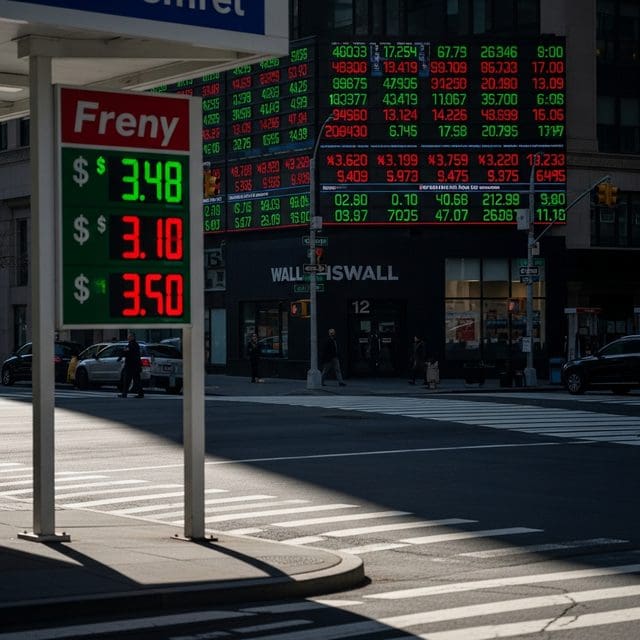
However, the strength in banking is being tested by the reality of the “Invisible Economy”—the rising costs of basic necessities that do not appear on a balance sheet but dictate market sentiment. U.S. Energy Secretary Chris Wright recently warned that gasoline prices may remain above the $3 per gallon threshold into 2027, driven by the ongoing conflict in Iran. In response, the Trump administration invoked the Defense Production Act on April 20 to accelerate the domestic production of motor fuels and electricity.
This inflationary pressure is already manifesting in the transport sector. The U.S. airline industry is grappling with a dual surge in jet fuel and labor costs. These pressures are forcing a re-evaluation of industry structures, with consolidation discussions increasing as carriers struggle to maintain margins. To mitigate these costs, the administration is considering an extension of the Jones Act waiver suspension to lower the expense of shipping oil between domestic ports.
In the capital markets, Interactive Brokers Group reported record first-quarter revenues of $1.68 billion, driven by a 24% increase in daily average revenue trades. This surge in trading activity suggests that investors are repositioning portfolios in anticipation of a prolonged period of high rates. Meanwhile, the real estate sector showed unexpected strength, with Equity Lifestyle Properties raising its full-year earnings guidance to a range of $3.12 to $3.22 per share, well above the previous market consensus.
While the Justice Department’s recent 11-count indictment of the Southern Poverty Law Center for bank and wire fraud has captured headlines, the primary concern for Wall Street remains the intersection of energy policy and monetary stability. With the Iran ceasefire extension providing only a temporary reprieve, the focus remains on whether domestic production can scale fast enough to prevent energy costs from further devaluing the American taxpayer’s purchasing power.

Jordan Lee serves as the Senior Correspondent for Wall Street, Finance, and Monetary Systems at Just Right News. Based in the heart of the world’s financial capital, New York City, Lee brings a sharp, principled eye to the complex mechanisms that drive the global economy. His reporting is defined by a commitment to fiscal responsibility, the defense of the free market, and a deep-seated belief that a transparent monetary system is the bedrock of a free society.
Raised in Portland, Oregon, Lee’s perspective was forged in a city that has undergone significant cultural and economic shifts. His upbringing in the Pacific Northwest instilled in him a profound appreciation for the industriousness of small business owners and the importance of local economic stability. Watching the evolution of his hometown’s landscape sparked an early interest in how federal fiscal policy and large-scale financial trends eventually trickle down to the average citizen. This background provides him with a unique vantage point; he understands the growing disconnect between the policy-making elite and the reality of Main Street, a theme that frequently resonates throughout his work.
Now operating from his base in New York City, Lee bridges the gap between the high-stakes trading floors of Manhattan and the households of everyday Americans. He views the financial sector not merely as a collection of numbers and tickers, but as a vital engine of American prosperity that requires constant vigilance and accountability. His reporting often highlights the dangers of centralized financial control and the necessity of maintaining a system that rewards merit, risk-taking, and innovation.
As the creator and lead of the featured series, “The Invisible Economy,” Lee pulls back the curtain on the often-opaque world of monetary systems. He specializes in translating the dense jargon of central banking and international finance into actionable insights for the Just Right News audience. His work explores the “invisible” forces—such as inflationary pressures, regulatory creep, and the expansion of the administrative state—that erode the purchasing power of American families. By focusing on these systemic issues, Lee empowers readers to understand the hidden forces shaping their financial independence.
Lee’s journalistic philosophy is rooted in a steadfast commitment to traditional American values. As an Asian American professional who has navigated the competitive corridors of the financial world, he is a vocal advocate for meritocracy and the preservation of the American Dream. He believes that a stable currency and a predictable regulatory environment are essential for national sovereignty and individual liberty. His reporting frequently warns against the risks of government overreach in the private sector, arguing that the most effective solutions to economic challenges arise from competition and individual enterprise rather than bureaucratic mandates.
At Just Right News, Jordan Lee remains dedicated to providing a clear-eyed defense of the taxpayer. Whether he is analyzing market volatility or investigating the long-term implications of national debt, his mission is to provide the truth about where the money is going and what it means for the future of the country. Through his rigorous analysis and principled stance, Lee has become a trusted voice for those who value a strong, sovereign, and fiscally sound America.