

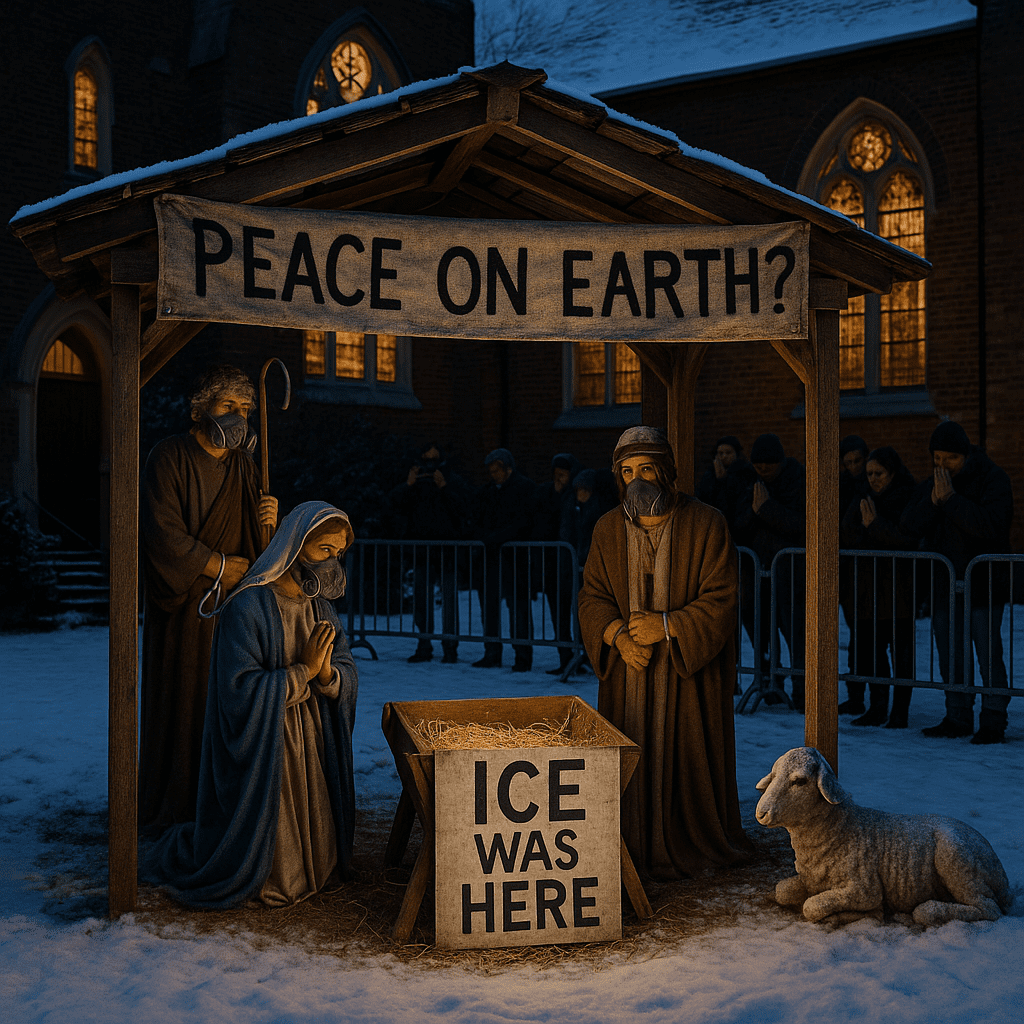
Churches in Illinois and Massachusetts are turning Nativity scenes into protests against immigration raids, depicting Jesus in zip ties, Mary in a gas mask, and “ICE was here” signs. Supporters say framing the Holy Family as refugees reflects parishioners’ fears of deportation and separation. Critics, including Catholic officials, denounce the displays as sacrilegious, politically divisive, and grounds for discipline. As Advent unfolds, church authorities and local investigations will decide whether these controversial tableaux stay up or are forced down.
One baby Jesus lies in a manger in the snow, wrapped in a silver emergency blanket with his wrists zip-tied. In another tableau, Mary stands in a plastic gas mask, flanked by Roman soldiers in tactical vests labeled “ICE.” Across Illinois and Massachusetts, churches are recasting the Nativity as a stark protest against immigration raids, forcing congregations—and their leaders—to confront how far faith should go in dramatizing the human costs of enforcement.
Outside Lake Street Church in Evanston, Illinois, the Holy Family appears as if caught in a paramilitary sweep. The church’s Nativity includes Mary in protective gear and soldiers branded with the immigration agency’s initials. Nearby, at Urban Village Church in another Chicago suburb, the manger sits empty beneath a sign that reads, “Due to ICE activity in our community the Holy Family is in hiding.” In Dedham, Massachusetts, parishioners at St. Susanna Parish removed the Christ child entirely, replacing him with a hand-painted placard: “ICE was here.”
These scenes are not only symbolic. Immigration enforcement has intensified in both states, with at least 2,000 people arrested in Illinois and Massachusetts in September alone, according to federal arrest figures cited in the Associated Press report. In Illinois, the detention campaign has left bystanders choking on chemical sprays and children traumatized after watching neighbors and teachers taken away, prompting state and local investigations. Churches hosting the provocative Nativity scenes say they are trying to mirror that reality back to the public.
Their creators explicitly frame the Holy Family as refugees living under threat. They argue that a story about a family forced to flee political violence can help congregants reflect on contemporary fears of separation and deportation among mixed-status and immigrant families in their pews. “We wanted to reflect sort of the reality that our community is experiencing,” said Jillian Westerfield, associate minister at a United Methodist church in Evanston. After a Joseph figure blew down and broke, leaving Mary alone with the baby, the church posted a sign: “Joseph didn’t make it. We hold this spaced to honor and remember all the victims of immigration enforcement terror.”
The installations have triggered fierce backlash from some Catholic authorities and conservative activists. The Archdiocese of Boston ordered St. Susanna’s manger “restored to its proper sacred purpose,” and a diocesan spokesperson insisted, “The people of God have the right to expect that, when they come to church, they will encounter genuine opportunities for prayer and Catholic worship — not divisive political messaging.” C.J. Doyle of the Catholic Action League of Massachusetts denounced the Dedham display as “a grave scandal for Catholics,” warning that the archbishop could remove the pastor, suspend him, or even close the parish and sell the property.
Yet local leaders at St. Susanna describe the Nativity as a natural extension of years of direct work with vulnerable families. Parish council member Phil Mandeville, who coordinates a multi‑church refugee support committee, said his group has assisted about 10 refugee families since 2019 with housing, schooling, language classes and employment, often in partnership with the federal government’s own vetting process. “Just to emphasize the reason for all of this — it’s not a stunt,” he said. “We work on a daily basis with refugees. But people get upset about a bit of plaster. I care more about individuals than I do a manger scene.”
Pastor Steve Josoma in Dedham, who has not yet complied with the archbishop’s order, says the goal is to move “beyond static traditional figures and evoke emotion and dialogue.” He connects the imagery directly to the fear parishioners feel as enforcement actions reach beyond people without legal status to include longtime legal residents. For him and allies like Mandeville, the scenes are an attempt to hold church spaces accountable to the Gospel’s concern for the persecuted, even when that concern clashes with institutional caution.
In Evanston, Lake Street Church has a history of turning its lawn into a moral billboard. Senior minister Rev. Michael Woolf recalled a prior Nativity in which Jesus lay in rubble as a “plea for peace” in Gaza. This year’s depiction, like the one in Dedham, collapses the distance between Scripture and current events, inviting worshippers to see modern immigration raids through the lens of a family seeking shelter.
The political charge has spilled beyond church walls. Outside St. Susanna, some bystanders posed for selfies and denounced the display as an abuse of churches’ tax‑exempt status. “We should speak to spiritual matters, not matters of political division,” said Walter Niland, a Catholic from a neighboring town. Others went further, with one man reportedly livestreaming himself tugging on the parish’s locked doors. But supporters like former Catholic schoolteacher Steve Grieger drove in from Worcester, Massachusetts, to stand with the parish. “The Archdiocese says, ‘Oh no, that goes against our tradition.’ Well, we’re living in times that are totally abnormal. We can’t just proceed as normal,” he said, arguing that ICE raids are “totally against” the scriptures of Jesus.
The controversy has also drawn ecumenical solidarity. In Evanston, volunteers from a nearby synagogue stood outside Lake Street Church during services to help worshippers feel safe amid the backlash, an interfaith gesture that underscored how enforcement sweeps ripple through whole communities.
As Advent progresses, pressure is mounting. Boston Archbishop Richard Henning has already ordered St. Susanna’s scene removed, and activists like Doyle are openly urging discipline. At the same time, parish leaders in both states show little sign of retreat, insisting that their Nativity protests will remain until at least Christmas. With investigations into raids ongoing in Illinois and archdiocesan deliberations continuing in Massachusetts, the coming weeks will determine whether these churches face sanctions—or whether their reimagined mangers help reshape how faith communities confront immigration enforcement and its impact on the most vulnerable.

James Foster serves as the Senior Correspondent for Inequality and the Social Safety Net at Just Right News, where he brings a principled and nuanced perspective to the most pressing economic challenges facing the nation. With a career dedicated to exploring the intersection of policy and personal responsibility, Foster has become a leading voice in documenting how government programs and economic shifts impact the American family. His reporting is characterized by a commitment to the “human element,” moving beyond cold statistics to highlight the stories of resilience, work, and community that define the modern American experience.
Foster’s perspective is deeply rooted in his upbringing in Birmingham, Alabama. Growing up in a city with a rich industrial heritage and a history of economic transformation, he witnessed firsthand the importance of the dignity of work and the strength of local institutions. In Birmingham, he saw how the most effective safety nets were often those woven by neighbors, faith-based organizations, and local civic groups. This background instilled in him a lifelong skepticism of “one-size-fits-all” solutions from distant bureaucracies, favoring instead the localized, community-driven support systems that he frequently champions in his writing.
Now based in Atlanta, Georgia, Foster operates from one of the most dynamic and rapidly evolving metropolitan hubs in the South. His location provides a front-row seat to the stark contrasts of the modern economy. From the gleaming towers of Atlanta’s financial districts to the struggling neighborhoods on the city’s periphery, Foster finds the stories that illustrate the complexities of upward mobility. His reporting from the Sun Belt serves as a microcosm for the national debate on poverty, highlighting how inflation, housing costs, and labor market shifts affect the working class in real-time.
As the lead for the acclaimed feature series “America’s Balancing Act,” Foster explores the delicate tension between providing a necessary hand up and fostering long-term independence. The series has become a cornerstone of Just Right News, offering a deep dive into the unintended consequences of social welfare policies. Foster’s work often focuses on the “cliff effect” and other systemic hurdles that can inadvertently discourage employment, arguing that true compassion is measured by how many people are empowered to leave the safety net, rather than how many are added to it.
Throughout his tenure, Foster has remained dedicated to the mission of Just Right News, providing a clear-eyed, conservative analysis of social issues. He believes that a free society thrives when individuals are empowered and the private sector is allowed to innovate. Whether he is interviewing small business owners about the challenges of a changing workforce or documenting the success of private charitable initiatives, Foster’s goal is to provide readers with the truth about the state of the American Dream. His work serves as a vital reminder that while the challenges of inequality are great, the solutions are often found in the strength of the American spirit and the preservation of traditional values.