

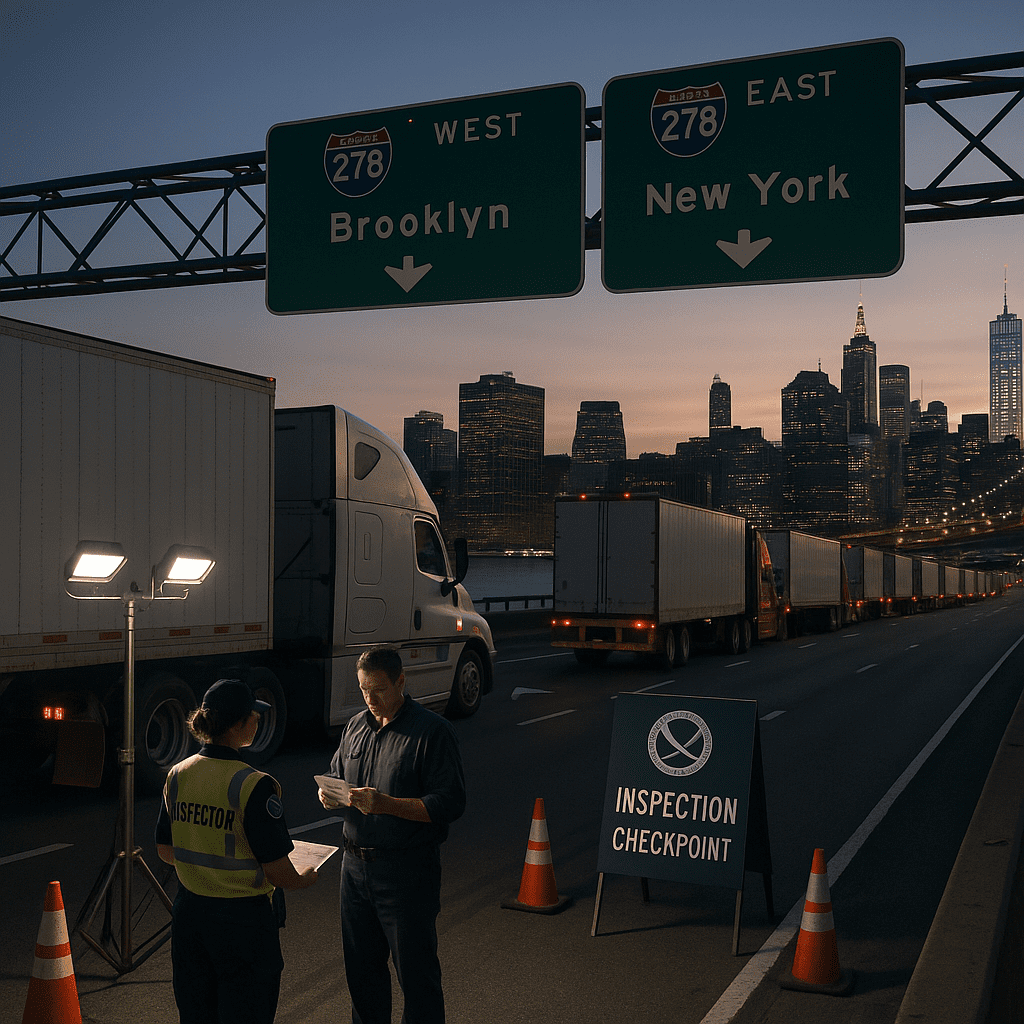
The Transportation Department is threatening to withhold $73 million in federal highway funds from New York over allegedly flawed commercial driver’s licenses issued to immigrants. Federal auditors say many licenses outlast workers’ legal authorization and that the state can’t document checks on tens of thousands of holders. New York insists it complies with federal rules and accuses Washington of score‑settling. The clash could affect labor supply in critical freight corridors and test how far funding leverage can push state licensing policy.
The Biden administration’s threat to strip New York of $73 million in federal highway funding over flawed immigrant commercial driver’s licenses has become an unmistakable instrument of leverage in domestic policy, with direct implications for the resilience of U.S. trade corridors. Transportation Secretary Sean Duffy warned that highway money will be withheld unless New York overhauls how it licenses non‑citizen commercial drivers, sharpening the link between federal funding, state immigration practices and the workforce that moves freight. At issue is whether the state has been issuing commercial licenses that remain valid long after immigrants are legally authorized to work in the United States, potentially putting unqualified drivers behind the wheel of 80,000‑pound trucks that underpin interstate commerce.
Federal investigators reviewed 200 non‑domiciled commercial licenses in New York and concluded that more than half had been issued improperly, Duffy said. Many defaulted to an eight‑year validity period regardless of when the driver’s work permit expired, and in some cases, New York issued licenses even when work authorizations were already lapsed. Beyond the sample, investigators found the state could not prove it had verified immigration status for the 32,000 active non‑domiciled commercial licenses on its books. Those findings gave the Transportation Department the basis to wield highway dollars as a compliance weapon, tying infrastructure investment to the integrity of licensing systems that keep freight corridors safe and predictable.
New York officials flatly dispute the federal narrative, underscoring how politicized that leverage has become. State DMV spokesperson Walter McClure insisted that New York “has, and will continue to, comply with federal rules,” arguing that commercial driver’s licenses are already regulated by Washington. He accused Duffy of “lying about New York State once again in a desperate attempt to distract from the failing, chaotic administration he represents.” The clash reflects more than a technical disagreement over record‑keeping; it is a contest over who defines acceptable risk in the commercial trucking workforce, which forms a critical link in domestic supply chains and cross‑border logistics.
Duffy, for his part, framed the campaign as a safety‑driven push that only incidentally touches immigration. He launched the broader effort after a truck driver who was not authorized to be in the U.S. made an illegal U‑turn and caused a fatal crash in Florida that killed three people, though the article notes that the licensing rules involved have been in place for years. “It is about making sure everyone behind the wheel of an 80,000‑pound truck is qualified and safe,” he said, rejecting suggestions that targeting Democratic‑led states is politically motivated. Despite those denials, the concentration of enforcement in a handful of blue states gives the funding threats clear domestic political resonance alongside their operational impact.
The Transportation Department is auditing non‑domiciled commercial licenses nationwide, but so far the only states Duffy has threatened to sanction are New York, California, Pennsylvania and Minnesota, all led by Democratic governors. In California, that pressure produced an immediate and sweeping response: the state revoked 17,000 licenses after auditors found that some credentials remained valid long after work permits had expired. Duffy has also threatened to withhold “millions” from California, Pennsylvania and Minnesota over similar findings. These moves demonstrate how federal agencies can translate safety concerns into hard financial leverage, forcing states to recalibrate how they vet immigrant drivers who are central to freight flows.
The stakes for the trucking workforce are substantial because immigrants are already deeply embedded in moving U.S. goods. Immigrants account for about 20% of all truck drivers, according to the federal data cited in the article, while non‑domiciled licenses make up only about 5% of all commercial licenses. That imbalance means a relatively small slice of credentials is now jeopardizing a large share of labor capacity in an industry where delays ripple quickly through ports, warehouses and retail shelves. Aggressive revocations or restrictive new rules could thin the ranks of experienced immigrant drivers just as policymakers are trying to strengthen supply chains and maintain reliable trade corridors.
Regulatory uncertainty compounds the risk. The Transportation Department has already proposed new restrictions that would “severely limit” which non‑citizens can obtain commercial licenses, but a court has put those rules on hold. For now, enforcement is being driven through audits and targeted funding threats rather than a new nationwide standard. That leaves states guessing how far they must go to satisfy Washington, even as they insist they are already compliant, as New York does. In practical terms, this uncertainty can slow investments in training, licensing infrastructure and data systems that would otherwise shore up the reliability of interstate freight routes.
New York has 30 days to answer the federal findings, a deadline that will determine whether the state loses the $73 million in question or negotiates changes that keep the money flowing. In the meantime, the episode signals to other states that commercial licensing for immigrants is now a frontline test of both safety policy and geopolitical competitiveness. How New York responds—and whether the Transportation Department escalates or narrows its campaign—will be closely watched by shippers, carriers and state governments that depend on stable highway funding to sustain infrastructure and the supply lines built upon it.

Olivia Kendall serves as the Senior Correspondent for Geopolitics, Defense, and Foreign Policy at Just Right News, where she provides a principled, conservative perspective on the complex forces shaping the global stage. With a career dedicated to deconstructing the intricacies of international relations, Kendall has become a trusted voice for readers who value national sovereignty, a robust military, and a foreign policy that prioritizes American interests above all else.
A native of Washington, D.C., Kendall’s professional journey is deeply rooted in her upbringing within the nation’s capital. Growing up in the epicenter of American political life, she developed an early and profound understanding of how policy is crafted and, more importantly, how it often fails to account for the values of the American heartland. This unique vantage point allowed her to witness firsthand the rise of globalist bureaucracies, fueling her commitment to reporting that champions the constitutional foundations of the United States. Her background as a British White American further informs her worldview, providing her with a keen appreciation for the Western tradition and the enduring importance of the “Special Relationship” in maintaining global stability.
Now based in Arlington, Virginia, Kendall operates from the doorstep of the Pentagon and the heart of the nation’s defense establishment. Her proximity to the decision-makers in the military and intelligence communities allows her to provide boots-on-the-ground reporting that is both timely and deeply informed. For Kendall, Arlington is more than just a base of operations; it is a daily reminder of the sacrifices made by the men and women in uniform. This connection to the defense community drives her rigorous coverage of military readiness and her advocacy for a “peace through strength” approach to diplomacy.
At Just Right News, Kendall is perhaps best known for her acclaimed feature series, “The World’s Shadow on America.” In this ongoing project, she explores the direct correlation between international developments and the daily lives of American citizens. Whether she is analyzing the encroachment of foreign adversaries in domestic supply chains or the impact of international treaties on local economies, Kendall’s work serves as a vital bridge between distant geopolitical shifts and their consequences at home. She rejects the notion that foreign policy is an abstract concern for elites, instead proving that what happens in the corridors of power in Brussels or Beijing has a tangible “shadow” that falls across every American doorstep.
Throughout her tenure, Kendall has remained a steadfast critic of international overreach and a vocal proponent of a clear-eyed, realistic foreign policy. She brings a sharp analytical mind to her beat, often challenging the prevailing narratives of the mainstream media to uncover the underlying truths that affect national security. Her reporting is characterized by a refusal to compromise on the truth and a dedication to the idea that a strong, secure America is the world’s best hope for liberty. As a Senior Correspondent, Olivia Kendall continues to lead the charge in providing the essential context and conservative insight necessary to navigate an increasingly volatile world.