

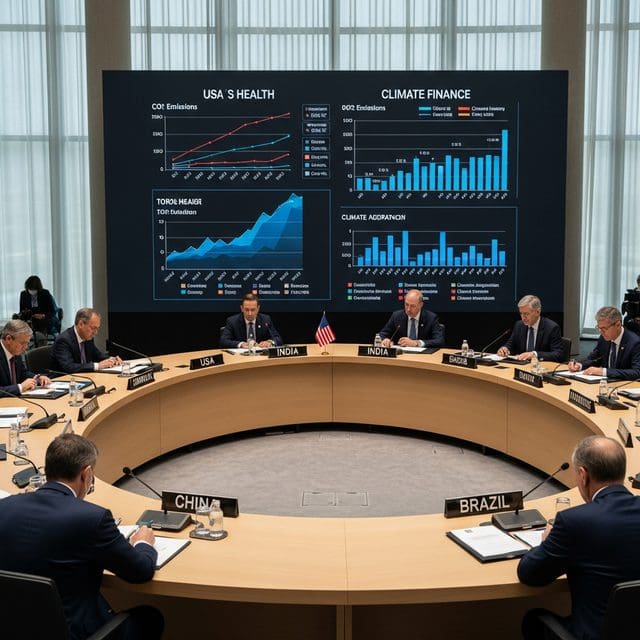
Health advocates are demanding $120 billion annually for climate-resilient systems, sparking debates over fiscal transparency and the conditioning of foreign aid on surveillance data.
Negotiations at the Bonn UN climate talks have taken a sharp turn toward fiscal expansionism, as a coalition of global health groups urges governments to triple grant-based adaptation finance. The proposed target of at least $120 billion annually by 2035 seeks to elevate climate-resilient health systems from a peripheral concern to a core pillar of international development policy. This demand coincides with a broader push by African leaders to close a $2.7 trillion climate finance gap, arguing that current funding levels cover less than a quarter of the continent’s projected needs. For American observers, the scale of these requests necessitates a skeptical look at the intersection of global bureaucracy and national sovereignty.
While the World Health Organization is simultaneously appealing for nearly $1 billion to maintain services in conflict zones, the institutional appetite for such expenditures is meeting significant resistance. The UN’s 2026 Financing for Sustainable Development Report warns of a ‘financing squeeze’ in developing nations, driven by high borrowing costs and debt service obligations. This economic reality suggests that the era of open-ended development grants may be reaching a breaking point. For the American taxpayer, these developments raise critical questions regarding the efficiency of multilateral aid and the lack of market-driven accountability in how these funds are allocated across the globe.
The health sector currently receives less than 0.5% of multilateral climate finance, a statistic frequently cited by organizations like Amref to justify larger budgetary carve-outs. However, the push for increased funding is complicated by emerging reports on the strings attached to such aid. A June assessment by Human Rights Watch highlights concerns that recent U.S. global health aid agreements in Africa have conditioned life-saving assistance on extensive surveillance access and pathogen data rights. This raises the specter of a bureaucratic quid pro quo that prioritizes data harvesting over tangible health outcomes, potentially compromising the individual liberty of those the programs claim to serve.
Furthermore, global climate finance to Africa actually decreased following the pandemic as aid was reallocated to other geopolitical priorities. This trend suggests that despite the rhetoric of ‘global collaboration,’ many donor nations are reassessing their international commitments in favor of national sovereignty and domestic fiscal health. The current debate in Bonn reflects a fundamental tension: health advocates view climate-resilient systems as a public good requiring massive state-led investment, while skeptics point to the lack of equitable benefit-sharing and the potential for administrative bloat within the UN apparatus.
In addition to these financial hurdles, the technological landscape is shifting rapidly. While Dahua Technology recently showcased AIoT innovations for renewable energy at Intersolar Europe 2026, and IBM announced breakthroughs in sub-1 nanometer chip technology, the application of these market-driven advancements to the developing world remains uneven. Instead of fostering private-sector solutions, the current UN narrative remains focused on state-to-state transfers. African leaders at the Africa Forward Summit have noted that the current funding gap jeopardizes both development goals and health resilience, yet the reliance on grant-based models rather than investment-friendly policy reform continues to dominate the discourse.
As the EU-supported programmes begin calling for integrated climate-health responses in sub-Saharan Africa, the challenge remains whether these initiatives can move beyond the ‘financing squeeze’ without infringing on the sovereignty of recipient nations or the wallets of donor citizens. Without a shift toward transparent, results-oriented development models that prioritize individual liberty over data surveillance, the ambitious $120 billion target may remain a point of contention rather than a path to resilience. The American stake in this debate is clear: ensuring that global health security does not become a pretext for unchecked spending and centralized control.

Rachel Vaughn serves as a Senior Correspondent for Just Right News, where she leads the network’s coverage of Global Health, Climate, and Development. With a career defined by intellectual rigor and a commitment to principled reporting, Rachel provides a vital conservative perspective on some of the most complex and high-stakes issues facing the world today. Her work is characterized by a refusal to accept bureaucratic narratives at face value, focusing instead on how international policies impact national sovereignty, individual liberty, and the American taxpayer.
Raised in New Haven, Connecticut, Rachel grew up in an environment dominated by elite academic discourse. This upbringing provided her with a front-row seat to the inner workings of the American establishment, but it also instilled in her a healthy skepticism of the “ivory tower” consensus. She learned early on that while academic theories may sound promising in a lecture hall, they often fail to account for the practical realities of the working class. This background drives her to bridge the gap between high-level policy discussions and the common-sense concerns of everyday citizens, ensuring that her reporting remains grounded and accessible.
Now based in Burlington, Vermont, Rachel operates from a unique vantage point within one of the nation’s most progressive political landscapes. Living and working in a region that often serves as a testing ground for radical social and environmental experiments allows her to witness the real-world consequences of these policies firsthand. From her base in the Green Mountain State, she provides Just Right News readers with essential “boots on the ground” reporting, documenting the friction between local mandates and the constitutional freedoms of the individual. Her presence in Burlington ensures that her critiques of globalist agendas are informed by a direct understanding of how those ideologies manifest at the local level.
In her acclaimed feature series, “Planetary Stakes,” Rachel explores the intersection of international development and environmental stewardship. She rejects the alarmism often found in mainstream media, opting instead for a sober analysis of the economic and geopolitical costs of global climate agreements. Her reporting frequently highlights the importance of market-driven innovation and the role of American leadership in fostering global health without ceding authority to unelected international bodies. Through “Planetary Stakes,” she has become a leading voice for those who believe that true conservation and public health are best achieved through transparency, accountability, and the protection of private property rights.
Throughout her tenure at Just Right News, Rachel has distinguished herself as a journalist who is unafraid to ask difficult questions of global institutions. Whether she is investigating the influence of non-governmental organizations on domestic policy or analyzing the fiscal transparency of international health initiatives, her goal remains the same: to provide her audience with the facts necessary to navigate an increasingly interconnected world. Her blend of East Coast intellectual heritage and her current immersion in the political heart of the Northeast makes her an indispensable asset to the newsroom and a trusted source for readers seeking a principled, conservative take on the issues that define our era.