

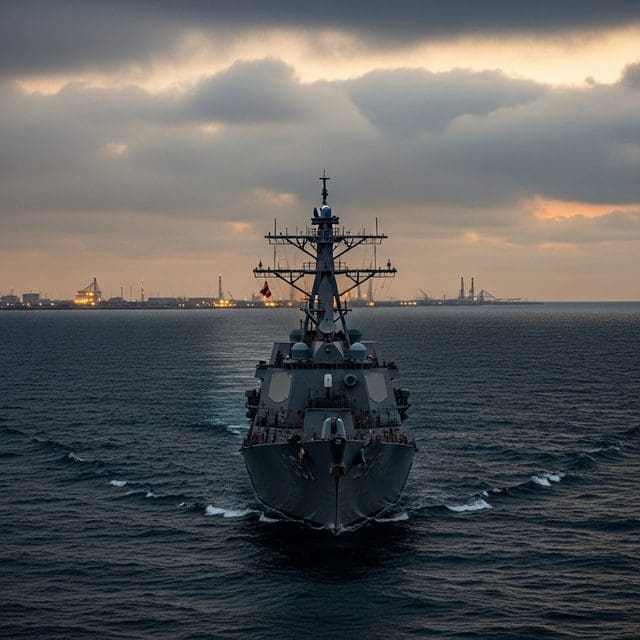
The Trump administration launched retaliatory strikes against Iranian military sites following drone attacks on commercial shipping, as Tehran asserts unilateral control over the world’s most critical maritime chokepoint.
The fragile detente in the Middle East has disintegrated into direct military confrontation. On June 27, 2026, the U.S. military conducted strikes against Iranian targets following persistent aggression against commercial shipping. These actions followed an Iranian drone attack on the tanker Kiku/Ever Lovely, an incident that effectively nullified the June 17 ceasefire memorandum. The collapse of this truce marks a significant shift, as both Washington and Tehran now openly charge one another with violating the interim agreement.
U.S. Central Command confirmed that Navy and Air Force assets neutralized approximately ten Iranian military installations, including coastal radar sites and missile storage facilities near Sirik and Qeshm Island. In retaliation, the Islamic Revolutionary Guard Corps launched ballistic missiles and drones targeting the U.S. Ali Al Salem airbase in Kuwait and the U.S. Fifth Fleet in Bahrain. While Tehran frames these strikes as defensive, the Trump administration has signaled that its patience for maritime disruption has ended. The President warned that Iran “will no longer exist” if it continues to target American forces, tying future military action to Tehran’s compliance with navigation protocols.
Tehran has moved to institutionalize its leverage over global energy markets by claiming sole authority over the Strait of Hormuz. Iranian officials now insist all foreign vessels must follow routes designated by their armed forces, asserting that no other institution possesses responsibility for navigation in these waters. This challenge to the Western doctrine of freedom of navigation places NATO and global shipping markets in a precarious position. The UK Maritime Trade Operations has already reported renewed attacks on commercial vessels near Oman, raising immediate questions regarding convoy protection and sanctions enforcement.
In Iraq, the geopolitical shift is mirrored by internal upheaval. Prime Minister Ali al-Zaidi ordered a lockdown of Baghdad’s Green Zone, executing a dawn sweep that resulted in the arrest of several high-ranking officials and members of Parliament. These figures, tied to Iran-aligned parties, are accused of involvement in oil-smuggling and espionage. The arrests reached a deputy oil minister and a senior National Security Service official. This crackdown represents a strategic effort by the Iraqi government to distance itself from Tehran’s influence and consolidate power under a nationalist mandate.
While the Middle East remains a flashpoint, the technological front of the global power struggle is accelerating. Chinese cybersecurity firm 360 Security Technology announced the development of domestic AI tools that match the capabilities of the American Mythos model. This advancement is a strategic cyber capability intended to close the gap in AI-driven offensive operations. As China defies Western restrictions to build the world’s fastest supercomputers, the race for digital supremacy continues to redefine national defense.
These developments underscore a return to a realist equilibrium where power is measured by territorial control, maritime dominance, and technological autonomy. From the shores of Bahrain to the server farms of Beijing, the United States is navigating a landscape where strength is the primary currency of diplomacy. The stakes for American power have rarely been higher as traditional alliances and modern technology converge in a contest for global primacy.

Olivia Kendall serves as the Senior Correspondent for Geopolitics, Defense, and Foreign Policy at Just Right News, where she provides a principled, conservative perspective on the complex forces shaping the global stage. With a career dedicated to deconstructing the intricacies of international relations, Kendall has become a trusted voice for readers who value national sovereignty, a robust military, and a foreign policy that prioritizes American interests above all else.
A native of Washington, D.C., Kendall’s professional journey is deeply rooted in her upbringing within the nation’s capital. Growing up in the epicenter of American political life, she developed an early and profound understanding of how policy is crafted and, more importantly, how it often fails to account for the values of the American heartland. This unique vantage point allowed her to witness firsthand the rise of globalist bureaucracies, fueling her commitment to reporting that champions the constitutional foundations of the United States. Her background as a British White American further informs her worldview, providing her with a keen appreciation for the Western tradition and the enduring importance of the “Special Relationship” in maintaining global stability.
Now based in Arlington, Virginia, Kendall operates from the doorstep of the Pentagon and the heart of the nation’s defense establishment. Her proximity to the decision-makers in the military and intelligence communities allows her to provide boots-on-the-ground reporting that is both timely and deeply informed. For Kendall, Arlington is more than just a base of operations; it is a daily reminder of the sacrifices made by the men and women in uniform. This connection to the defense community drives her rigorous coverage of military readiness and her advocacy for a “peace through strength” approach to diplomacy.
At Just Right News, Kendall is perhaps best known for her acclaimed feature series, “The World’s Shadow on America.” In this ongoing project, she explores the direct correlation between international developments and the daily lives of American citizens. Whether she is analyzing the encroachment of foreign adversaries in domestic supply chains or the impact of international treaties on local economies, Kendall’s work serves as a vital bridge between distant geopolitical shifts and their consequences at home. She rejects the notion that foreign policy is an abstract concern for elites, instead proving that what happens in the corridors of power in Brussels or Beijing has a tangible “shadow” that falls across every American doorstep.
Throughout her tenure, Kendall has remained a steadfast critic of international overreach and a vocal proponent of a clear-eyed, realistic foreign policy. She brings a sharp analytical mind to her beat, often challenging the prevailing narratives of the mainstream media to uncover the underlying truths that affect national security. Her reporting is characterized by a refusal to compromise on the truth and a dedication to the idea that a strong, secure America is the world’s best hope for liberty. As a Senior Correspondent, Olivia Kendall continues to lead the charge in providing the essential context and conservative insight necessary to navigate an increasingly volatile world.