

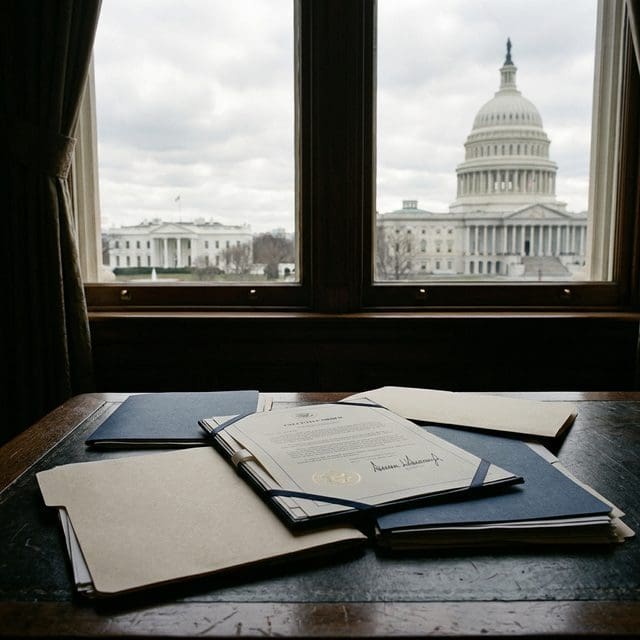
Trump suspended nearly every Russia-related provision of a law passed by Congress, citing peace negotiations and invoking waiver authority written into the statute.
President Donald Trump has waived nearly every Russia-related provision of the Graham Act, suspending sanctions and tariffs set to take effect in two days and raising questions about how broadly a president may use authority Congress placed in the law.
The executive order, signed Friday, says the waivers are in the national interest but gives no further explanation. The White House says enforcing the sanctions now would impede U.S. efforts to negotiate a durable peace between Russia and Ukraine. The waivers remain in place until Trump or the secretary of state, consulting relevant cabinet secretaries, determines further action is warranted.
The law, named for the late Sen. Lindsey Graham, passed Congress by large margins and was signed by Trump last month. Its Russia provisions target political officials and oligarchs, financial institutions, and the so-called shadow fleet of tankers used to evade sanctions. The Senate vote was 86-11, according to Republican Sen. Thom Tillis.
The order waives tariffs of up to 500 percent on Russian goods, including oil and gas, and tariffs of up to 100 percent on major buyers of Russian crude and countries helping Russia evade oil sanctions. It also suspends requirements concerning foreign banks doing significant business with Russian state-owned banks, purchases of Russian sovereign debt, U.S. investment in Russia, and financial transfers benefiting the Russian government or its officials.
The order also waives a statutory requirement that existing sanctions remain in place. It does not itself revoke sanctions previously imposed by executive order, but removing that statutory constraint could allow Trump to change them unilaterally. The administration has not said it is lifting all existing sanctions.
The law expressly permits the president to waive Russian sanctions. Last week, the Treasury Department’s Office of Foreign Assets Control issued a general license authorizing the sale, delivery and import of Russian diesel into the United States through April. The source material describes the license as part of an arrangement under which Russia would supply hundreds of thousands of tons of diesel to U.S. and global markets. Without the waiver, the law would have required tariffs on Russian petroleum products and sanctions on ships carrying them.
Trump also waived a provision allowing sanctions to end if Russia accepted a peace agreement approved by Ukraine and ceased hostilities. Under that provision, Congress could block a termination. The law’s Russia measures are otherwise scheduled to expire in 2031.
The central dispute is not whether the law permits waivers, but how broadly that authority should be used. Congress gave the president power to suspend sanctions, providing a statutory basis for Friday’s order. But the order waives nearly all operative Russia provisions, and its public rationale does not explain why that breadth is necessary. Congress can examine the decision through oversight or revise the authority it granted.
Republican responses were divided. Tillis called the move “beyond irresponsible.” Sen. John Cornyn said Graham “would be appalled” and called for scrutiny. Cornyn, Tillis, Sen. Mitch McConnell and Sen. Susan Collins had earlier urged Trump to end the diesel arrangement and impose sanctions. Rep. Thomas Massie, who voted against the bill, welcomed Trump’s use of authority Congress had granted.
Democratic Sen. Chuck Schumer accused Trump of helping Russia’s economy. Zelenskyy said the decision encourages Russian President Vladimir Putin to keep fighting, while thanking the bipartisan lawmakers who supported the legislation.
The administration argues sanctions could obstruct negotiations; critics say suspending them weakens U.S. leverage. The order makes the executive branch’s immediate choice clear, but leaves lawmakers to decide whether the waiver clause should permit action this sweeping.

Miles Harrington serves as the Senior Correspondent for Federal Systems & Executive Power at Just Right News, where he brings a disciplined, constitutionalist lens to the inner workings of the American government. With a focus on the mechanics of the federal bureaucracy and the limits of executive authority, Harrington has established himself as a vital voice for readers who value transparency, accountability, and the preservation of the separation of powers.
A native of Richmond, Virginia, Harrington’s perspective is deeply rooted in the traditions of the Old Dominion. Growing up in a city defined by its historical significance and its role as a center of American jurisprudence, he developed an early appreciation for the foundational principles of the Republic. His upbringing in Richmond—a place where the legacy of the Founding Fathers is woven into the landscape—instilled in him a belief that the federal government should remain within its constitutional bounds. This background informs his skepticism of centralized overreach and his commitment to reporting on the ways in which the administrative state impacts the lives of everyday citizens.
In his current role, Harrington specializes in the complexities of federal systems. He doesn’t just report on the headlines of the day; he digs into the structural shifts within the executive branch that often go unnoticed by the mainstream press. Whether he is analyzing the implications of a new federal regulation or investigating the expansion of agency jurisdiction, his work is characterized by a rigorous adherence to the facts and a dedication to the rule of law.
Harrington is perhaps best known for his signature feature series, “How Washington Works.” Through this ongoing project, he demystifies the often-opaque processes of the nation’s capital, pulling back the curtain on the “Deep State” and the unelected officials who wield significant influence over national policy. By breaking down complex legislative maneuvers and executive orders, he empowers Just Right News readers to understand the true levers of power in Washington. His reporting serves as a necessary check on the federal government, ensuring that the actions of those in power are held up to the light of public scrutiny.
Now based in Washington, D.C., Harrington operates at the epicenter of the political world, yet he remains intentionally distanced from the “Beltway bubble.” His proximity to the halls of power allows him to maintain a robust network of sources across the federal landscape, but his heart remains in the principled conservatism of his Virginia roots. He views his role not merely as a reporter, but as a steward of the public trust, dedicated to providing the clarity and context that conservative voters need to navigate an increasingly complex political environment.
Through his sharp analysis and unwavering commitment to the truth, Miles Harrington continues to be a cornerstone of the Just Right News team. His work ensures that the principles of limited government and executive restraint remain at the forefront of the national conversation, providing a crucial service to those who believe in a government that is truly of, by, and for the people.