

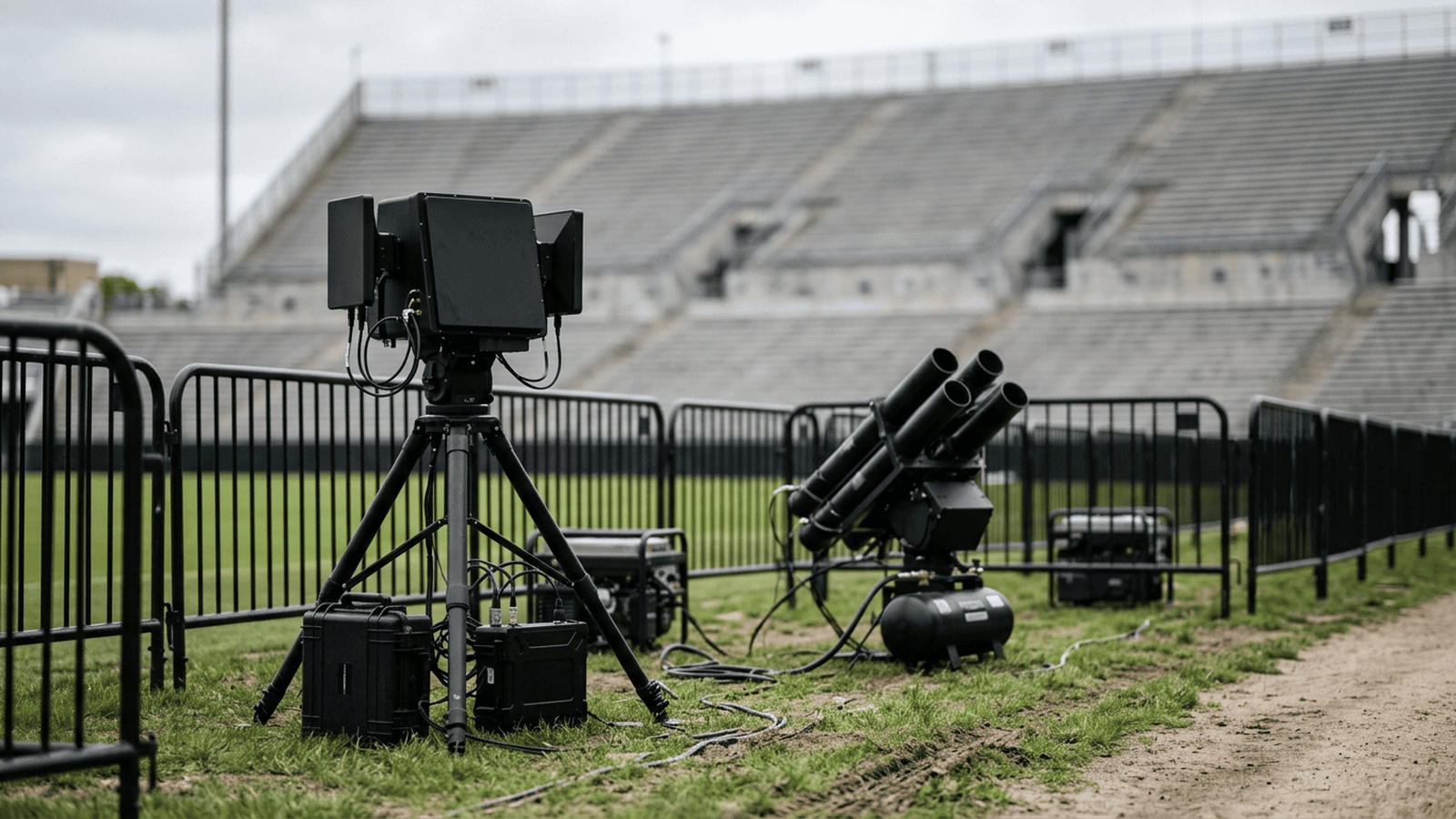
The Secret Service is developing offensive and defensive drone capabilities through a multimillion-dollar program led by Deputy Director Matthew Quinn. The agency says it is planning ahead because drone technology used in conflict could reach the United States, while acknowledging that the swarm problem remains unsolved. It has already used electronic jamming to take down a drone at the December Army-Navy game. The effort comes amid 10,000 reported threats against protectees this year and a 40 percent year-over-year rise in cases involving full-time protectees. The program’s exact budget, completion date and public oversight schedule are not provided in the account.
TLDR: A multimillion-dollar Secret Service effort is developing tools to detect, disable and capture hostile drones, building on lessons from Ukraine and a jamming response at the Army-Navy game. Officials say swarms remain an unsolved challenge, and the program’s full budget and timeline have not been disclosed.
The Secret Service is building new tools to counter attack drones, a threat the agency says it has not fully solved. Deputy Director Matthew Quinn leads a multimillion-dollar program intended to develop both offensive and defensive drone capabilities. One tool under development uses artificial intelligence and radar to find hostile drones, disable them and capture them with a net.
The agency’s stated rationale is straightforward: drone technology used in conflict could reach the United States, so the Secret Service is using lessons from Ukraine to prepare before that happens. Director Sean Curran said the agency must assume attacks are possible to avoid being caught unprepared. That is the basis for the program, rather than a claim that current defenses can stop every threat.
Quinn has described drone swarms as a major problem and said they are not yet solved. He also said the White House is the safest place on Earth. Both statements matter: the agency is expressing confidence in protection at a major site while acknowledging a wider capability gap. Its public account does not specify how many drones a swarm could involve or when the new program will be complete.
The concern includes simple devices, not only advanced military systems. A small, rudimentary drone carrying explosives could cause serious damage at a concert, sporting event or campaign rally, according to the account. Those gatherings bring large numbers of people together, and the agency says it has to plan for risks that may be difficult to identify in advance.
There is one documented example of a response already used in public. The Secret Service used electronic jamming equipment to bring down a drone at the December Army-Navy game, where the president and members of Congress were present. That incident demonstrates an existing countermeasure in use. It does not show that jamming would work against every drone or against a coordinated swarm.
The agency is also dealing with a broader rise in threats to people under its protection. Curran said there have been 10,000 threats against protectees so far this year, and that cases involving full-time protectees are up 40 percent year over year. He attributed some of the increase to the internet, which has made people and information more accessible. Quinn pointed to mental health issues as a major factor, while Curran said the agency does not sort threats by political party.
The drone threat is part of a larger security workload, but the available figures should not be treated as evidence that all threats involve drones. The 10,000 figure covers threats against Secret Service protectees. The excerpt gives no number for drone incidents or for attempted swarm attacks. Keeping those categories separate makes the public record clearer and avoids turning a broad threat count into a more specific claim than the evidence supports.
The agency is making changes after the 2024 Butler attack, when an inspector general report found that the Secret Service missed multiple opportunities to detect, prevent and disrupt the assassination attempt. The report and the agency’s acknowledged staffing shortfall provide context for current preparations. A separate inspector general finding said the counter-sniper team was staffed 73 percent below the level needed to protect the nation’s most senior leaders. Quinn said 942 people are now in training, compared with perhaps 200 the prior year.
The practical impact is an expanded federal security effort, but its full cost and timetable remain undisclosed in the excerpt. The drone program is described only as multimillion-dollar; no itemized budget, fee, public application, form, compliance deadline or enforcement schedule is provided. The people most directly affected by the protective mission include the president and other protectees, while people attending major public events could also be within the potential reach of a drone attack. The source does not identify new limits on public drone use or describe changes to local event rules.
The program’s next steps are to develop and build out the drone capabilities, with the agency applying lessons from Ukraine and drawing on the tools already used to stop a drone at the Army-Navy game. No completion date or public oversight timetable is stated. Those details remain part of the plan, rather than facts that can be filled in from the available account. The acknowledged gap, the inspector general’s findings and the staffing figures give the public concrete measures to watch as the work continues. The agency says it is preparing for the threat; the available facts do not establish that the swarm problem is solved.

Max Grant serves as the Senior Correspondent for Data and Financial Forensics at Just Right News, where he brings a meticulous, investigative eye to the complex world of numbers. In an era where media narratives often overshadow objective reality, Max operates on a simple but firm principle: while rhetoric can be manipulated, the ledger never lies. As the architect behind the acclaimed feature series “Numbers That Talk,” he has carved out a vital niche in conservative journalism, translating dense financial data into clear, actionable insights for the American public.
Max’s journey to the forefront of financial reporting began in Buffalo, New York. Growing up in the Queen City, he was raised with the grit and grounded perspective typical of the Rust Belt. Buffalo is a place that understands the value of a dollar and the consequences of economic shifts on the working class. This upbringing instilled in Max a deep-seated respect for fiscal responsibility and a healthy skepticism toward bureaucratic overreach. He carries the spirit of his hometown into every investigation, viewing his work not just as reporting, but as a form of public service dedicated to protecting the interests of taxpayers and everyday citizens.
Now based in Brooklyn, New York, Max operates from the heart of one of the world’s most influential financial and cultural hubs. This vantage point allows him to keep a close watch on the institutions that drive the global economy. Living and working in a city often defined by progressive policy experiments, Max provides a necessary counter-perspective, using his forensic skills to analyze the real-world costs of local and national governance. His proximity to the financial district ensures he is never far from the source of the data he deconstructs, yet he remains firmly rooted in the conservative values that prioritize transparency and individual liberty.
His beat, Data and Financial Forensics, is more than just a job title; it is a commitment to uncovering the truth hidden within spreadsheets and annual reports. In “Numbers That Talk,” Max dives deep into federal spending, corporate accountability, and the intricate web of international finance. He has a unique ability to spot the anomalies that others miss, identifying where public funds are being mismanaged or where economic policies are failing to deliver on their promises. His reporting is characterized by a relentless pursuit of clarity, stripping away the jargon to show readers exactly how their money is being used and how the economy is truly performing.
At Just Right News, Max Grant is recognized as a steady hand and a sharp mind. He understands that for a free society to function, its citizens must have access to the facts regarding their financial future. By combining his British heritage’s tradition of rigorous inquiry with an American drive for accountability, Max ensures that the numbers don’t just sit on a page—they tell the story of where the country has been and where it is headed. His work stands as a testament to the power of forensic journalism in holding the powerful to account and championing the principles of a transparent, fiscally sound nation.