

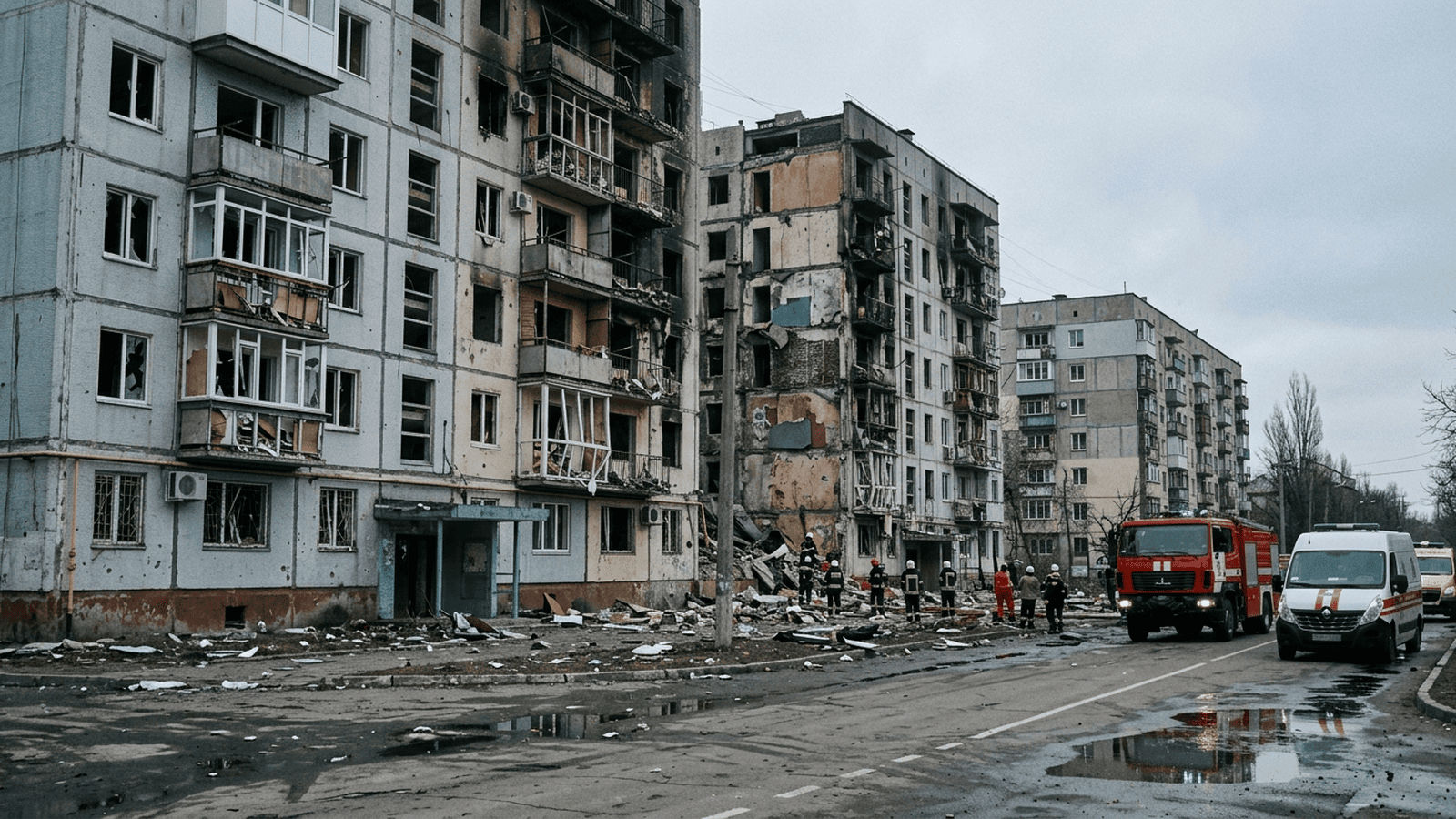
Russian strikes killed at least 15 people, including three children, in Ukraine’s Zaporizhzhia region, and officials reported at least 16 wounded. The attack followed President Donald Trump’s announcement of a Russian diesel supply deal and a temporary Treasury waiver of energy sanctions. Trump described deliveries beginning immediately, with further shipments planned for November and later, though the excerpt provides no prices or complete contract terms. The administration’s stated aim is to address high fuel prices and allow Russian diesel into the global market. Ukrainian officials say the arrangement could strengthen Moscow’s ability to continue the war, while Trump’s envoys were meeting Ukrainian officials to discuss a proposal to end it.
TLDR: Officials reported at least 15 deaths in Zaporizhzhia after Russian bombs hit residential buildings. The attack came a day after Trump announced Russian diesel shipments and Treasury said it would temporarily waive energy sanctions to permit supply to the global market.
Russian strikes killed at least 15 people, including three children, in Ukraine’s Zaporizhzhia region on Saturday, according to regional officials. At least 16 people were wounded. The attack came one day after President Donald Trump announced an agreement for Russian diesel supplies and the Treasury Department said it would temporarily waive sanctions on Russia’s energy sector.
The administration’s stated rationale for the diesel arrangement is to address high fuel prices and allow Russian diesel to reach the global market. Treasury described the temporary sanctions waiver as a way to “allow the supply of Russian diesel to the global market.” The announcement makes energy supply and consumer fuel costs a direct part of the policy decision, even as Ukrainian officials warn that revenue from Russian energy sales could support Moscow’s war.
Officials said Russian aerial bombs struck residential buildings in Zaporizhzhia. Mykhailo Semikin, head of the regional military administration, reported the strikes. Ivan Fedorov, co-chair of the region’s defense council, said at least 16 people were wounded. The reported death toll was at least 15, with three children among those killed.
The attack is part of a wider aerial conflict. Russia and Ukraine continue long-range strikes while their armies remain largely deadlocked on the front line, more than four and a half years after Russia’s full-scale invasion. Ukraine has struggled to counter escalating Russian bombardments. Those attacks have killed more than 60 people over the past four days, according to the report.
The diesel agreement was announced after a phone call between Trump and Russian President Vladimir Putin. Trump said the call had been expected to address a suspected plague case in Russia. Instead, he announced a supply arrangement. He said Russia would immediately provide more than 300,000 tons of diesel, followed by 500,000 tons in November and one million tons “immediately thereafter.” He also described a further three million tons to be delivered within a short period, based on the condition of Russian refineries.
Those quantities and delivery descriptions came from Trump’s social media post. The excerpt does not provide prices, a full contract, or other commercial terms. It also does not specify the duration of the Treasury waiver. The reported timetable includes an immediate initial supply and a November delivery, while the timing of later deliveries is described only in general terms.
The decision reverses years of U.S. pressure on Moscow over the war and comes after Trump signed a broad Russia sanctions law last month. That law sought to restrict oil and gas revenue that helps fund the war. The temporary waiver creates a clear tension between that sanctions approach and the new effort to permit Russian diesel exports. The report does not explain how the waiver interacts with the broader law beyond identifying the temporary change.
Ukrainian President Volodymyr Zelenskyy linked the timing of the strikes to the sanctions decision. On social media, he said Russia had responded to the easing of pressure by dropping five glide bombs on residential buildings. He argued that Moscow treats reduced pressure as permission to continue fighting and attacking cities. His account is a statement by Ukraine’s president; the excerpt separately reports that Russian aerial bombs hit residential buildings and that officials reported deaths and injuries.
Zelenskyy also said the diesel arrangement could help finance Russia’s war and allow it to continue longer. The Ukrainian Embassy in Washington described his view of the decision as a weak choice by strong partners. In Kyiv, people gathered at a memorial to fallen soldiers reacted with anger and resignation. One attendee, Oleksandr Petrenko, said he believed the administration was focused on fuel prices and the coming U.S. midterm elections. Those remarks reflect his assessment, not an established account of the administration’s motives.
The immediate practical impact described in the report is a temporary waiver of sanctions on Russia’s energy sector and a planned flow of diesel in several stated installments. The affected parties include Russian energy suppliers, the global diesel market, and U.S. consumers whom the administration is seeking to protect from high fuel prices. No fee, consumer price reduction, application form, new reporting requirement, or compliance deadline is specified. The cost of the arrangement and the precise enforcement terms are also not provided, so those details remain unclear in the available account.
At the same time, the arrangement sets aside the recent policy of using sanctions to limit Russian energy income. That trade-off touches familiar concerns about accountability, national interests, and the reliability of rules. The available reporting does not establish whether the deal will lower fuel prices or how Russian revenues will be monitored under the waiver. Trump’s envoys Steve Witkoff and Jared Kushner were meeting Ukrainian officials in Miami to discuss a proposal to end the war when he announced the agreement. Those talks are the next reported diplomatic step; the excerpt gives no further timetable or oversight plan for the diesel deliveries. Any additional monitoring or compliance steps are not described and should not be assumed.

Ryan Mitchell serves as a Staff Writer for Just Right News, where he anchors the desk for Cyber, Technology Policy, and Digital Sovereignty. In an era where the digital landscape has become as much a battlefield as any physical territory, Ryan provides a critical conservative lens on the forces shaping the future of American innovation and national security. His work is defined by a commitment to the idea that American leadership in the digital age is not just a matter of economic success, but a necessity for the preservation of global liberty.
Born and raised in Austin, Texas, Ryan’s perspective is deeply rooted in the Lone Star State’s tradition of independence and skepticism of centralized authority. Growing up in a city that transformed from a quiet state capital into a global technology hub, he witnessed firsthand the disruptive power of the tech industry. This upbringing instilled in him a firm belief in free-market principles and the necessity of protecting individual liberties from both government overreach and corporate overstep. His Texan background serves as a foundational compass, guiding his reporting toward stories that emphasize national resilience and the preservation of constitutional values in an increasingly virtual world.
Now based in San Francisco, California, Ryan operates from the epicenter of the very industry he scrutinizes. Living and working in the heart of Silicon Valley allows him to provide “boots on the ground” reporting that few conservative journalists can match. He navigates the cultural and political complexities of the Bay Area to bring Just Right News readers an inside look at the boardrooms and coding labs where the next generation of digital policy is forged. For Ryan, being stationed in San Francisco is a strategic choice; it allows him to challenge the prevailing ideological monoculture of the tech elite from within their own backyard, ensuring that the concerns of middle America are represented in the conversation about our digital future.
His beat—Cyber, Technology Policy, and Digital Sovereignty—covers the high-stakes world of data privacy, artificial intelligence, and the infrastructure of the modern web. Ryan is particularly focused on the concept of digital sovereignty, arguing that for a nation to remain truly free, it must maintain control over its own technological destiny and critical infrastructure. He frequently explores how international regulations and domestic policies impact the ability of American firms to compete without sacrificing the privacy or security of their citizens.
Central to his current body of work is his featured series, “The New Cold War.” Through this project, Ryan examines the escalating technological rivalry between the United States and its global adversaries. He delves into the complexities of state-sponsored hacking, the global race for semiconductor dominance, and the ideological struggle to define the rules of the internet. Ryan views this competition not merely as a commercial race, but as a fundamental defense of Western values against authoritarian digital models. Through his rigorous reporting and principled analysis, Ryan Mitchell ensures that the readers of Just Right News stay informed about the invisible forces defining the 21st century, always advocating for a future where technology serves the cause of freedom.