

Ukraine says Russia broke a proposed energy truce as NATO prepares a deterrence message and attacks threaten civilian and digital infrastructure.
The proposed pause in Russian and Ukrainian attacks on energy infrastructure is already under strain. Ukrainian President Volodymyr Zelensky accused Russia on October 12 of violating the arrangement with a strike on a thermal power plant in Kharkiv and urged Washington to enforce it. Reuters reported that Russia had not confirmed the agreement.
President Donald Trump said a day earlier that Russia and Ukraine had agreed to stop attacking each other’s energy facilities. Zelensky said Ukraine would comply if Russia did. The gap between the announcement and the competing accounts is the central test: whether a political declaration can restrain the fighting, and what leverage Washington will use if it does not.
Energy infrastructure is strategically important because damage can disrupt electricity, industry and military operations. A pause limited to these facilities might reduce immediate risks without resolving the war. But without agreed terms and a way to verify violations, each side can accuse the other while attacks continue. The Wall Street Journal reported that oil prices rebounded amid doubts about the truce and a Houthi-linked attack on a Saudi airport.
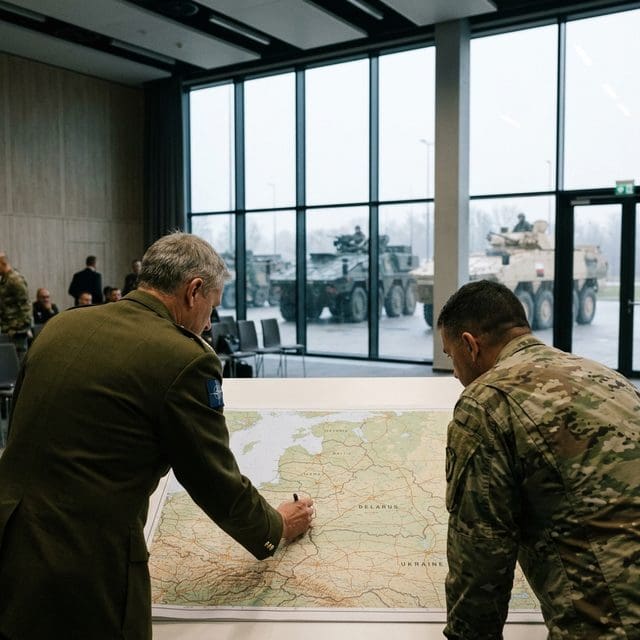
NATO’s response is focused on deterrence, not the ceasefire itself. Gen. Alexus Grynkewich, the alliance’s Supreme Allied Commander Europe, was expected on October 12 to outline NATO’s “theory of victory” at a Warsaw security conference, AFP reported. The alliance’s message, according to AFP, is that it can counter an attack and remains defensive in posture. The Financial Times separately reported that Grynkewich warned Moscow against attacks in Europe, including hybrid activity.
Credible deterrence requires forces, readiness and political agreement among member states. A clear account of how NATO would respond can help prevent miscalculation; divided or vague signals can invite it. The issue matters to Americans because the United States remains central to NATO’s military capacity, even as Washington weighs European security against other demands on its resources. The Warsaw message is meant to reassure allies and make the potential costs of aggression clear to Moscow.
The conflict’s effects extend beyond military targets. The Register reported that Ukrainian drone strikes on Yandex data centers disrupted the Russian company’s cloud services and payments, with connectivity falling sharply, according to the outlet. The report illustrates how attacks on digital infrastructure can affect ordinary users and financial access. The supplied reporting does not independently establish the scale of the damage or clarify whether the facilities were military targets.
Saudi Arabia said it faced a new barrage of incoming fire on October 12 and that Riyadh airport would remain closed, Reuters reported in coverage carried by Al-Monitor. Reuters also reported interceptions involving missiles and drones. The attacks threaten a regional transport hub and underscore the vulnerability of civilian infrastructure. The available reporting does not establish who carried out every reported attack or verify its full effects.
A separate defense concern is navigation when satellite signals are disrupted. SOFREP reported that Northrop Grumman is developing Lumberjack, a system intended to navigate without GPS using magnetic maps. Backup navigation could matter to the Pentagon because adversaries can degrade satellite signals used for military positioning and operations. The available information does not establish the system’s maturity or fielding timeline.
Together, these developments point to a basic constraint: agreements and alliances matter when backed by capability and clear decisions. The energy truce remains disputed, NATO is working to communicate deterrence, and civilian and digital networks are exposed to conflict. Washington’s challenge is to press for verifiable limits while sustaining the strength that makes them consequential.

Olivia Kendall serves as the Senior Correspondent for Geopolitics, Defense, and Foreign Policy at Just Right News, where she provides a principled, conservative perspective on the complex forces shaping the global stage. With a career dedicated to deconstructing the intricacies of international relations, Kendall has become a trusted voice for readers who value national sovereignty, a robust military, and a foreign policy that prioritizes American interests above all else.
A native of Washington, D.C., Kendall’s professional journey is deeply rooted in her upbringing within the nation’s capital. Growing up in the epicenter of American political life, she developed an early and profound understanding of how policy is crafted and, more importantly, how it often fails to account for the values of the American heartland. This unique vantage point allowed her to witness firsthand the rise of globalist bureaucracies, fueling her commitment to reporting that champions the constitutional foundations of the United States. Her background as a British White American further informs her worldview, providing her with a keen appreciation for the Western tradition and the enduring importance of the “Special Relationship” in maintaining global stability.
Now based in Arlington, Virginia, Kendall operates from the doorstep of the Pentagon and the heart of the nation’s defense establishment. Her proximity to the decision-makers in the military and intelligence communities allows her to provide boots-on-the-ground reporting that is both timely and deeply informed. For Kendall, Arlington is more than just a base of operations; it is a daily reminder of the sacrifices made by the men and women in uniform. This connection to the defense community drives her rigorous coverage of military readiness and her advocacy for a “peace through strength” approach to diplomacy.
At Just Right News, Kendall is perhaps best known for her acclaimed feature series, “The World’s Shadow on America.” In this ongoing project, she explores the direct correlation between international developments and the daily lives of American citizens. Whether she is analyzing the encroachment of foreign adversaries in domestic supply chains or the impact of international treaties on local economies, Kendall’s work serves as a vital bridge between distant geopolitical shifts and their consequences at home. She rejects the notion that foreign policy is an abstract concern for elites, instead proving that what happens in the corridors of power in Brussels or Beijing has a tangible “shadow” that falls across every American doorstep.
Throughout her tenure, Kendall has remained a steadfast critic of international overreach and a vocal proponent of a clear-eyed, realistic foreign policy. She brings a sharp analytical mind to her beat, often challenging the prevailing narratives of the mainstream media to uncover the underlying truths that affect national security. Her reporting is characterized by a refusal to compromise on the truth and a dedication to the idea that a strong, secure America is the world’s best hope for liberty. As a Senior Correspondent, Olivia Kendall continues to lead the charge in providing the essential context and conservative insight necessary to navigate an increasingly volatile world.