

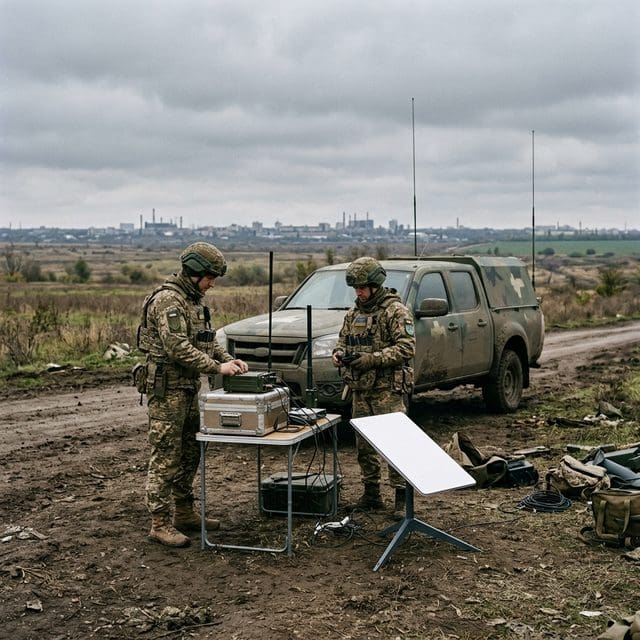
Ukrainian units report brief Starlink signal losses as Kyiv seeks answers, amid Russian strikes, an uncertain energy truce and rising costs from the Iran war.
Ukraine’s reliance on Starlink for battlefield communications has become a fresh point of uncertainty in a war where connectivity can shape military operations. On October 14, Ukraine’s 7th Rapid Reaction Corps reported signal losses lasting 10 to 20 seconds at speeds of 110 to 120 kilometers per hour. One unmanned-systems unit canceled missions, according to military reporting. Later accounts described dropouts at lower speeds, though that threshold was not independently established.
Ukrainian officials have asked both the U.S. government and SpaceX to explain the restriction, but had received no response as of October 14, NBC News reported. The White House and SpaceX had not commented. Available reporting does not establish why the service changed or whether the disruptions were intended to limit a particular military activity.
Starlink has become an important communications tool for Ukrainian forces, including for drone operations. Poland says it pays Ukraine’s subscription, and Foreign Minister Radosław Sikorski publicly challenged Elon Musk over the restrictions on October 14. The episode shows how a privately operated U.S. communications network can affect an allied country’s military capacity—and how difficult that dependence can be when a change goes unexplained.
Some Ukrainian officials and analysts have interpreted the move as potentially connected to President Donald Trump’s pressure on Kyiv over attacks against Russian energy infrastructure. No public evidence establishes that link. Speculation about the motive is not a confirmed account of what Washington or SpaceX decided.
The uncertainty coincides with competing signals about a possible Russia-Ukraine energy truce. A White House official described the proposal as a potential deal that would initially halt attacks on oil refineries. Ukraine said it had not attacked Russian energy targets for the preceding two days. Yet President Volodymyr Zelensky said Russia fired 39 ballistic missiles and more than 120 drones at energy and critical infrastructure in Kyiv, the surrounding region and Kharkiv on October 14. He called the strikes “ostentatious disrespect” toward Trump.
A truce limited to energy targets would fall short of a general ceasefire. The reported attacks underscore the difficulty of turning a proposed arrangement into a durable one. For the United States, the test is whether Washington can make its leverage understandable and credible to both sides. Unexplained changes to a service used by Ukrainian forces risk adding doubt as the administration discusses limits on attacks against energy infrastructure.
The stakes also reach American households. U.S. inflation rose to 3.7% year over year in September, from 3.4% in August; core inflation was 2.6%. The Iran war’s disruption of oil and gas supplies was identified as a major supply shock. Diesel prices remained above $6 a gallon on October 13 amid a global shortage. Those pressures help explain why energy figures in discussions involving Russia, even as bipartisan lawmakers object to easing sanctions for Russian diesel supplies.
Princeton scheduled a public discussion on October 14 featuring Peter Pomerantsev, a senior fellow at Johns Hopkins University, titled “Is Putin Really Winning?” The event listing said it would examine propaganda, unity, strength and deterrence; it provided no new assessment by Pomerantsev. The question points to a practical challenge for Western policy: Russia’s position depends not only on battlefield gains, but also on whether it can exploit divisions, uncertainty and economic strain among its opponents.
For Kyiv, reliable communications and predictable U.S. policy are military necessities. For Washington and its allies, the episode is a reminder that leverage works best when its purpose and limits are clear. As the energy truce remains unsettled, the terms of support—and the systems behind it—are part of the contest over whether Western commitments can shape Russia’s calculations.

Olivia Kendall serves as the Senior Correspondent for Geopolitics, Defense, and Foreign Policy at Just Right News, where she provides a principled, conservative perspective on the complex forces shaping the global stage. With a career dedicated to deconstructing the intricacies of international relations, Kendall has become a trusted voice for readers who value national sovereignty, a robust military, and a foreign policy that prioritizes American interests above all else.
A native of Washington, D.C., Kendall’s professional journey is deeply rooted in her upbringing within the nation’s capital. Growing up in the epicenter of American political life, she developed an early and profound understanding of how policy is crafted and, more importantly, how it often fails to account for the values of the American heartland. This unique vantage point allowed her to witness firsthand the rise of globalist bureaucracies, fueling her commitment to reporting that champions the constitutional foundations of the United States. Her background as a British White American further informs her worldview, providing her with a keen appreciation for the Western tradition and the enduring importance of the “Special Relationship” in maintaining global stability.
Now based in Arlington, Virginia, Kendall operates from the doorstep of the Pentagon and the heart of the nation’s defense establishment. Her proximity to the decision-makers in the military and intelligence communities allows her to provide boots-on-the-ground reporting that is both timely and deeply informed. For Kendall, Arlington is more than just a base of operations; it is a daily reminder of the sacrifices made by the men and women in uniform. This connection to the defense community drives her rigorous coverage of military readiness and her advocacy for a “peace through strength” approach to diplomacy.
At Just Right News, Kendall is perhaps best known for her acclaimed feature series, “The World’s Shadow on America.” In this ongoing project, she explores the direct correlation between international developments and the daily lives of American citizens. Whether she is analyzing the encroachment of foreign adversaries in domestic supply chains or the impact of international treaties on local economies, Kendall’s work serves as a vital bridge between distant geopolitical shifts and their consequences at home. She rejects the notion that foreign policy is an abstract concern for elites, instead proving that what happens in the corridors of power in Brussels or Beijing has a tangible “shadow” that falls across every American doorstep.
Throughout her tenure, Kendall has remained a steadfast critic of international overreach and a vocal proponent of a clear-eyed, realistic foreign policy. She brings a sharp analytical mind to her beat, often challenging the prevailing narratives of the mainstream media to uncover the underlying truths that affect national security. Her reporting is characterized by a refusal to compromise on the truth and a dedication to the idea that a strong, secure America is the world’s best hope for liberty. As a Senior Correspondent, Olivia Kendall continues to lead the charge in providing the essential context and conservative insight necessary to navigate an increasingly volatile world.