

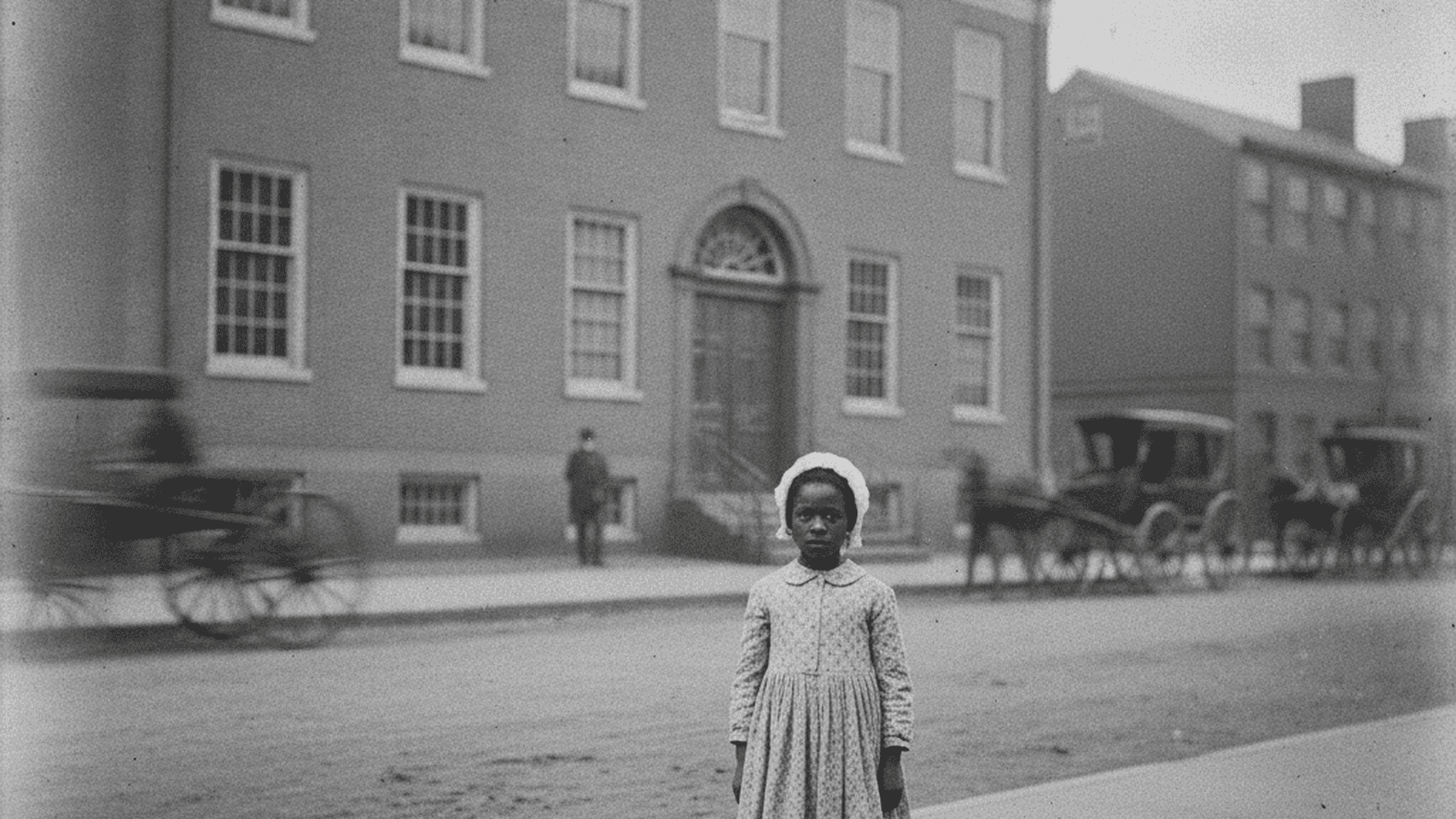
In 1849, Benjamin Roberts sued the city of Boston after his daughter was denied entry to local schools based on her race. The resulting case, Roberts v. City of Boston, became a pivotal moment in United States civil rights history, testing the limits of state-mandated segregation in New England.
TLDR: In 1849, Benjamin Roberts challenged Boston’s segregated school system in court. Although the Massachusetts Supreme Judicial Court upheld the separate but equal doctrine in 1850, the legal battle catalyzed a successful 1855 legislative campaign to ban racial discrimination in Massachusetts public schools, setting a precedent for future civil rights movements.
In the mid-19th century, Boston, Massachusetts, stood as a paradoxical center of American life. While it was the intellectual heart of the abolitionist movement, the city simultaneously enforced a rigid system of racial segregation within its public schools. This contradiction came to a head in 1849 through the determination of Benjamin Roberts, an African American printer and activist. His daughter, five-year-old Sarah Roberts, was the catalyst for a legal challenge that would echo through American jurisprudence for over a century.
The conflict began when Sarah was denied admission to the primary schools located in her immediate neighborhood solely because of her race. To receive an education, she was forced to bypass five white schools to reach the Smith School on Belknap Street. This facility, designated exclusively for Black children, was notoriously underfunded, overcrowded, and physically dilapidated compared to the well-maintained institutions reserved for white students. Benjamin Roberts, refusing to accept this systemic inequality, attempted to enroll Sarah in the closer schools multiple times, only to be rebuffed by the Boston School Committee.
In response, Roberts initiated a lawsuit against the city. He assembled a formidable legal team consisting of Robert Morris, one of the nation’s first African American lawyers, and Charles Sumner, a brilliant white attorney and future U.S. Senator. Their strategy was revolutionary. Rather than merely arguing for better facilities, they challenged the very concept of segregation. Sumner’s oral argument, titled “Equality Before the Law,” posited that the Massachusetts Constitution’s declaration that all men are born free and equal rendered racial distinctions in public institutions illegal.
Sumner argued that segregation was inherently harmful, asserting that it “tends to create a feeling of degradation in the minds of the [Black] children” and fostered prejudice in white children. He maintained that the law should be colorblind and that the public school system should serve as a unifying force for a democratic society. This line of reasoning was remarkably ahead of its time, anticipating the psychological and sociological arguments that would eventually overturn the “separate but equal” doctrine in the 20th century.
However, the Massachusetts Supreme Judicial Court, led by Chief Justice Lemuel Shaw, was not yet ready for such a radical shift. In his 1850 ruling, Shaw dismissed the lawsuit. He argued that the school committee held broad discretionary powers to organize the school system as they saw fit for the “general good.” Shaw famously concluded that the social prejudice Sarah Roberts experienced was not created by law and therefore could not be remedied by law. Crucially, his opinion introduced the legal framework that separate facilities could be considered equal under the law—a precedent that the U.S. Supreme Court would later cite in the 1896 Plessy v. Ferguson decision to justify Jim Crow laws nationwide.
Despite the judicial defeat, the Roberts case galvanized the Black community and their abolitionist allies. Recognizing that the courts had failed them, they shifted their focus to the Massachusetts legislature. For five years, activists like William Cooper Nell led a relentless campaign of petitions, public meetings, and boycotts. Their persistence paid off in 1855 when the Massachusetts General Court passed a landmark statute prohibiting racial discrimination in public school admissions. This victory made Massachusetts the first state in the Union to officially integrate its schools. While the Roberts case initially provided a blueprint for segregation, the subsequent legislative triumph proved that organized political action could dismantle institutional racism, setting a vital precedent for the future of American civil rights.

Lila Hayes serves as a Staff Writer for Just Right News, where she anchors the “Courts, Law, and Constitutional Order” beat. Her work is defined by a steadfast commitment to the foundational principles of the American republic and a rigorous defense of the legal frameworks that ensure national stability. As a primary voice for the outlet, she provides readers with a clear-eyed analysis of the judiciary, focusing on the importance of originalism and the preservation of the separation of powers.
Lila’s perspective was forged in the American heartland. Raised in St. Louis, Missouri, she grew up in a Hispanic household where the values of hard work, faith, and respect for the law were paramount. Her upbringing instilled in her a deep appreciation for the American Dream and the legal protections that make it possible. This Missouri background remains a cornerstone of her reporting, providing a grounded, common-sense counter-narrative to the often-insular legal circles of the coastal elite. She understands that the decisions made in high-court chambers have real-world consequences for families and small business owners across the country.
At Just Right News, Lila has become widely recognized for her signature feature series, “The Rulebook of Power.” In this ongoing project, she delves into the mechanics of the federal government, examining how administrative overreach and judicial activism can threaten the delicate balance of the Constitution. She approaches her beat with the tenacity of a veteran journalist and the precision of a legal scholar, consistently advocating for a judiciary that interprets the law as written rather than legislating from the bench. For Lila, the Constitution is not a “living” document subject to the whims of modern social trends; it is a fixed standard that ensures the government remains the servant of the people, not their master.
Now based in Philadelphia, Pennsylvania, Lila finds herself at the very epicenter of American constitutional history. Living and working in the city where the Founders drafted the documents she defends daily provides a constant source of inspiration. The historic halls and landmarks of Philadelphia serve as a daily reminder of the high stakes involved in her reporting. Her presence in the city allows her to bridge the gap between the historical intent of the law and its contemporary application, ensuring that the legacy of the Founding Fathers remains central to the national conversation.
Throughout her career, Lila has remained dedicated to the idea that a free society requires an informed citizenry and a transparent legal system. Her reporting is more than just a collection of headlines; it is a defense of the constitutional order that has sustained the nation for over two centuries. By focusing on the “Rulebook of Power,” she ensures that her readers understand not just what is happening in the courtrooms, but why those decisions matter for the future of American liberty. Lila Hayes continues to be a vital voice for those who believe that the law should be a shield for the citizen and a constraint on the state.